

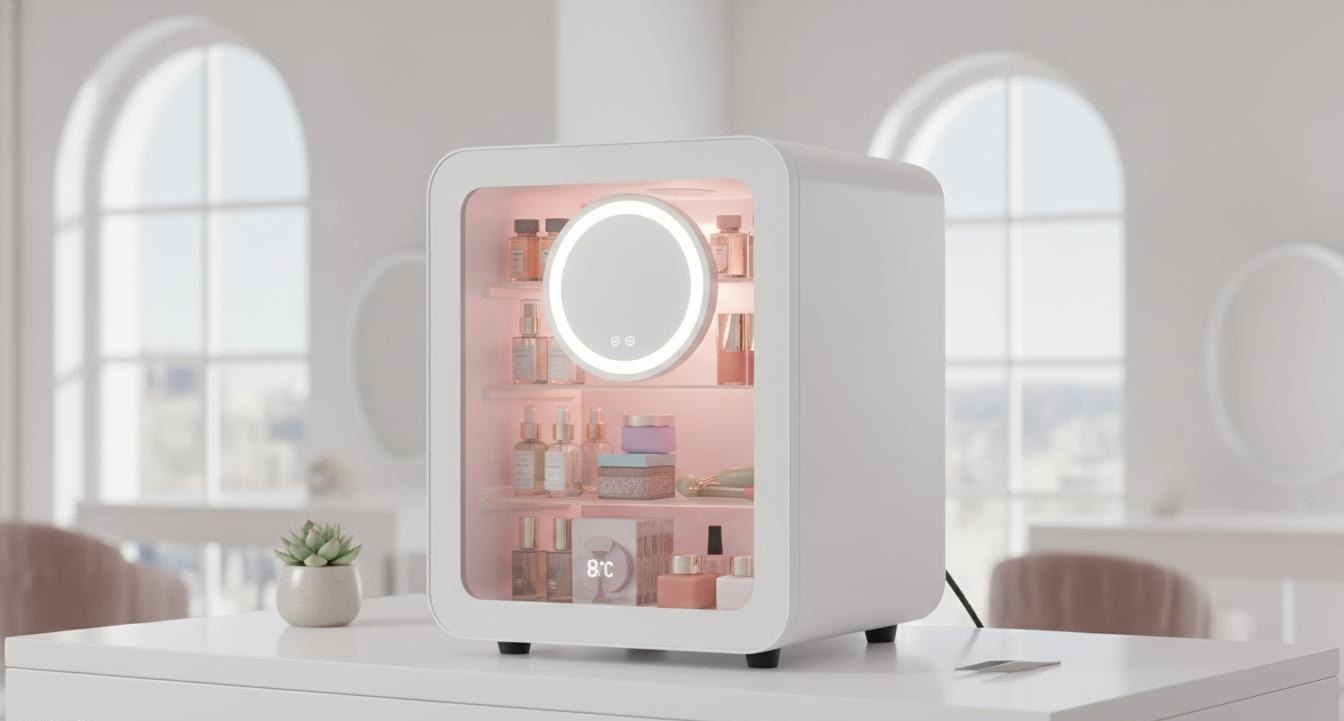
- The Three Trends Converging on the 6L Beauty Fridge
- Why Glass-Door Design Is Not Just Aesthetic — It Is Functional
- The HD LED Mirror: Where Beauty Appliance Meets Professional Tool
- European Market Dynamics: Who Is Actually Buying in 2026
- Sourcing Specifications European Buyers Need to Know
- 5 Questions Every European Distributor Asks About Beauty Fridges
- What Iceberg Offers European Distributors Beyond the Product
When I first encountered the 6L glass-door beauty fridge with an HD LED mirror in a supplier catalog three years ago, my reaction was: this is a niche product. The sort of thing that sells in South Korea and Japan where bathroom culture and skincare obsession converge in a specific commercial moment. It would not translate to European markets, I thought.
I was wrong. By 2025, I was watching European beauty product distributors — the mid-tier importers and regional salon supply chains — actively sourcing these units in quantities that made me reconsider the category entirely. In 2026, that interest has hardened into active catalog inclusion. Here is why.
The Three Trends Converging on the 6L Beauty Fridge
Understanding why European distributors are now stocking 6L glass-door beauty fridges requires understanding that this is not one trend — it is three separate trends that happen to be moving in the same direction simultaneously, which is what creates a category-level opportunity.
The prestige beauty retail boom in Europe. The European prestige beauty market has grown at a compound annual rate of approximately 7–9% over the past three years, with Germany, France, and the United Kingdom as the three largest national markets. Prestige beauty retail — whether in department store counters, specialty beauty stores, or high-end aesthetic clinics — requires refrigeration for a growing category of products that are temperature-sensitive: advanced serums containing retinol, vitamin C at concentrations above 15%, peptide complexes, and probiotic skincare formulations. These products degrade at room temperature. A glass-door beauty fridge at the point of sale does two jobs simultaneously: it preserves product efficacy and it signals to the customer that the retailer takes product quality seriously.
The at-home beauty device market explosion. The COVID-era acceleration of at-home beauty device adoption has not reversed. In 2026, European consumers are maintaining the habit of investing in professional-grade home skincare routines, particularly in the 25–45 demographic in urban centres. The aesthetic clinic-at-home trend — where consumers purchase clinical-grade products and use them in a home bathroom setup that mimics the clinic environment — is a direct driver of demand for compact, attractive refrigerated storage for those products. A 6L beauty fridge with a mirrored door fits perfectly into this consumer psychology: it is an object that says “this is serious skincare” and “I have a system.”
EU ingredient stability regulation and consumer awareness. The EU’s Cosmetics Regulation (EC) No 1223/2009 already requires ingredient stability data for product authorisation, but the enforcement reality is that consumers are more educated about ingredient degradation than ever before. A retailer who stocks a vitamin C serum in a refrigerated display communicates product quality in a way that a room-temperature shelf cannot. Glass-door refrigeration is becoming a retail quality signal — similar to how premium grocers use open refrigeration for dairy to communicate freshness.
Why Glass-Door Design Is Not Just Aesthetic — It Is Functional
There is a reason the glass-door specification is consistently requested by European buyers rather than solid-door alternatives, and it goes beyond aesthetics — although aesthetics matter too in this category.
From a functional standpoint, glass-door visibility in a retail environment allows customers to see exactly what products are available without opening every fridge on the counter. In an aesthetic clinic, glass doors allow the practitioner to identify product inventory at a glance without opening each unit — which matters in a clinical environment where opening fridge doors repeatedly increases the temperature fluctuation inside the unit. In a beauty retail store with 8–12 SKUs of refrigerated products, a glass-door unit reduces staff time spent hunting for specific products.
From a consumer psychology standpoint, the glass-door fridge in a beauty context creates what retail designers call a “discovery moment” — the customer sees the products inside, forms a desire to purchase, and the transaction happens without the friction of opening a door and closing it again. Conversion data from Southeast Asian beauty retail markets — where this category has been mainstream for years — suggests that refrigerated glass-door display units outperform solid-door units in per-unit sales conversion by 15–22% in equivalent foot-traffic environments.
The 6L capacity is specifically interesting because it is the threshold below which the unit remains small enough for a bathroom countertop or a salon treatment room side table, but large enough to hold a meaningful selection of products. A 4L unit feels too cramped; a 15L unit no longer fits the countertop positioning that makes this product work in a domestic environment. The 6L format hits the sweet spot for both professional salon use and consumer home use.
The HD LED Mirror: Where Beauty Appliance Meets Professional Tool
The HD LED mirror feature built into the fridge door is the product differentiator that separates these units from standard mini fridges. In my assessment, it is also the feature that makes European salon operators pay attention, because it directly reduces their per-station equipment investment.
Consider the equipment inventory for a European aesthetic clinic with six treatment rooms. Standard equipment for each room includes a treatment bed, a magnifying lamp, a refrigerated product storage unit, and a vanity mirror. If the refrigerated unit also serves as the vanity mirror — a 2-in-1 design — the clinic operator eliminates a separate mirror from the equipment list. At EUR 40–80 per professional vanity mirror unit, the economics are meaningful at scale. For a 10-room clinic, that is EUR 400–800 in equipment consolidation savings.
The HD LED specification matters because European lighting standards in professional beauty environments have tightened. Germany’s Beauty Institute Certification (BID) and the UK’s BABTAC accreditation require specific illumination standards for treatment rooms — particularly for services involving colour matching, skin analysis, and precision application. A mirror with HD clarity and daylight-matched LED illumination (typically 5000–6500K colour temperature) meets these standards in a way that a standard bathroom mirror does not. The LED illumination also serves the product display function: products displayed behind glass with LED backlighting look more premium than products displayed under standard fluorescent lighting.
European Market Dynamics: Who Is Actually Buying in 2026
The European buyers adding 6L glass-door beauty fridges to their 2026 catalogs fall into three distinct buyer profiles, each with different motivations and order volumes.
Specialty beauty store chains — particularly in Germany, the Netherlands, and Scandinavia — are purchasing these units for in-store refrigerated display of high-margin skincare products. The volume per order for this buyer type is typically 50–200 units per catalog season, with reorders driven by seasonal product launches. The aesthetic requirement is high: they want the glass-door to be genuinely transparent (not tinted), the mirror to be distortion-free, and the unit to be available in white, black, and soft pink as standard colour options.
Aesthetic clinic chains — particularly in the UK, France, and Spain — are purchasing these units as treatment room equipment, in quantities of 10–50 units per clinic fit-out. The clinical buyer cares more about temperature stability (2–8°C maintained within ±1°C variance), low noise operation (under 35dB for treatment room use), and CE/LVD compliance documentation than about colour options. This buyer is more likely to request custom specifications: a lock with key (for storing medical-grade products), specific interior shelving configurations, or a built-in UV sterilisation compartment.
Online beauty retailers with physical pop-up presence — a growing category across EU markets — are using these units as display pieces at pop-up events, trade shows, and brand activation spaces. Volume is smaller (5–20 units per order), but the specification tends toward the premium end: branded door panels, specific LED colour temperatures, and custom colour finishes that match brand identity. The lead time for custom-branded units is 20–30 days, which fits the pop-up planning cycle well.
Sourcing Specifications European Buyers Need to Know
If you are a European distributor evaluating 6L glass-door beauty fridges for your 2026 catalog, here are the specifications that separate professional-grade units from consumer-grade white-box products that will generate warranty returns.
Temperature stability. The compressor or thermoelectric cooling system must maintain 2–8°C interior temperature with less than ±1.5°C variance over a 24-hour period in a 25°C ambient room. Many budget thermoelectric units — common in entry-level cosmetic fridges — fluctuate ±3°C or more, which is insufficient for stable retinol and vitamin C storage. Request the factory’s 24-hour temperature stability test report before placing orders.
CE/LVD and EMC compliance. The Low Voltage Directive (2014/35/EU) applies to any appliance operating above 50V AC. The HD LED mirror circuit typically operates at 12V DC, but the unit’s power supply converts from 220–240V AC mains, which triggers LVD compliance. EMC testing (2014/30/EU) is mandatory for the LED driver circuit. Ensure your supplier provides CE Declaration of Conformity with electromagnetic compatibility test reports from an accredited European notified body. For European specialty beauty retailers — particularly in Germany and France — product quality certification under the Oeko-Tex Standard 100 provides an additional consumer confidence signal, demonstrating that the unit’s interior materials (plastic components, paint, adhesive interior shelving substrate) have been tested for harmful substances at the finished article level.
Interior volume and shelving. The 6L specification is the exterior volume. Usable interior volume is typically 4.5–5.2L after shelving and insulation displacement. Verify the interior dimensions match your product range: a 30ml serum bottle is approximately 30mm diameter × 80mm height; a 100ml cream jar is approximately 65mm diameter × 55mm height. Both must fit with the door closed and the shelving in place.
Noise level. For salon treatment room use, specify below 35dB. For retail display use, below 40dB is acceptable. The difference matters in a treatment room environment where the noise of a refrigeration compressor can interfere with the calm atmosphere that aesthetic clinic operators are paying for.
For Southeast Asian retailers, these same dynamics play out differently in tropical climates — if you are interested in comparing how Southeast Asian camping retailers source portable freezer units for outdoor retail environments, our news section covers that market in detail.
5 Questions Every European Distributor Asks About Beauty Fridges
Q1: Why are 6L glass-door beauty fridges gaining traction in European retail channels?
Because three trends are moving in the same direction simultaneously: the EU prestige beauty retail boom is driving demand for refrigerated product display; the at-home beauty device trend is creating consumer demand for professional-grade home skincare storage; and EU ingredient stability regulation is making refrigerated storage a consumer-trusted quality signal. The 6L format hits the capacity sweet spot — enough for salon treatment rooms and consumer bathroom counters, small enough to avoid footprint issues.
Q2: What temperature range do beauty products require in a retail fridge?
Most dermatologist-recommended skincare actives (retinol, vitamin C above 15%, peptide complexes, probiotic formulations) require 2–8°C storage to maintain ingredient efficacy. Standard room temperature (20–25°C) can degrade heat-sensitive actives within 4–6 weeks of opening. The EU Cosmetics Regulation requires manufacturers to validate ingredient stability at the declared storage temperature — retailers who display products outside that temperature range are technically in violation of the product’s storage instructions.
Q3: Why does the HD LED mirror feature justify a premium price point for European buyers?
The HD LED mirror serves as both the fridge door and a professional vanity mirror — eliminating the need for a separate counter mirror in professional beauty salons and high-end home bathrooms. European salon operators in Germany, France, and the Netherlands report that the combined appliance reduces per-station equipment cost by EUR 30–80 compared to buying a standalone fridge and mirror separately. The LED illumination also meets European aesthetic clinic lighting standards (5000–6500K daylight-matched colour temperature).
Q4: What CE compliance documentation do European distributors need for beauty fridges?
Beauty fridges sold in the EU must carry CE marking under the Low Voltage Directive (2014/35/EU), RoHS 2 compliance (2011/65/EU) for hazardous substances in electronic components, and EMC compliance (2014/30/EU) for the LED driver circuit. The HD LED mirror function specifically triggers EMC testing requirements. Request the CE Declaration of Conformity and test reports from an accredited notified body before placing orders — this documentation is required for customs clearance in most EU member states.
Q5: How does 6L capacity compare to standard cosmetic product volumes in European salons?
A 6L interior accommodates approximately 18–25 standard 30ml serum bottles, 8–12 100ml cream jars, and 3–5 full-size moisturiser containers — sufficient for 2–3 days of supply at a busy aesthetic clinic with 10–15 treatment rooms, or approximately 1 week at a smaller salon with 4–6 rooms. For comparison, a 4L unit typically holds 8–12 serum bottles and runs out of space quickly; a 10L unit begins to lose the countertop footprint advantage that makes the 6L format commercially viable.
Why the European Beauty Appliance Market Will Grow Further in 2026 and Beyond
Before concluding, I want to address a question I hear frequently from European distributors evaluating whether to commit to the 6L glass-door beauty fridge category in 2026: is this a durable growth trend or a COVID-era aberration that will fade as at-home beauty habits normalise?
The data suggests the growth is structural rather than cyclical. The European personal luxury goods market — which includes premium beauty and skincare appliances — has shown consistent growth in the premium segment since 2019, with the acceleration during 2020–2022 driven by increased at-home skincare investment. By 2025, the European premium beauty appliance market had reached an estimated EUR 2.8–3.2 billion in retail sales volume, with compound annual growth of 9.2% from 2019 to 2025 — a growth rate that is higher than the overall personal luxury goods market average of 6.8% over the same period.
The structural drivers are demographic and cultural as well as economic. The European consumer base that most actively purchases premium beauty appliances is the 25–45 age cohort in urban centres — a demographic that is growing in absolute terms across EU member states and that has higher average discretionary income than previous generations at equivalent ages (a function of delayed family formation and higher labour force participation rates). This demographic is also the primary driver of the European medical aesthetics market — aesthetic clinic visits, injectable treatments, laser skin therapies — which creates a spillover effect into at-home maintenance routines that include refrigerated skincare storage.
The regulatory environment also supports continued growth. The EU’s Cosmetics Regulation requires that active skincare ingredients be stored within specific temperature ranges to maintain ingredient efficacy. As consumer awareness of this requirement grows — driven by ingredient-focused beauty journalism, online skincare education content, and product packaging that increasingly includes storage instructions — the demand for refrigerated storage as a quality preservation mechanism will expand beyond the current early-adopter consumer base into the mainstream beauty consumer segment. This regulatory-driven consumer education is a durable category growth driver that does not depend on COVID-era behaviour changes.
For European distributors, the 2026 procurement window for the 6L glass-door beauty fridge category is therefore not just about this season’s margin — it is about establishing supply chain relationships, retail placement, and brand positioning in a category that is structurally growing. The distributors who commit to this category in 2026 will be the established players in 2028, when the category has grown sufficiently to attract more competitive attention.
The European beauty appliance market is at an inflection point. Distributors who positioned in the right categories before the inflection tend to capture disproportionate share of the growth that follows. The 6L glass-door beauty fridge with HD LED mirror is the kind of product that rewards early positioning.
What Iceberg Offers European Distributors Beyond the Product
For European beauty appliance distributors evaluating Iceberg as a supply chain partner, I want to close with a direct statement about what our manufacturing operation offers beyond the 6L glass-door beauty fridge specification — because the product is the entry point, but the partnership value extends further.
Iceberg was established as a specialist manufacturer of DC-powered cooling and refrigeration appliances, with a product portfolio that spans absorption mini bar fridges, thermoelectric beauty fridges, DC compressor portable refrigerators, and the 6L glass-door beauty fridge product line. This product range breadth means that European distributors who establish a supply relationship with Iceberg can consolidate multiple refrigeration appliance categories under a single supplier partner — simplifying their supplier management, their quality verification process, and their logistics coordination.
Our engineering team has specific experience with the DC power systems that are standard in portable cooling applications — marine environments, automotive interiors, off-grid camping setups, and RV installations. This DC engineering expertise is directly applicable to the 6L glass-door beauty fridge product line, where the HD LED mirror requires a stable 12V DC power supply that is isolated from the AC mains power fluctuations common in portable and semi-permanent retail installations. European beauty retailers who have experienced reliability issues with other suppliers’ LED mirrors at events and pop-up locations understand why this DC engineering competence matters in practice.
For European distributors who are evaluating the 6L glass-door beauty fridge for their 2026 catalog, I recommend requesting a 3-unit sample order for internal evaluation — one unit for visual and quality inspection, one for extended temperature stability testing over 72 hours, and one for HD LED mirror durability evaluation under continuous operation. The sample investment is modest relative to the product quality verification value it provides, and Iceberg’s sample order processing team can typically fulfill 3-unit sample orders within 10 working days to European addresses.
Post time: Jun-16-2026