

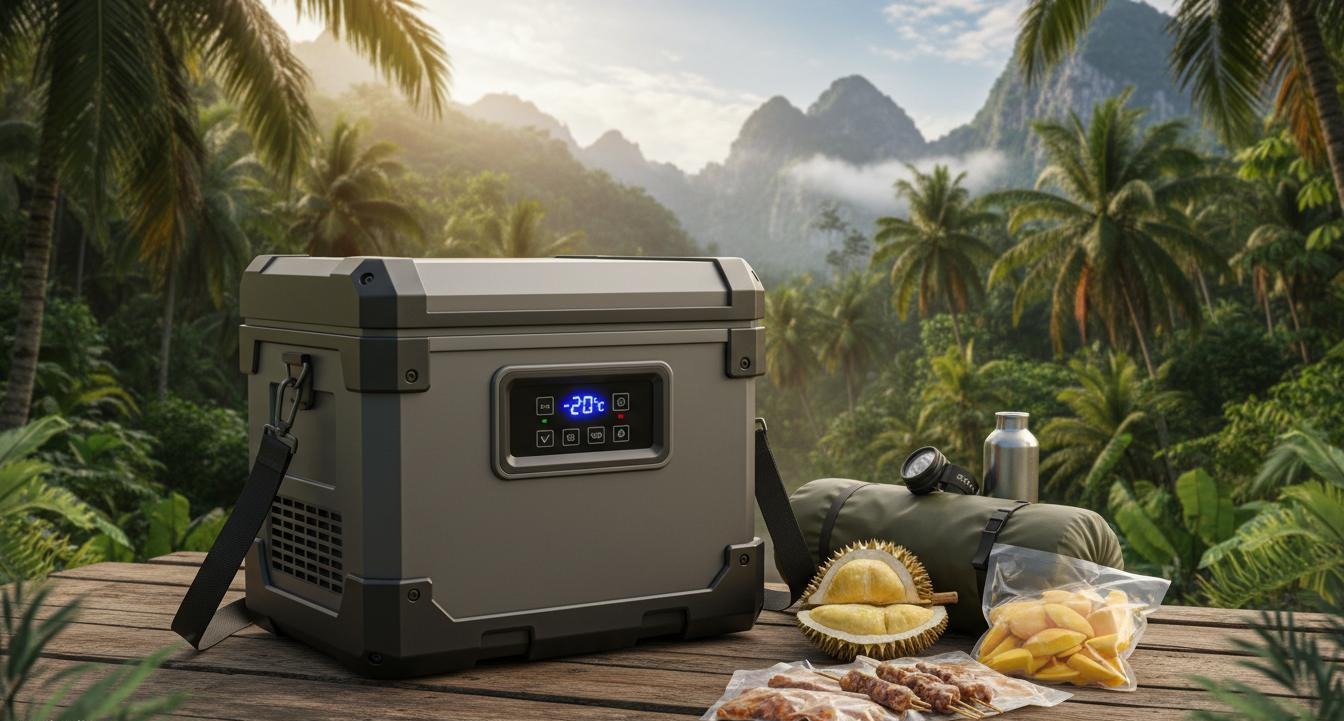
- Southeast Asian camping retailers are prioritizing-20°C deep-coolingportable freezers with30L capacityto meet rising demand for extended off-grid adventures
- DC brushless compressor technology delivers the reliability and temperature performance outdoor enthusiasts demand in tropical climates
- Chinese manufacturers like Iceberg offer/wholesale OEM and ODM programs tailored for regional retail market requirements
- Key sourcing criteria: temperature performance verification, battery compatibility, warranty terms, and regional safety certifications
- Strategic wholesale partnerships with certified suppliers reduce landed costs by30–50% compared to distributor-sourced alternatives
Table of Contents
- Market Demand: Why Southeast Asian Retailers Are Ramping Up Orders
- Understanding -20°C Deep Cooling Technology
- Why 30L Is the Ideal Capacity for Camping Retail
- Key Technical Specifications to Verify Before Wholesale Purchase
- Regional Certifications and Import Compliance
- Selecting the Right Supplier: What Retailers Need to Know
- Pricing and Economic Advantages of Direct Factory Sourcing
- Frequently Asked Questions
1. Market Demand: Why Southeast Asian Retailers Are Ramping Up Orders
The camping and overland travel sector across Southeast Asia has experienced a structural shift since2020. What was once a niche activity pursued by expatriate communities and adventure tourists has become a mainstream leisure category embraced by middle-class families in Thailand, Indonesia, Vietnam, Malaysia, and the Philippines. This is not a temporary post-pandemic spike — it reflects a deep change in how urban populations in tropical climates relate to outdoor recreation.
Government tourism promotion campaigns, improved road infrastructure connecting rural provinces, and a new generation of travel content creators showcasing remote destinations have collectively accelerated demand. Retailers operating in this space have responded by expanding their product ranges, but many are discovering that conventional coolers — reliant on ice that melts within 24–48 hours in35°C ambient heat — do not meet the expectations of customers investing in multi-day camping trips, fishing expeditions, or overland journeys along the region’s extensive coastlines.
This performance gap has created a clear market opening for portable compressor freezers. Unlike thermoelectric coolers that can only achieve approximately 20°C below ambient temperature — and struggle significantly in Southeast Asia’s intense heat — compressor-driven portable freezers can maintain interior temperatures of -20°C regardless of external conditions. This capability unlocks genuine food preservation, safe medication storage, and, critically for the region’s large recreational fishing community, the ability to preserve catch at sea for 48 hours or longer without ice.
Wholesale buyers from Bangkok, Jakarta, Ho Chi Minh City, and Kuala Lumpur are increasingly searching for suppliers who can deliver this level of performance at price points that preserve retail margins while remaining accessible to end consumers. The target product — a 30L portable freezer capable of -20°C operation — sits at the intersection of capacity, performance, portability, and price that makes it the most versatile unit for the regional market.
2. Understanding -20°C Deep Cooling Technology
How Compressor-Based Cooling Achieves -20°C
The core technology enabling true deep-freezing in a portable form factor is theDC brushless compressor, a direct-current powered refrigeration system derived from mobile refrigeration units used in delivery vehicles and marine vessels. These compressors operate on a thermodynamic cycle similar to household refrigerators but are engineered to operate at varying angles, vibrations, and battery power conditions encountered in outdoor and vehicular environments.
A DC brushless compressor works by compressing a refrigerant gas (typically R-134a or R-404A in most portable units) into a high-pressure liquid, which then passes through an expansion valve into a low-pressure gas, absorbing heat from the freezer compartment in the process. The variable-speed driver — a key innovation in modern units — modulates compressor speed based on the temperature differential between the set point and the interior, maintaining precise temperature control while conserving battery power during the maintenance phase.
To reach and maintain -20°C in a 30L chamber while the exterior ambient temperature hovers at 32–38°C, the compressor must overcome a temperature delta of approximately 52–58°C. This demands a robust compressor with adequate cylinder displacement, high-quality condenser coils (typically aluminum finned for heat dissipation), and an efficient insulation structure — usually vacuum insulation panels (VIP) combined with high-density polyurethane foam.
Why -20°C Matters for Specific Outdoor Applications
The -20°C threshold is not arbitrary. It corresponds to the minimum temperature required for long-term preservation of fresh proteins without crystallization damage to cell walls. For the camping and fishing community, this means:
- Fish and seafood preservation: Deep-freezing at -20°C preserves the cellular structure of fresh-caught fish, preventing the textural degradation that occurs at warmer storage temperatures. Recreational fishers traveling4–8 hours from their fishing grounds need this capability to bring quality catch home.
- Food safety for camping provisions: Tropical temperatures accelerate bacterial growth in perishable foods. A unit capable of genuine deep-freezing allows campers to pre-freeze provisions before departure and maintain them at safe temperatures throughout their trip.
- Medical and first-aid storage: Certain injectable medications, insulin, and emergency biologics require storage at -20°C or below. Remote expedition teams and healthcare outreach workers operating in off-grid locations depend on reliable deep-freeze capability.
- Ice block independence: At -20°C, the unit can produce ice blocks in as little as 2–3 hours, eliminating dependence on ice vendors that may not be available in remote areas.
Battery Compatibility and Off-Grid Performance
A critical practical consideration for portable freezers used in camping and overland travel is power supply compatibility. Southeast Asian camping enthusiasts typically rely on one or more of the following power sources:
- 12V/24V DC vehicle power (cigarette lighter or dedicated DC outlet)
- Portable lithium battery packs (e.g., Jackery, EcoFlow, Bluetti series)
- Solar panel setups with charge controller
- 240V AC household mains (at campsites with grid access)
The most capable portable freezer units integrate asmart power management system that automatically detects input voltage, switches between DC and AC power without user intervention, and includes low-voltage cutoff protection to prevent battery depletion beyond safe thresholds. This feature set is non-negotiable for the Southeast Asian market, where users frequently connect units to aging vehicle electrical systems or portable batteries with varying state-of-charge.
3. Why 30L Is the Ideal Capacity for Camping Retail
The30L storage capacity represents what product designers call the “sweet spot” for individual and small-group outdoor use. To understand why this capacity resonates so strongly with both retailers and end consumers, it helps to examine the typical load profile of Southeast Asian camping trips.
Load Profile Analysis
A standard 2–3 day camping trip for a family of 3–4 people requires storage of:
- Fresh protein:1.5–2 kg of chicken, seafood, or fish portions
- Vegetables and fruits: 1–1.5 kg
- Beverages (pre-frozen): 6–10 cans or small bottles
- Dairy and eggs: 0.5 kg
- Condiments and cooked staples: 0.5–1 kg
- Emergency medication or fish bait (for fishing expeditions): small quantities
Total net storage requirement: approximately 5–7 kg of provisions, which in volume terms translates to roughly 20–25L once items are organized and the compressor’s internal basket is used. A 30L unit provides adequate headroom for additional ice blocks or for longer expeditions where resupply is not available.
Physical Footprint and Vehicle Integration
Equally important as storage volume is the physical size of the unit. A 30L portable freezer typically measures approximately 600–700mm in length, 350–400mm in width, and 350–400mm in height — compact enough to fit:
- In the footwell behind the front seats of a standard sedan
- In the cargo area of a compact SUV without fully occupying luggage space
- On the cargo bed of a pickup truck, secured with tie-down straps
- Inside a tent or awning area at base camp
Weight is also a critical factor. A 30L unit with a DC brushless compressor typically weighs between 12–18 kg when empty — manageable for one person to lift and position but substantial enough to remain stable during vehicle travel on rough roads. This balance of weight, volume, and functionality is what makes the 30L category the fastest-growing segment in the portable freezer wholesale market across Southeast Asia.
Retail Margin Considerations
From a retail business perspective, the 30L capacity also offers superior margin dynamics. Units in this size range typically wholesale in the USD 180–320 range from Chinese manufacturers, allowing retailers in Southeast Asian markets to achieve markups of 45–80% while maintaining retail prices in the USD 300–500 range — consistent with the disposable income levels and willingness-to-pay for quality outdoor equipment among the region’s middle-class consumer base.
4. Key Technical Specifications to Verify Before Wholesale Purchase
Retailers sourcing portable freezers for the Southeast Asian market must verify a core set of technical specifications before confirming wholesale orders. Specification mis-match is among the most common causes of customer returns and reputational damage in this product category.
| Specification | Recommended Value | Why It Matters |
|---|---|---|
| Lowest Achievable Temperature | -20°C or below | Core performance claim; verify with third-party test reports |
| Storage Capacity | 28–32L (effective) | Gross capacity less insulation and basket volume |
| Compressor Type | DC brushless, variable speed | Efficiency, durability, and battery compatibility |
| Input Voltage | DC12V/24V + AC 220–240V auto-switch | Universal compatibility across vehicle types and campsites |
| Average Power Consumption | 45–65W at -20°C set point | Critical for battery life calculations on off-grid trips |
| Low-Voltage Cutoff (LVCO) | Configurable, 10–11V for 12V systems | Prevents vehicle battery drain and battery pack damage |
| Temperature Precision | ±1°C digital controller display | User confidence and food safety assurance |
| Insulation Type | VIP (Vacuum Insulation Panel) + PU foam | Reduced power consumption, faster cool-down time |
| Climate Class | T (Tropical, rated to 43°C ambient) | Southeast Asia ambient temperatures can exceed 38°C |
| Net Weight | 12–18 kg | Affected by insulation density and compressor quality |
| External Dimensions (approx.) | L620–700 × W 350–400 × H 350–400 mm | Vehicle fit verification for target markets |
| Warranty | 12–24 months on compressor and PCB | Indicates manufacturer confidence in product quality |
The Tropical Climate Class Requirement
One specification that Southeast Asian buyers frequently overlook is the climate class rating of the portable freezer. The International Electrotechnical Commission (IEC) standards define climate classes for refrigeration equipment:
- Class N (Normal): rated to 25°C ambient — inadequate for Southeast Asia
- Class ST (Subtropical): rated to 38°C ambient — minimum acceptable for the region
- Class T (Tropical): rated to 43°C ambient — recommended standard for Southeast Asian retail
A unit rated only for Class N or Class ST conditions will significantly underperform — or fail entirely — when used in a vehicle cabin that has been sitting in 38°C+ sunlight for several hours. Retailers should insist on Class T rated units and verify this designation in the product’s technical documentation.
5. Regional Certifications and Import Compliance
Sourcing portable freezers from Chinese manufacturers for sale in Southeast Asian markets requires navigating a patchwork of national electrical safety and consumer product certification regimes. Below is an overview of the key certification requirements for the region’s major markets.
Thailand – TISI Mark
The Thai Industrial Standards Institute (TISI) requires that electrical cooling appliances meet Thai Industrial Standard TIS 1562 for refrigerating appliances. Imported portable freezers must undergo testing at TISI-accredited laboratories and carry the TISI mark before entering the Thai market legally. Retailers working with Thai import distributors should confirm that their supplier can provide test reports compatible with TISI requirements or, at minimum, IEC CB Scheme test reports that TISI recognizes as a basis for simplified certification.
Indonesia – SNI Mark
Indonesia’s Badan Standarisasi Nasional (BSN) requires the SNI (Standar Nasional Indonesia) mark for a wide range of electrical products sold domestically. While enforcement varies by product category and import route, retailers distributing in Indonesia should seek SNI-certified products or maintain documentation demonstrating product conformity to avoid customs seizure and administrative penalties.
Malaysia – SIRIM Certification
The Standards and Industrial Research Institute of Malaysia (SIRIM) provides certification for electrical and electronic products under the Malaysian Standards (MS) framework. Portable cooling appliances may fall under MS IEC 60335 household appliance standards. While SIRIM certification is not always legally mandatory for import, it is commercially expected by major retailers and e-commerce platforms operating in Malaysia.
Vietnam – Vietnam Electricity Regulations
Vietnam’s Ministry of Industry and Trade regulates electrical products through the Vietnam Electricity Regulations (VER) and the Circular on Technical Regulations for Electrical Equipment. Portable freezers should comply with QCVN requirements aligned with IEC standards. Import documentation should include test reports from IEC-accredited laboratories and a Vietnamese language declaration of conformity.
Philippines – PS Mark and ICC
The Philippines Bureau of Product Standards (BPS) requires either the Philippine Standard (PS) mark or an Import Commodity Clearance (ICC) for regulated products. Portable refrigerators and freezers fall under the BPS consumer product categories. Retailers importing from China typically pursue the ICC route, which requires submission of batch-specific test reports and application to the BPS.
CB Scheme as a Foundation
Rather than pursuing separate certifications for each national market from scratch, the most efficient approach for retailers is to source portable freezers from manufacturers whose products carry a validIEC CB Scheme test report. The CB Scheme, administered by the IEC, is a mutual recognition arrangement among national certification bodies worldwide. A CB Scheme report, when accompanied by national deviation testing for each target market, significantly reduces the cost and timeline of obtaining national certifications across Thailand, Indonesia, Malaysia, Vietnam, and the Philippines.
6. Selecting the Right Supplier: What Retailers Need to Know
The proliferation of Chinese manufacturers marketing portable freezers across wholesale platforms makes supplier selection the single most consequential decision a Southeast Asian retailer makes. A product that appears specification-compliant on paper can disappoint in practice through inferior component quality, overstated performance claims, or inadequate after-sales support infrastructure.
Component Quality Indicators
Retailers should evaluate supplier products based on the brand or specification of key components rather than accepting generic descriptions at face value. Key components to investigate include:
- Compressor brand: Recognized brands such as Danfoss (Denmark), Secop (formerly known asCULina, Germany), and LG (South Korea) manufacture DC compressors specifically designed for mobile refrigeration. Units using in-house or unbranded compressors may offer lower prices but typically exhibit higher failure rates and greater performance inconsistency.
- Control board and display: Quality units use PCB assemblies from established electronics manufacturers with rigorous burn-in testing. The digital temperature display should be readable in direct sunlight and provide accurate readings.
- Condenser and evaporator coil materials: Copper-aluminum alloy coils offer better heat exchange efficiency and corrosion resistance than aluminum-only alternatives. This matters in coastal areas of Southeast Asia where salt air accelerates corrosion.
- Battery management system (BMS): Integrated BMS with configurable LVCO thresholds is a hallmark of quality units. Inferior products often include fixed cutoff thresholds that do not match the actual discharge characteristics of the batteries retailers’ customers use.
Factory Audit and Verification
For wholesale orders above USD 5,000, retailers should insist on factory audit rights as a contractual term. A credible Chinese manufacturer accustomed to export business will welcome third-party inspection agencies such as SGS, Bureau Veritas, or Intertek conducting production process audits. Key audit checkpoints include:
- Compressor incoming inspection records
- VIP insulation panel density and vacuum integrity testing
- Temperature performance testing on production samples (minimum 3 units from each production batch)
- Leak detection records (helium mass spectrometer testing)
- Burn-in testing duration for electronic control modules
Communication and Sample Evaluation
Before placing bulk orders, reputable retailers request product samples for their own evaluation — typically 1–2 units. This allows direct testing of the temperature performance claims under conditions approximating real-world use. Sample evaluation should include:
- Cool-down time from 30°C ambient to -20°C interior (target: under 4 hours)
- Temperature stability over 48-hour period at -20°C set point
- Power consumption monitoring over a 24-hour cycle
- Battery depletion behavior at configured LVCO threshold
- Noise level measurement (target: below 45 dB for sleep-proximate use)
7. Pricing and Economic Advantages of Direct Factory Sourcing
One of the most compelling arguments for Southeast Asian retailers to establish direct wholesale relationships with Chinese manufacturers is the structural cost advantage it creates. Understanding the economics of this supply chain choice helps retailers make informed decisions about order volumes, payment terms, and inventory management.
Cost Structure Comparison
When a retailer sources a portable freezer through a distributor or trading company, the landed cost typically includes:
- Manufacturer ex-works price
- Trading company margin (typically 8–15%)
- Export handling and documentation fees
- International freight (sea freight for full container loads)
- Customs brokerage and duties
- Local warehousing and distribution margin (another 10–18%)
By sourcing directly from a manufacturer capable of handling export documentation, the retailer eliminates the trading company margin and local distribution layer, reducing the landed cost by 20–35% on equivalent specification products. This cost advantage can be distributed across the supply chain to improve retailer margins, reduce retail prices, or both — creating a competitive moat against rivals still sourcing through intermediary channels.
OEM and ODM Flexibility
Chinese manufacturers with established export operations typically offer both OEM (Original Equipment Manufacturer) and ODM (Original Design Manufacturer) programs. OEM programs apply the retailer’s brand to a manufacturer’s existing product platform — ideal for retailers with established brands seeking to add portable freezer SKUs without tooling investment. ODM programs allow retailers to request custom modifications to existing platforms, such as alternative color schemes, custom voltage configurations for specific national markets, branded control panel interfaces, or modified interior basket configurations.
For the Southeast Asian market, custom modifications worth discussing with suppliers include tropical-climate-specific condenser sizing (larger condenser coils for improved heat rejection in sustained high-ambient conditions), multilingual control panel interfaces (display text in Thai, Bahasa Indonesia, Malay, Vietnamese, or Tagalog alongside English), and ruggedized exterior case designs with enhanced dust and water splash resistance for open-air camping use.
Iceberg Product Range
Iceberg offers a comprehensive portable freezer platform designed for the Southeast Asian wholesale market. The product range includes units spanning 20L to 55L capacity, all featuring DC brushless compressor technology, Class T tropical climate rating, and multi-voltage compatibility. For example, the compact portable car cooler box with handle exemplifies the lightweight, travel-focused engineering that characterizes the Iceberg platform. The product platform supports OEM and ODM customization programs for qualified wholesale partners. Retailers and importers seeking to review the full product specifications, request samples, or initiate wholesale pricing discussions can explore the Iceberg product catalog at https://www.cniceberg.com/products/.
8. Frequently Asked Questions
Why are Southeast Asian camping retailers increasingly sourcing portable freezers with -20°C cooling capacity?
Southeast Asian camping retailers are seeing rising demand for extended outdoor trips, overland travel, and remote fishing expeditions where reliable deep-freezing is essential. A -20°C capable portable freezer ensures food safety, fish preservation, and medical supply storage in tropical heat.
What makes a 30L portable freezer ideal for camping retail businesses?
A 30L capacity hits the sweet spot for individual campers and small groups — large enough to store 2–3 days of provisions, yet compact enough to fit in most vehicle interiors without sacrificing passenger or gear space.
What compressor technology should retailers look for in portable freezers?
DC brushless compressors with variable speed control offer the best balance of energy efficiency, low noise, and deep-freezing capability down to -20°C. Look for units with built-in battery protection and solar-input compatibility for off-grid use.
How do Southeast Asian import regulations affect portable freezer sourcing?
Most Southeast Asian countries regulate portable cooling appliances under consumer electronics and electrical safety standards (e.g., Thailand’s TISI, Indonesia’s SNI, Malaysia’s SIRIM). Retailers should ensure sourced products carry relevant certifications to avoid customs delays.
What warranty and after-sales support should retailers negotiate with Chinese suppliers?
Reputable Chinese manufacturers typically offer 12–24 month warranties covering the compressor and main control board. Retailers should negotiate clear spare-parts access, local service center agreements, and express shipping clauses for defect returns.
How can retailers verify the real -20°C performance of a portable freezer before bulk ordering?
Request third-party test reports from accredited laboratories (e.g.,SGS, Bureau Veritas) confirming the unit’s lowest achievable temperature under standardized ambient conditions. Reputable manufacturers can provide temperature mapping data and performance curves.
About the Authors
The Iceberg refrigeration equipment team consists of industry specialists with deep expertise in portable cooling technology, B2B wholesale distribution, and outdoor recreation equipment markets across the Asia-Pacific region. The team works directly with retailers and importer-distributors to provide technical consultation, product customization, and supply chain optimization for commercial and retail cooling needs. For product inquiries, wholesale pricing, or technical consultation, contact the Iceberg team through the official website.
Ready to Source Portable Freezers for Your Retail Business?
Iceberg manufactures high-performance30L portable freezers rated to -20°C, built for the demands of Southeast Asian tropical climates. Explore the full product range, request wholesale pricing, or schedule a technical consultation with the Iceberg team.
Post time: Jun-12-2026