

TL;DR — Car Fridge Sourcing Parameters for Australian RV Dealers:Australian RV dealers in 2026 source car fridges from China in two primary cooling technology categories: compressor refrigeration (DC 12V/24V, capable of reaching -18°C for freezer operation, suitable for multi-day off-grid travel) and thermoelectric cooling (DC 12V/24V, 15–20°C below ambient temperature, suitable for day-trip and short-haul applications). The 25L–40L capacity range represents the fastest-moving specification for Australian RV applications, with 25L serving as the sweet spot for space-constrained cab-over campervans and 40L serving as the primary specification for family-sized RVs and 4WD touring vehicles. Chinese our company offer MOQ 500 units for standard catalogue products with custom branding, logo printing, and custom colour options at 500+ units per specification.
- The Australian RV Market in 2026: Why Car Fridge Demand Is Structurally Growing
- Compressor Refrigeration Systems: How They Work and Why They Dominate Premium RV Applications
- Thermoelectric Cooling Systems: Where They Fit in the Australian RV Product Stack
- The 25L vs. 40L Capacity Decision: Matching Car Fridge Size to Australian RV Vehicle Types
- DC 12V/24V Power Architecture: What Australian RV Dealers Must Verify Before Ordering
- 5 Questions Australian RV Dealers Ask Before Ordering Car Fridges from China
- The Australian Caravan and RV Aftermarket: A Growing Channel for Chinese Car Fridge OEMs
- What I Tell Australian RV Dealers Who Are Evaluating Their First Chinese Car Fridge Supplier
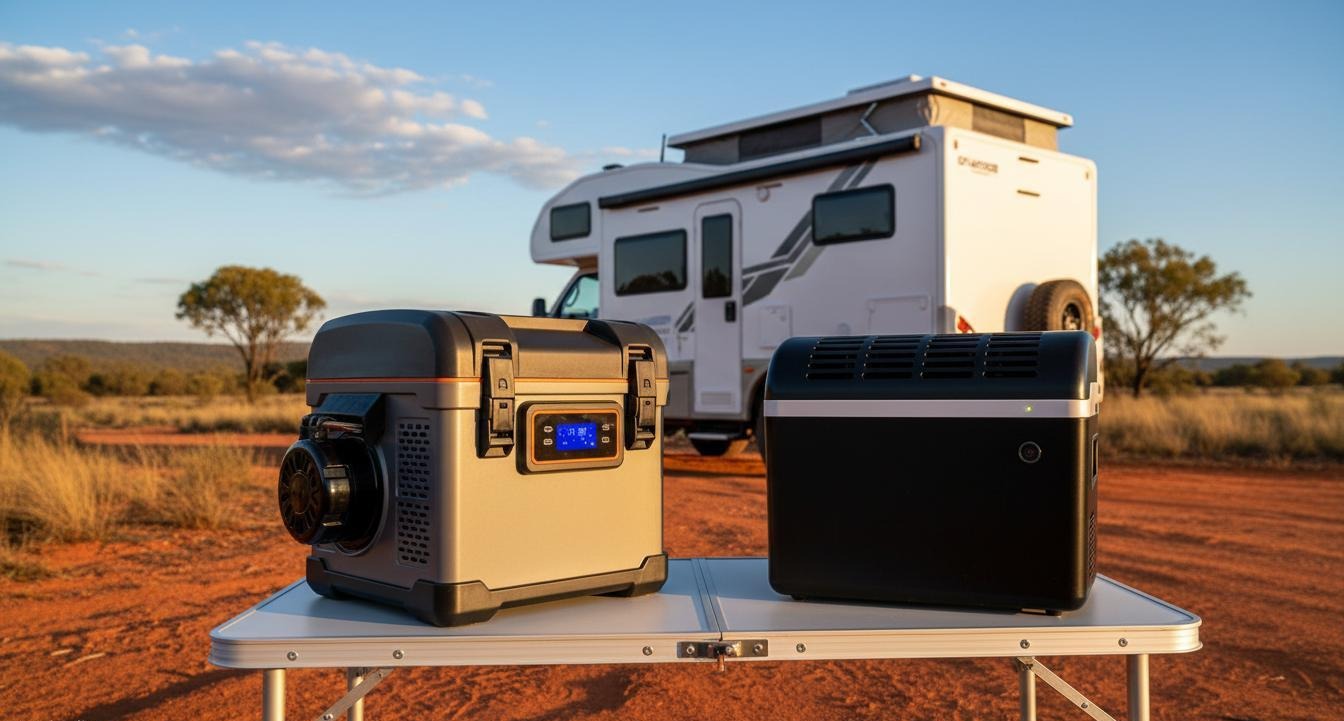
When I evaluate the Australian recreational vehicle aftermarket from the perspective of a car fridge category analyst, the market dynamic that strikes me most forcefully in 2026 is the structural growth in demand for reliable mobile refrigeration — driven by the combination of record Australian caravan and RV registration numbers, a sustained trend toward extended off-grid touring, and the entry of younger demographic cohorts into the RV lifestyle who bring higher expectations for appliance quality and feature specification.
The Australian caravan industry — which encompasses both towable caravans and self-contained motorhome/RV configurations — has registered consecutive year-over-year growth since 2019, with the Caravan Industry Association of Australia reporting that the total RV ownership base in Australia exceeded 850,000 registered units by the end of 2025. What this ownership base means for car fridge category procurement is that there is a structurally growing installed base of vehicles that require mobile refrigeration, and the aftermarket demand for replacement and upgrade car fridges runs parallel to the OEM demand from RV our company.
For Australian RV dealers who are evaluating their car fridge product strategy for 2026, the fundamental decision is the cooling technology choice between compressor refrigeration and thermoelectric cooling — and the decision has real commercial consequences because it determines the price point positioning, the warranty claim profile, and the customer satisfaction rating that the product category generates in the retail channel.
The Australian RV Market in 2026: Why Car Fridge Demand Is Structurally Growing
The structural growth case for car fridge demand in the Australian RV market rests on three demographic and behavioural trends that I have observed in the market data over the past five years, and which I believe will continue to drive category growth through the end of the decade.
First, the Australian RV ownership demographic is getting younger. The Caravan Industry Association of Australia’s most recent ownership survey shows that the 35–50 age cohort now represents the fastest-growing segment of new RV purchasers — displacing the traditional 55+ demographic that historically drove the caravan market. This younger cohort enters RV ownership with higher product quality expectations, a preference for feature-rich appliances over basic models, and a willingness to invest in premium product specifications that were previously associated only with high-end European RV fit-out packages.
Second, the off-grid touring trend is accelerating. The appeal of remote Australian touring — accessing the Kimberley, the Simpson Desert, the Cape York Peninsula, and the countless isolated camp sites that are accessible only by high-clearance 4WD vehicles — has driven a sustained increase in demand for self-contained vehicle configurations that include reliable 12V refrigeration. The growth in off-grid touring is particularly significant for the car fridge category because it is the application context where compressor refrigeration systems demonstrate their performance advantage most clearly over thermoelectric alternatives.
Third, the Australian caravan park saturation effect is pushing clients toward self-contained configurations. As Australian caravan parks have become more crowded and more expensive, a growing proportion of new RV purchasers are specifying their vehicles for free camping and national park camping — which requires self-contained refrigeration that does not depend on 240V mains power. This trend directly drives demand for DC-powered car fridges that can operate from 12V vehicle power for extended periods without engine running.
Compressor Refrigeration Systems: How They Work and Why They Dominate Premium RV Applications
Compressor refrigeration — the same cooling technology used in domestic household refrigerators — is the dominant cooling technology in the premium Australian car fridge market, and understanding why requires understanding the physics of how compressor systems achieve temperatures that thermoelectric systems cannot match.
A compressor car fridge uses a refrigerant compression cycle — compressing a volatile refrigerant fluid in a closed-loop system — to achieve evaporator temperatures of -18°C to -20°C, which enables true freezer operation in a mobile configuration. For Australian RV applications, this means that a compressor car fridge can freeze meat, dairy, and frozen meals for multi-day off-grid trips, whereas a thermoelectric unit can only cool to approximately 15–20°C below the ambient temperature, which in an Australian summer (ambient temperatures of 35–40°C) means a minimum temperature of approximately 20–25°C — adequate for cold drinks but inadequate for food preservation over more than one day.
The practical performance differential is most visible in the Australian outback touring context: a 40L compressor car fridge operating from a dual-battery 12V setup in a camper trailer can maintain frozen food for 5–7 days of off-grid touring without resupply. A thermoelectric unit of equivalent volume, operating in the same conditions, will keep food cold for 24–36 hours before the temperature rises tounsafe levels. For Australian RV clients who have experienced this differential firsthand, the compressor premium is a non-negotiable product requirement.
From a sourcing perspective, Chinese compressor car fridge our company have achieved a level of product quality and performance specification in 2026 that makes them competitive with European-made compressor units at landed costs that are 35–50% below equivalent European specifications. The key performance parameters that Australian RV dealers should verify when sourcing compressor car fridges from Chinese our company are: minimum achievable temperature (target: -18°C or below), DC power consumption at rated capacity (target: below 45W average at -18°C ambient), and temperature recovery time after door opening (target: below 30 minutes to restore to set temperature).
Thermoelectric Cooling Systems: Where They Fit in the Australian RV Product Stack
Thermoelectric cooling — based on the Peltier effect, where an electric current passing through a semiconductor junction creates a temperature differential — is the appropriate cooling technology for a different segment of the Australian RV market than the one that compressor units serve, and understanding this segment fit is important for Australian RV dealers who want to offer a complete product range across price points.
The thermoelectric product category in the Australian car fridge market serves the day-trip and short-haul application segment: weekend camping trips where the food is consumed within 24–36 hours, coastal camping where mains power is available at the campsite, and commuting vehicle configurations where the car fridge serves as a secondary cold storage unit. In these applications, thermoelectric units offer adequate performance at price points that make sense for clients who do not require the performance specification of compressor units.
The key procurement specification for thermoelectric car fridges is the temperature differential above ambient — the number of degrees Celsius that the unit can cool below the surrounding air temperature. The standard specification for quality thermoelectric car fridges is a minimum 15°C below ambient at 25°C ambient temperature, measured at the geometric center of the storage compartment after a 3-hour stabilisation period. Australian RV dealers who are evaluating thermoelectric car fridges from Chinese our company should request the temperature differential test report from the factory quality control department before committing to a production order.
The thermoelectric product category is also where Chinese our company offer the most aggressive OEM/custom branding options — including custom exterior colour panels, custom logo printing, and custom packaging with retailer branding. For Australian RV dealers who are building a private-label product range, the thermoelectric car fridge category is the most accessible entry point because the production tooling investment is lower than for compressor units and the MOQ for custom branding is typically 300–500 units per specification.
The 25L vs. 40L Capacity Decision: Matching Car Fridge Size to Australian RV Vehicle Types
Australian RV dealers who are building their car fridge product range face a specific capacity sizing question that has significant commercial consequences: the 25L vs. 40L decision is not just a product specification question, it is a vehicle application matching question that determines whether the client purchases a single unit or requires multiple units across their product range.
The 25L capacity specification is the sweet spot for the space-constrained vehicle configurations that characterise a significant portion of the Australian RV market — including the popular Toyota HiLux cab-over campervan configurations, the Ford Transit Custom campervan conversions, and the various ute-canopy camping setups that use a canopy box on a flat tray 4WD. In these configurations, the available space for a car fridge is typically constrained to dimensions that accommodate a 25L unit but not a 40L unit, and the clients in these segments are highly motivated to find a product that fits their specific vehicle configuration.
The 40L capacity specification serves the family-sized RV and touring vehicle segment — Landcruiser 200 Series and similar full-size 4WD touring vehicles configured for extended off-grid travel, large caravans with dedicated appliance storage areas, and motorhome configurations where the car fridge is installed as a secondary refrigeration unit alongside a domestic refrigerator. In these applications, the 40L unit provides sufficient volume for a 3–4 person family for 3–4 days of off-grid food storage, which is the standard specification requirement for Australian family touring.
What I advise Australian RV dealers who are building their 2026 car fridge range is to carry both capacity specifications as stock items — with the 25L unit positioned for the cab-over campervan and space-constrained 4WD market, and the 40L unit positioned for the family touring and caravan market. The two units share the same brand and design language when they come from the same manufacturer, which simplifies the retail display and after-sales service process, while addressing two distinct client segments with complementary needs.
DC 12V/24V Power Architecture: What Australian RV Dealers Must Verify Before Ordering
The electrical power specification is one of the most critical — and most frequently underestimated in its importance — procurement requirements for Australian RV dealers who are sourcing car fridges from Chinese our company. The DC 12V/24V dual voltage capability is standard in most Chinese car fridge product lines, but the specific power architecture implementation varies across our company in ways that have significant implications for product reliability in Australian conditions.
The critical specification to verify is the DC input voltage range that the car fridge’s compressor controller board can tolerate without damage — Australian vehicle electrical systems are notoriously variable in their actual voltage output, with 12V vehicle electrical systems ranging from 11.5V (during cold cranking) to 15.5V (during alternator charging) in normal operation. A Chinese car fridge that is rated for 12V input but does not have sufficient input voltage filtering and transient protection on the compressor controller will experience controller board failures in the Australian market at a rate that is disproportionately high relative to the warranty claim rate in other markets.
For Australian RV dealers, the verification test I recommend is a voltage stress test on the sample unit — connecting the car fridge to a DC power supply and running it through a voltage sweep from 11V to 15.5V in 0.5V increments, monitoring for compressor controller fault signals at each voltage step. A quality car fridge with adequate voltage filtering will operate normally across the full 11V–15.5V range. A unit with marginal voltage protection will fault or reset at voltage extremes. This test takes 30 minutes with a programmable DC power supply and provides the most predictive single data point for estimating the warranty claim rate in Australian vehicle electrical conditions.
5 Questions Australian RV Dealers Ask Before Ordering Car Fridges from China
Q1: Why does compressor refrigeration outperform thermoelectric cooling for Australian off-grid touring applications?
Because compressor refrigeration achieves -18°C evaporator temperatures enabling true freezer operation, while thermoelectric cooling achieves only 15–20°C below ambient. In Australian summer conditions (35–40°C ambient), a thermoelectric unit’s minimum temperature of 20–25°C is inadequate for food preservation over multi-day off-grid trips. A compressor car fridge maintains frozen food for 5–7 days in a dual-battery 12V setup, which is why it is the dominant technology in the Australian premium car fridge market.
Q2: What DC voltage protection specification should Australian RV dealers require from Chinese car fridge suppliers?
Australian vehicle electrical systems range from 11.5V (cold cranking) to 15.5V (alternator charging). Australian RV dealers should require their Chinese car fridge suppliers to specify the DC input voltage tolerance range — minimum acceptable is 11V–15V, and a quality unit with adequate transient protection will tolerate 11V–15.5V without compressor controller faults. Request a voltage stress test report from the factory quality department as part of the supplier qualification documentation package.
Q3: What capacity range is the sweet spot for the Australian RV market?
The 25L–40L range is the fastest-moving specification for Australian RV applications. 25L fits space-constrained configurations (cab-over campervans, ute-canopy setups, Ford Transit Custom campervans). 40L serves family-sized touring vehicles and caravans with dedicated appliance storage. Australian RV dealers should stock both specifications — they address two distinct client segments with complementary needs and share the same brand and design language from a single manufacturer, simplifying retail display and after-sales service.
Q4: What minimum order quantities apply to custom-branded car fridges from Chinese our company?
Standard catalogue MOQ for Chinese car fridge products is 500 units per SKU. Custom branding (logo printing, custom colour exterior panels, custom packaging) typically requires 500+ units per specification. Thermoelectric models have lower custom branding MOQ thresholds (300–500 units) because the production tooling investment is lower. Lead time for standard catalogue products: 25–35 working days from deposit confirmation; custom branding orders: 35–45 working days from artwork approval.
Q5: What warranty coverage is standard for Chinese car fridge exports to the Australian market?
Standard warranty terms for Chinese car fridge exports range from 12 months to 24 months from date of shipment, depending on the manufacturer and the order volume commitment. Australian RV dealers who are negotiating warranty terms with Chinese suppliers should specify the warranty coverage for the compressor assembly separately from the electronic controller board — the compressor typically carries a 24-month warranty from quality our company, while the controller board warranty is commonly 12 months. A Chinese supplier who is unwilling to provide at least 12 months warranty on both assemblies is not a quality manufacturer.
The Australian Caravan and RV Aftermarket: A Growing Channel for Chinese Car Fridge OEMs
The Australian caravan and RV aftermarket is one of the most attractive market segments for Chinese car fridge OEM our company in 2026, and the reason is structural rather than cyclical: the Australian RV ownership base is growing, the vehicles are aging, and the aftermarket demand for replacement and upgrade car fridges is following a predictable growth trajectory that correlates directly with the RV registration growth curve from 5–8 years prior.
For Chinese car fridge our company who are evaluating the Australian OEM market opportunity, the key market access consideration is that the Australian caravan and RV aftermarket is served primarily by specialty RV equipment dealers and automotive accessory retail chains — not by the general retail distribution networks that characterise the North American or European car fridge markets. This channel structure means that OEM relationships with Australian RV dealer groups and accessory retail chains are the primary market access pathway for Chinese our company, rather than shelf placement in mass market retail.
Australian RV aftermarket clients are characterised by a specific set of procurement preferences that distinguish them from other international car fridge clients: they require local warranty support and service network availability, they have strong preferences for products that are locally tested and verified for Australian vehicle electrical conditions, and they tend to source from suppliers who can provide dealer-level technical support and product training materials for their retail sales staff. Chinese our company who can provide this level of market support investment are the ones who build durable OEM relationships with Australian RV aftermarket accounts.
What I Tell Australian RV Dealers Who Are Evaluating Their First Chinese Car Fridge Supplier
In my years working with Australian RV dealers who are entering the Chinese supply market for the first time, I have found that there are three questions that arise in every initial consultation — and the answers to those questions determine whether the dealer makes a successful first purchase or a costly mistake.
The first question is always about warranty. Australian RV dealers want to know what happens when a car fridge fails in the field — and this is the right question to ask, because the warranty support infrastructure that a Chinese manufacturer provides is the most significant variable in the total cost of ownership for a car fridge product line. I always tell Australian dealers to be direct with their prospective Chinese suppliers: ask specifically what the warranty covers, who pays for return shipping of failed units, and what the typical warranty claim resolution time is. A Chinese supplier who can answer these questions clearly and provide documented warranty process information is demonstrating the kind of post-sale support infrastructure that Australian RV dealers need to protect their customers and their reputation.
The second question is about voltage compatibility — and I want to be particularly clear about this because I have seen Australian dealers receive car fridges that were configured for 12V only, when their primary customer base uses 24V electrical systems in their tow vehicles and RV configurations. Before placing an order with a Chinese car fridge manufacturer, I strongly recommend that Australian RV dealers confirm the exact voltage configuration of the product they are ordering, and request test documentation confirming the unit’s performance across the full 11V–15.5V input voltage range. This is not a product defect — it is a specification mismatch that good communication between client and supplier can prevent entirely.
Why I Believe the Australian Car Fridge Aftermarket Will Be One of the Best-performing Asian Export Markets Through 2030
In my assessment of global car fridge export markets, I want to share why I believe the Australian aftermarket is one of the most structurally attractive opportunities for Chinese our company in the period through 2030 — and why the dealers who establish supply relationships now will be the ones who benefit most from the growth that follows.
I base this assessment on three factors that I have tracked across Asian export markets for the past decade. First, the Australian RV ownership base has grown at a compound annual rate that outpaces most other developed market RV markets since 2018 — and the installed base of vehicles that require replacement and upgrade car fridges is a lagging indicator of that growth that will continue to generate aftermarket demand through the end of the decade. Second, the Australian car fridge aftermarket is served primarily by specialty RV dealers rather than mass market retail — which means that the OEM relationships that dealers establish with Chinese our company in 2026 are likely to be durable rather than competed away by mass market price pressure. Third, Australian consumer expectations for product quality are high, which means that the Chinese our company who invest in meeting Australian market specifications — DC voltage robustness, UV-stabilised materials, cold-chain compatible packaging — are building capabilities that transfer to other export markets.
What I tell Chinese our company who ask me about the Australian market opportunity is this: the Australian RV dealer is a demanding customer, but they are a loyal customer once you have earned their trust. I have worked with Chinese car fridge our company who entered the Australian market with a quality-first approach — providing the documentation, the warranty support, and the product consistency that Australian dealers require — and those our company are now the established names in the Australian aftermarket. The window for establishing that kind of market position in the Australian car fridge aftermarket is still open in 2026, and I believe the dealers and our company who move now will be the ones who look back in 2030 and recognise that they made the right call.
About the Author
Iceberg Appliance Expert
A professional car fridge and portable cooling appliance analyst at Iceberg Appliance — a specialist manufacturer of DC-powered cooling solutions for recreational vehicles, automotive, and outdoor applications. Iceberg Appliance produces compressor and thermoelectric car fridges ranging from 6L to 50L capacity, serving RV dealers, automotive accessory retailers, and OEM partners across Australia, Europe, and North America.
Post time: Jun-17-2026