

TL;DR — Key Takeaways
- Beauty fridges store skincare at 8–18°C, preserving active ingredients and enhancing product experience — ideal for private label gifting and retail.
- Capacity range: 4–5L (compact gift), 6–9L (most popular private label), 9–12L (double-door display), 15L+ (salon/studio).
- Private label customization: color, logo, packaging, LED mirror, APP control — confirm scope at sample stage before bulk orders.
- Market certifications: CE (EU), ETL/UL (North America), UKCA (UK) — retailers require these before accepting delivery.
- MOQ: 500 units standard; 1,000+ units unlocks 10–18% discount and custom color tooling amortisation.
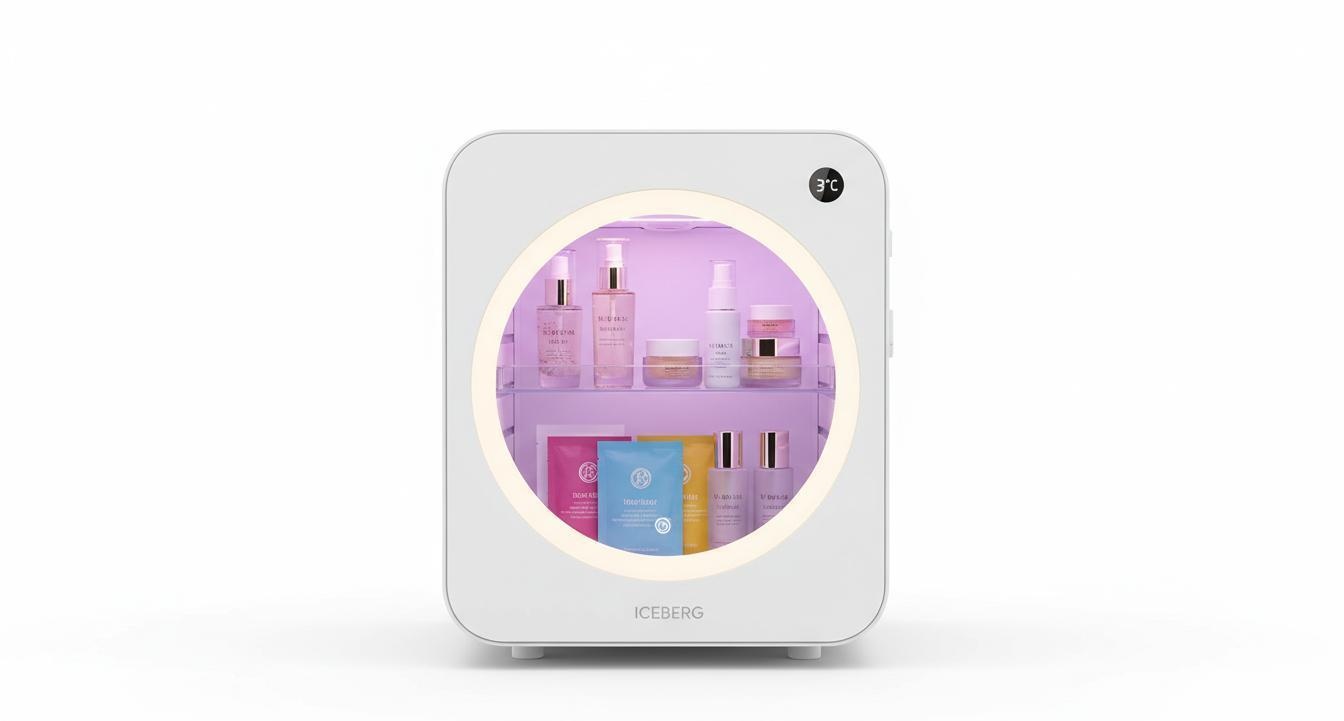
The first time I saw a beauty fridge used as a branded retail product rather than a utility appliance, it was at a K-beauty trade show in Seoul. A premium serum brand had placed their branded 6L beauty fridge — with the brand color (soft rose gold) and logo screen-printed on the door — alongside their display at a department store beauty counter. The fridge was keeping the serums cool, yes. But it was also doing something more commercially interesting: it was making the brand feel complete. The unboxing experience, the vanity presence, the cool-to-the-touch application ritual — it was a product ecosystem, not just a serum bottle.
That commercial insight is why beauty fridges have become one of the most requested private label items from skincare brands in 2026. The market has moved beyond the generic mini fridge with a skincare label. Private label buyers now want LED mirror doors, dual-temperature zones, APP-controlled smart models, and packaging that makes the unboxing moment Instagram-worthy. Meeting those expectations requires working with manufacturers who understand the beauty industry’s quality and design standards — not just a refrigerator factory that has added a skincare SKU.
In this guide, I cover the technical and commercial criteria for evaluating beauty fridge manufacturers for private label skincare brands: product types, capacity selection, customization scope, certification requirements, and the procurement process from sample to container.
What Defines a Beauty Fridge vs. a Generic Mini Fridge
Not all compact refrigerators are suitable for skincare product storage. The difference between a beauty fridge and a generic mini fridge is in the temperature performance and the product design.
Temperature Range: Precision Matters for Active Ingredients
Skincare formulations containing active ingredients — retinol, vitamin C derivatives, niacinamide, hyaluronic acid, probiotics — have temperature sensitivities that require specific storage conditions. Retinol degrades rapidly above 25°C. Vitamin C (ascorbic acid) oxidizes faster at elevated temperatures. Probiotic skincare formulations require consistent refrigeration below 8°C to maintain bacterial viability.
Thermoelectric beauty fridges (the standard technology for beauty-grade units under 15L) achieve temperatures of 17–19°C below ambient room temperature using the Peltier effect. In a standard 25°C room, a thermoelectric beauty fridge reaches approximately 6–8°C — within the range needed to preserve most active skincare ingredients. This is distinct from compressor-driven mini refrigerators, which achieve lower temperatures (below 5°C) but generate vibration and are typically too cold for comfortable skincare application.
The key specification to verify with any beauty fridge manufacturer is the minimum achieved temperature at standard ambient (typically defined at 25°C ambient, no load). Many manufacturers quote “cooling to 8–18°C below ambient” — which at 35°C ambient (hot climate, or sunlit bathroom) can mean only 17–18°C inside the fridge, above the storage threshold for temperature-sensitive actives. If your product portfolio includes probiotic or high-retinol formulations, request temperature performance data at 32°C ambient before committing to a supplier.
Dual-Temperature: Heating Function for Winter Markets
The dual-use hot and cold function — heating to 45–55°C in winter — is a significant differentiator for markets with cold winters (Northern Europe, Northeast US, Canada). Some skincare formulations, such as certain oil-based serums and warming eye creams, are more effective when warmed before application. A beauty fridge with heating function serves this need without requiring a separate warming device. When specifying the heating function, verify the thermostat precision: budget units may have temperature variance of ±5°C, while better-quality units maintain ±2°C stability.
The Four Capacity Tiers: Selecting the Right Size for Your Brand
Beauty fridge manufacturers typically offer four standard capacity tiers. The right selection depends on the primary use case and the retail channel.
4–5L: Compact Gift Sets and Single-User Applications
The 4–5L category is the entry point for private label beauty fridge programs. A 4L unit holds 4–6 standard 330ml cans or 3–4 full-size 100ml serum/cream bottles. The form factor is compact enough for a travel bag or a small vanity. This capacity is most commonly used for: gift-with-purchase programs (a branded beauty fridge included with a minimum spend), limited edition collections, and travel-size product bundles. The MOQ for 4–5L private label models is typically 500 units, with unit costs in the USD 18–28 range depending on features.
6–9L: The Core Private Label Range
The 6–9L range is where most private label skincare brands集中投入. At 6L, the fridge holds 8–12 standard 330ml cans or 6–8 full-size skincare products including standard serum bottles, jar creams, and sheet mask packets. At 9L, models with APP control (Bluetooth or WiFi connectivity) become available, allowing consumers to monitor and adjust the fridge temperature via a smartphone app — a feature that resonates with tech-forward skincare consumers and adds a connectivity narrative to the brand.
The 6–9L range also includes models with LED vanity mirror doors — the mirror surface on the door serves as a functional element (touch-up mirror) as well as the primary brand logo placement area. The LED lighting in the mirror door also illuminates the interior, making the products inside visible as a display. For premium and masstige skincare brands, the LED mirror door model is the most commercially compelling option in this category.
9–12L: Double-Door Configurations for Retail Display
At 9–12L, manufacturers offer double-door and dual-zone configurations. The dual-zone approach — separate compartments at different temperatures — allows simultaneous storage of two product categories. A typical implementation: one zone at 8–10°C for serums and eye creams (higher temperature-sensitive products) and one zone at 4–6°C for sheet masks and probiotic formulations (lower temperature products). This configuration is more complex to customize (two cooling circuits) and has higher unit costs, but creates a differentiated retail product that supports premium pricing.
15L+: Salon and Beauty Studio Category
Units above 15L are better classified as mini refrigerators than beauty fridges. They are used in beauty studio and salon environments rather than consumer vanities. For private label programs, these larger units are less relevant unless the brand operates its own retail environment or wants a branded functional refrigerator for a beauty studio concept.
LED Mirror and Smart Features: What Adds Value
LED Mirror Doors
The LED mirror door has become the signature feature of the premium beauty fridge category. The mirror surface — typically formed from acrylic or glass with an LED light strip around the perimeter — serves three functions simultaneously: it is a vanity mirror for makeup application; it is a display window showing the products inside; and it is the primary brand logo placement surface. The LED light temperature (warm white at 2,700–3,000K or cool white at 5,000–6,500K) affects both the mirror’s usability for makeup application and the visual presentation of the interior products. Cool white LEDs make serums and creams appear brighter; warm white LEDs create a more relaxing atmosphere.
When specifying LED mirror doors for private label orders, the key technical parameters to confirm are: LED strip lifespan (minimum 20,000 hours before significant lumen depreciation), LED driver voltage (typically 12V DC, integrated into the fridge’s power supply), and the mirror surface material (tempered glass mirrors are more durable than acrylic for long-term use in humid bathroom environments).
APP Control and Smart Features
Smart fridge features — Bluetooth or WiFi connectivity with a companion smartphone app — are increasingly standard in the 9L+ premium category. The APP allows consumers to: view and adjust the current interior temperature; receive alerts if the door is left open (which would cause temperature excursions for temperature-sensitive products); and set schedules for when the fridge should be cooling (e.g., turn on 30 minutes before the consumer’s morning skincare routine). For brands targeting tech-forward consumers (skincare consumers who also buy smart home devices), APP-controlled models support the brand’s positioning narrative. For brands targeting traditional beauty consumers, the APP feature adds cost without meaningful consumer benefit.
Private Label Customization: Scope and Process
Color Customization
Standard colors from beauty fridge manufacturers typically include white, pink, rose gold, mint green, and black. Custom RAL color matching requires a color swatch (Pantone or RAL reference) and a tooling setup fee (USD 500–1,500 one-time). The tooling setup covers the custom color masterbatch for the ABS plastic injection. For orders below 1,000 units, manufacturers typically apply custom color through spray painting rather than injection molding, which has higher per-unit cost and lower durability (the paint may chip over time). For 1,000+ unit orders, custom injection molding is cost-effective and produces a more durable finish.
Logo and Branding Application
Silk-screen printing on the fridge door or body is the standard logo application method for private label beauty fridges. Screen printing is durable (resists scratching, cleaning chemicals, and UV exposure) and cost-effective at volumes above 500 units. For higher-end positioning, pad printing or in-mold labeling (IML) produces a higher-quality finish with finer detail reproduction. Debossed or embossed branding requires custom tooling (USD 800–2,000 one-time) and is only cost-effective at 2,000+ unit orders.
Packaging Customization
Standard packaging for beauty fridges is plain brown carton with the unit, a power adapter, and an instruction manual. Private label packaging typically includes: branded carton design with product imagery and brand colors; foam inserts or molded pulp inserts to protect the unit in transit; a branded thank-you card or product information insert; and accessory packaging (custom-colored shelves, branded storage baskets). Packaging tooling for custom foam inserts costs USD 300–800 one-time; custom carton printing plates cost USD 200–500 one-time.
Certification Requirements by Market
| Market | Certification Required | Relevant Standards | Lead Time Impact |
|---|---|---|---|
| European Union | CE Marking | LVD 2014/35/EU, EMC 2014/30/EU | +3–4 weeks testing |
| United States / Canada | ETL Listed or UL Listed | UL 60335-1, CSA C22.2 | +4–6 weeks testing |
| United Kingdom | UKCA Marking | UK LVD, UK EMC | +3–4 weeks testing |
| Australia | RCM Marking | AS/NZS 60335.1 | +3–4 weeks testing |
| Japan | PSE Mark | JIS C 9335-1 | +4–5 weeks testing |
For brands selling through major retailers (Sephora, Ulta, Boots, Douglas, Space NK), the retailer will have their own vendor compliance requirements that go beyond the regulatory certifications. These typically include: product liability insurance (minimum USD 2–5 million coverage), a test report from an accredited laboratory (not just a manufacturer’s declaration of conformity), and compliance with the retailer’s restricted substances list (RSL) for packaging materials. Factor 8–12 weeks into the procurement timeline for retailer compliance documentation processing.
The Procurement Checklist for Private Label Beauty Fridges
- ☐ Temperature performance data: request the manufacturer’s temperature curve at 25°C and 32°C ambient — verify minimum achieved temperature suits your product portfolio’s most temperature-sensitive SKU
- ☐ LED mirror specifications: confirm LED lifespan (20,000+ hours), driver voltage (12V DC integrated), and mirror material (tempered glass preferred over acrylic for bathroom humidity environments)
- ☐ MOQ and customization threshold: confirm the minimum order for custom color (typically 500 units for spray-painted; 1,000+ for injection-molded custom color)
- ☐ Sample approval process: request pre-production samples (USD 50–100 per unit, credited against bulk order) before committing to production — verify color match, logo print quality, and temperature performance
- ☐ Certifications for target markets: confirm the manufacturer holds CE, ETL/UL, and UKCA certifications for the specific models you are ordering — not just for similar models
- ☐ Retailer compliance documentation: identify the full documentation package required by your retail channel before placing the order — test reports, liability insurance, RSL compliance
- ☐ Packaging compliance: for EU markets, verify packaging materials comply with EU Packaging and Packaging Waste Directive; for US markets, check state-specific packaging recycling requirements (e.g., CA AB 793)
- ☐ Warranty and defect policy: standard warranty is 12 months from shipment; negotiate defect handling procedures and freight allocation for warranty claims before signing the purchase agreement
- ☐ Production lead time: standard lead time is 20–30 working days from sample approval to shipment for 500–1,000 unit orders; add 5–10 working days for custom color or packaging tooling
Conclusion: Sample First, Scale Second
The most common private label beauty fridge procurement mistake is committing to a bulk order before approving a physical sample. The visual presentation of a branded beauty fridge — the exact color match, the logo print quality, the LED mirror brightness, the interior shelf configuration — cannot be reliably assessed from photos or specifications. A pre-production sample, even at USD 50–100 per unit, is the most cost-effective quality control step in the entire procurement process. The cost of re-labelling or re-boxing 2,000 units that arrived with a color mismatch or a logo in the wrong position far exceeds the sample cost.
The second most common mistake is underestimating the certification timeline. If you are selling through a retailer, the retailer compliance process — test reports, documentation, product liability insurance — takes 8–16 weeks in parallel with production. Do not plan to receive your inventory and then start the compliance process. Start the certification and compliance documentation work in parallel with the manufacturing planning.
Ningbo Iceberg Electronic Appliance Co., Ltd. manufactures beauty fridges and cosmetic fridges including LED mirror door models, dual-temperature units, and APP-controlled smart fridges with CE, ETL, and UKCA certification. The procurement checklist above applies to any beauty fridge private label sourcing project regardless of which manufacturer you select.
Disclaimer: This article provides general industry guidance for private label skincare brands sourcing beauty fridges wholesale. Technical specifications (temperature ranges, LED specifications, thermoelectric cooling technology), certification requirements (CE, ETL, UL, UKCA, PSE, RCM), and commercial parameters (MOQ, pricing tiers, lead times) are based on general industry knowledge and typical market observations. All specifications must be verified with the specific manufacturer before procurement. Certification requirements and regulatory compliance obligations must be confirmed for the specific target market and sales channel. Product liability insurance requirements should be confirmed with the brand’s legal and insurance advisors.
Post time: May-26-2026