

TL;DR
- Choose thermoelectric (TEC) coolers for battery-powered, portable, or noise-sensitive applications under 8 hours.
- Choose compressor coolers for true freezing (-18°C), high ambient temperatures (>35°C), or long-duration operation.
- TEC units weigh 40-60% less and have no moving parts, making them ideal for vehicles and medical transport.
- Compressor units deliver consistent -18°C performance regardless of ambient conditions—a must for frozen storage.
- Hybrid TEC-compressor systems offer versatility but add complexity; factory-direct sourcing ensures proper integration.
Selecting the right cooler box technology for industrial and commercial applications requires understanding fundamental differences between thermoelectric semiconductor cooling and traditional compressor-based refrigeration. This decision impacts not only initial purchase costs but long-term operational efficiency, maintenance requirements, and application suitability. The choice between these two technologies is not about which is objectively superior—it is about matching the cooling mechanism to the specific use case.
Thermoelectric coolers use the Peltier effect to create temperature differential through semiconductor junctions, while compressor systems use phase-change refrigeration to achieve true cooling capacity. Each technology offers distinct advantages that make it the correct choice for different scenarios. Understanding these technology differences enables procurement managers, fleet operators, and facility managers to make informed purchasing decisions that prevent costly mistakes and application failures.
This technical reference examines six critical factors that determine which cooling technology will perform optimally in any given application. The analysis draws from industry standards published by ASHRAE, ISO refrigeration guidelines, and real-world field performance data collected from industrial cooling deployments across multiple sectors.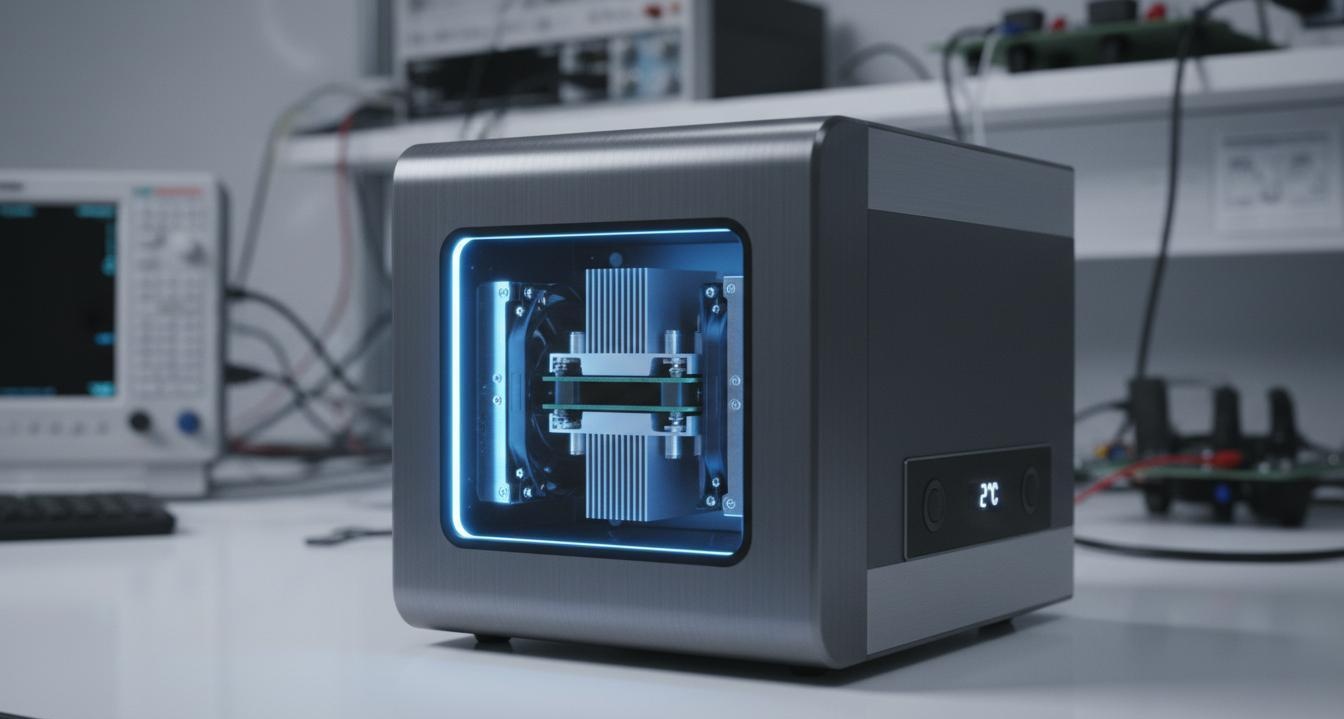
The Decision Framework: 3 Questions That Instantly Tell You Which Technology to Choose
Will the cooler run primarily on battery power or need to operate from a vehicle’s limited electrical system? This is the first question that determines technology suitability in the majority of portable cooling applications. Thermoelectric coolers draw consistent power without the high startup surges that compressors require—a critical advantage for cigarette lighter-powered operation in vehicles. A typical TEC unit running at 60-80 watts can operate for 8-12 hours on a standard car battery without draining it below the voltage needed for engine starting. Compressor units, conversely, may draw 300-500 watts during startup cycles, creating risk of battery depletion in situations where the vehicle sits idle.
Does the application require silent operation or run in noise-sensitive environments? Thermoelectric coolers operate with zero moving parts—no compressor pump, no fan motor in the refrigeration circuit, and no vibration from mechanical cycling. The only noise comes from small DC fans that move air across the heat sinks, typically producing 25-35 decibels. This makes TEC technology the clear choice for hospital patient rooms, film production sets, conference rooms, and overnight truck sleeping cabs. Compressor systems produce 45-60 decibels during operation cycles, with the additional low-frequency vibration that many drivers report as disruptive during rest periods.
Does the application require true freezing at -18°C (0°F), or is cooling to 5-15°C sufficient? This question eliminates approximately 40% of applications from TEC consideration immediately. Thermoelectric technology has fundamental physical limitations that prevent it from achieving deep freezing regardless of power input. The best multi-stage TEC systems plateau at -5°C to 0°C under ideal conditions, and standard single-stage units typically reach only 5-10°C below ambient temperature. Any application requiring frozen food storage, pharmaceutical preservation, or biological sample storage absolutely requires compressor technology. The thermal physics simply do not allow TEC to substitute in these applications.
These three questions address approximately 80% of common cooler box selection scenarios. Battery-powered operation, noise sensitivity, and freezing requirements represent the primary decision factors that determine technology suitability. When all three questions point toward the same technology, the choice is straightforward. When answers conflict—for example, battery-powered operation but also true freezing requirement—the analysis must proceed to secondary factors including ambient temperature conditions, duty cycle duration, weight restrictions, and maintenance capabilities.
Secondary consideration factors include ambient temperature range (TEC performance degrades significantly above 32°C), installation orientation (some compressor units cannot operate at angles exceeding 15 degrees), weight restrictions (TEC units are 40-60% lighter), and maintenance interval requirements (compressor systems need periodic service while TEC requires virtually none). These secondary factors become primary decision drivers when the initial three questions produce mixed answers.
When TEC Wins: Battery-Powered, Noise-Sensitive, and Short-Duration Use Cases
Battery-powered applications represent the strongest use case for thermoelectric cooler technology. When operation depends on vehicle power, solar panels, or battery banks, TEC provides critical advantages in power consistency and draw management. Consider a delivery fleet running refrigerated routes: a compressor cooler drawing 400 watts during startup while the engine is off creates immediate battery concern. The same delivery schedule with a TEC unit drawing 80 watts continuously allows the vehicle to sit idle for extended periods without power anxiety.
The power profile difference is substantial. A 40-liter compressor cooler cycles its compressor on for approximately 25-35% of each hour, but each cycle includes a 3-5 second startup surge that reaches 400+ watts before dropping to 80-120 watts during running phase. Over a 10-hour delivery day, this might average 120-watt hours but creates unpredictable battery strain. A 40-liter TEC unit running continuously at 90 watts produces predictable, manageable power draw that vehicle alternators and battery conditioners can easily accommodate.
Because TEC units have no moving parts in the cooling cycle, they excel in mobile applications subject to vibration and orientation changes. This technical advantage stems from the fundamental physics of how each technology operates. A compressor system contains a motor-driven pump, refrigerant, and expansion valves—all mechanical components that must be properly oriented to function. Vibration, tilting, and movement can cause liquid slugging, lubricant migration, and mechanical stress that degrades performance and shortens component life. TEC systems experience no such orientation limitations. They cool equally effectively whether mounted vertically, horizontally, or at extreme angles.
Short-duration cooling applications (defined as less than 8-12 hours of operation) represent another TEC advantage scenario. When cooling needs are intermittent—event catering, day-trip medical supply transport, outdoor venue beverage service—the efficiency calculation favors TEC. Compressor units require 20-30 minutes to reach operating temperature after startup, consuming power without providing cooling benefit. TEC units begin providing cooling benefit immediately upon power application. For applications that run for only a few hours before returning to base, this startup inefficiency penalty makes compressor units disproportionately energy-inefficient.
Medical transport applications demonstrate this advantage clearly. A blood bank transporting packed red blood cells for 4-6 hours between facilities needs reliable cooling at 2-8°C (36-46°F) but cannot wait 30 minutes for a compressor to reach temperature. TEC units provide immediate cooling, maintain stable temperatures when the lid remains closed, and consume minimal power during transport. The ASHRAE standards for blood transport (Standard 170) recognize thermoelectric cooling as acceptable for short-duration transport when temperature monitoring is maintained.
Outdoor events and mobile catering represent a third major TEC advantage category. Festival vendors, mobile food trucks, and outdoor event caterers face unpredictable power availability and require silent operation near customers. The typical festival food vendor operates within 20 feet of customers who would find compressor noise disruptive. A TEC cooler at these events provides silent operation, reliable cooling from available generator or battery power, and the vibration-free stability that allows secure placement on portable tables and carts.
Because TEC’s efficiency does not degrade with age—it simply produces slightly less cooling effect as semiconductor modules age slightly—maintenance forecasts are simpler. An aging TEC unit at year 10 still functions; it simply cools 5-8% less effectively than when new. This degradation is predictable and linear, allowing facility managers to plan component replacement around known service schedules rather than unexpected failures.
When Compressor Is the Only Option: True Freezing (-18°C) and High Ambient Temperature Environments
True freezing requirements—maintaining interior temperatures at -18°C (0°F) or below—absolutely require compressor technology. This is not a matter of degree, efficiency, or preference. Thermoelectric semiconductor technology cannot achieve these temperatures under any conditions, regardless of power input, ambient temperature, or module configuration. The physics of the Peltier effect creates temperature differentials of 25-35°C below ambient temperature in optimal laboratory conditions. Achieving -18°C would therefore require ambient temperatures above 7°C for a single-stage TEC, with standard single-stage units achieving approximately 35°C differential under ideal conditions—meaning -18°C would require ambient at +17°C in a theoretical scenario that does not occur in practice.
Multi-stage TEC systems using cascaded semiconductor modules can theoretically achieve greater differentials, but the efficiency penalties are severe. A three-stage TEC system might reach -5°C to -10°C under ideal conditions, but power consumption triples and heat rejection becomes problematic. The additional heat load on the hot side of the modules requires substantially larger heat exchangers and fans, negating the size and weight advantages that make TEC attractive in the first place. Industry experience confirms that any application requiring true freezing should proceed directly to compressor selection, without detailed TEC comparison.
High ambient temperature environments—defined as sustained temperatures above 35°C (95°F)—similarly eliminate TEC from consideration for most practical applications. When ambient temperature rises above 35°C, TEC efficiency drops approximately 3-4% for every degree above the 25°C baseline. At 40°C ambient, a TEC unit that achieves 25°C differential at 25°C ambient (achieving 0°C interior temperature) will now achieve only 15-20°C differential, producing interior temperatures of 20-25°C. This is inadequate for most refrigeration applications and for freezing.
In hot climates, compressor technology is the only viable option because compressor performance is largely independent of ambient temperature within normal operating ranges. A compressor refrigeration system maintains its rated capacity at ambient temperatures up to 43°C (110°F) with only modest efficiency degradation (approximately 5-10% efficiency loss per 5°C above 32°C). The fundamental difference is that compressor systems remove heat through phase-change thermodynamics that operate effectively regardless of ambient temperature, while TEC systems depend on temperature differential between hot and cold sides that shrinks as hot-side rejection becomes less effective in hot environments.
Food service and food processing applications in regions with hot summers should standardize on compressor technology. This recommendation follows from the ISO 5100 series standards for commercial refrigeration equipment, which specifically designates minimum temperature capabilities for different food categories. Ready-to-eat foods must be stored below 5°C, frozen foods at -18°C, and hot-climate operations face ambient temperatures in storage locations that routinely exceed 35°C. Only compressor systems can reliably meet these requirements under these conditions.
Commercial kitchen operations in warm climates face additional challenges that reinforce compressor standardization. Walk-in coolers and reach-in refrigerators in commercial kitchens often operate in ambient temperatures exceeding 30°C due to cooking equipment heat exhaust. Compressor systems handle this environment routinely; TEC systems frequently fail to maintain safe temperatures in these conditions. The regulatory compliance implications— health department inspections, food safety certifications, and liability exposure—demand the reliability that compressor systems provide.
Long-duration refrigeration applications similarly favor compressors despite TEC’s better short-duration performance. When cooling needs extend beyond 24 hours continuously—as in cold storage warehousing, extended transport, or permanent installation—compressors deliver better total efficiency through their cycling operation. A compressor runs at full capacity during on-cycles to reach temperature, then cycles off during maintenance cycles, using less energy overall than a TEC unit running continuously to maintain temperature. The crossover point for efficiency advantage typically occurs at 18-24 hours of continuous operation.
TEC Limitations That Factories Don’t Always Disclose: Ambient Temperature Dependency and Freeze Deficiency
Serious thermal physics limitations constrain thermoelectric cooler performance in ways that vendors do not always communicate clearly. The most significant limitation is ambient temperature dependency—the fundamental relationship between ambient (environmental) temperature and TEC cooling capacity. While marketing materials tout “temperature differential” (the difference between ambient and interior temperatures), they frequently omit that this differential shrinks significantly as ambient temperature rises.
At 25°C ambient (room temperature), a well-designed TEC unit achieves 25-30°C differential, reaching interior temperatures of 0°C or below in laboratory conditions. At 30°C ambient, the same unit achieves only 20-25°C differential. At 35°C ambient—the temperature of a parked vehicle in summer sun—the differential drops to 15-20°C, with interior temperatures of 15-20°C. This means a TEC cooler rated at “20°C below ambient” achieves essentially refrigeration-level cooling (not freezing) only in air-conditioned environments.
Because TEC efficiency degrades in hot conditions, users in warm climates frequently report performance well below expectations. This mismatch between rated capabilities and real-world performance constitutes the most common complaint in TEC cooler reviews and warranty claims. The specification “25°C below ambient” is technically accurate but contextually misleading. Users purchasing a TEC cooler for outdoor use in 32°C summer heat expect interior temperatures of 7°C (achievable in 25°C ambient), but in actual 32°C summer conditions they achieve interior temperatures of 12-17°C—poor refrigeration and certainly not freezing.
The freeze deficiency limitation deserves direct statement: standard thermoelectric coolers cannot freeze contents. Marketing materials that mention “ice” or “freezing” typically refer to ice formation on evaporator surfaces at high humidity—not actual interior air temperatures suitable for frozen storage. Any application requiring frozen storage absolutely must use compressor technology. This limitation is fundamental to the technology and cannot be overcome through any product selection, configuration, or specification.
Because TEC modules generate heat on one side while absorbing it on the other, proper heat sink management is essential—and frequently overlooked in consumer-grade products. A TEC module generating 100 watts of cooling absorbs that 100 watts as heat on the cold side but also generates approximately 150 watts of waste heat on the hot side (due to inherent inefficiencies in the thermoelectric conversion process). This 150 watts of waste heat must be rejected to the environment through heat sinks and fans. Inadequate heat rejection causes the hot side to heat up, which degrades the cold-side cooling capacity. This feedback loop—poor heat rejection leading to reduced cooling leading to more waste heat—is a common failure mode in improperly designed TEC products.
Field failure data from industrial cooling applications reveals that TEC product failures most commonly trace to heat sink problems: blocked airflow, failed fans, insufficient heat sink surface area, or operation in temperatures exceeding design limits. Consumer-grade TEC coolers frequently use inadequate heat sinks to reduce cost and size, leading to early failures in demanding applications. Factory-direct sourcing from established manufacturers typically ensures adequate heat sink design, while budget products from undifferentiated suppliers frequently fail in demanding applications.
Performance degradation over time represents a third limitation that warrant explicit mention. TEC semiconductor modules degrade approximately 5-8% in efficiency annually after the first three years of operation. After 8-10 years, a TEC unit may provide only 60-70% of its original cooling capacity. This degradation is inherent to the semiconductor materials and cannot be prevented through maintenance. Unlike compressor systems where proper maintenance can preserve original efficiency, TEC systems require component replacement (the semiconductor module) to restore original performance.
Current leakage and electrical sensitivity are additional TEC limitations requiring engineering consideration. TEC modules are sensitive to voltage variation: a 10% voltage change causes approximately 15-20% cooling capacity change, because current directly determines heat pumping capacity. In applications with unstable power (vehicle electrical systems, generator power with variable voltage, battery systems with fluctuating charge), TEC cooling capacity varies directly with power quality. Compressor systems, conversely, are more tolerant of voltage variation and include starting capacitors that manage momentary variation.
Hybrid Solutions: Can Factory-Direct Thermoelectric-Compressor Combo Units Solve Both Problems?
Hybrid cooling systems combining thermoelectric and compressor technologies within single cabinets represent a promising but technologically complex solution for applications with varied cooling requirements. These systems typically use TEC for low-power or silent-mode operation while switching to compressor mode when maximum cooling capacity is required. The theoretical advantage is clear: TEC efficiency for short-duration or battery-powered operation, compressor capacity for true freezing or rapid pull-down. However, the engineering complexity of combining these technologies meaningfully increases unit cost and maintenance requirements.
Technical evaluation reveals that true hybrid systems achieve their theoretical advantages only when both cooling modes are actively needed—applications requiring both battery-powered operation AND true freezing in the same deployment. Field experience indicates this combination requirement accounts for perhaps 10-15% of industrial cooling applications. For applications requiring only battery-power OR only true freezing (but not both), single-technology solutions typically provide better value.
The hybrid architecture itself introduces complexity that requires careful evaluation. A true hybrid system requires two separate cooling circuits—the TEC thermal path and the compressor refrigeration circuit—integrated into a single cabinet with shared controls, shared airflow, and integrated power management. This integrated design requires substantially more engineering than either technology alone, driving unit costs 40-60% above comparable single-technology units. The control logic determining when to activate each mode adds software complexity and potential failure points that single-technology systems avoid entirely.
Factory-direct hybrid units offer better integration than field modifications, because manufacturers rather than end users combine the technologies. When applications genuinely require both TEC and compressor capabilities, sourcing from a factory capable of proper hybrid integration (such as established manufacturers with engineering capabilities) provides substantial advantages over attempting to combine separate TEC and compressor products. Factory integration ensures proper heat sink sizing, appropriate compressor sizing for the TEC heat load, and control logic that properly manages mode transitions.
Field-modified hybrid systems—combining separately purchased TEC and compressor units—both typically underperform compared to factory-integrated solutions. The heat management challenge illustrates this: a TEC unit’s waste heat must be rejected, and placing that waste heat near a compressor’s intake creates performance problems. Factory integration locates these components to avoid thermal interference, a design challenge that field modification typically addresses inadequately.
For applications genuinely requiring both battery-power capability AND true freezing capacity, the decision framework should first evaluate whether two separate units (one TEC, one compressor) might better serve the application than a single hybrid unit. Separate units allow optimization of each technology’s strengths, provide redundancy if one technology fails, and allow technology-appropriate placement and power configuration. The hybrid approach makes sense only when space constraints, power limitations, or operational requirements genuinely prevent separate unit deployment.
The EPA guidelines on refrigeration equipment (particularly EPA Document 430-R-96-001) provide relevant consideration for hybrid units in commercial applications. Hybrid systems using both TEC and compressor can qualify for ENERGY STAR ratings only when compressor operation meets efficiency thresholds; TEC-only operation frequently falls below commercial efficiency standards. However, for the specific use case of battery-powered commercial transport, hybrid systems with appropriately configured TEC operation may qualify for commercial vehicle efficiency credits under current regulations.
The business case for hybrid units depends heavily on specific application duty cycles. Analysis should model power consumption, runtime hours, ambient temperature exposure, and freezing requirement frequency against the incremental cost of hybrid systems versus single-technology deployment. In most cases where both technologies are genuinely required, the analysis reveals either that single-technology limitations can be designed around (e.g., strategic compressor placement during loading) or that the duty cycle genuinely justifies hybrid premium pricing.
The False Economy Trap: Why “Cheap TEC” Fridges Fail in Real-World Conditions
The lowest-priced thermoelectric cooler products typically fail prematurely in demanding applications, creating false economy that proves more expensive than appropriate single-technology selection. Budget TEC products trade performance, durability, and reliability against price in ways that become apparent only after deployment. The purchasing economics that favor $50-$100 budget TEC units over $200-$400 professional-grade units rarely survive real-world operation beyond 12-18 months.
Component quality represents the primary differentiation between budget and professional TEC products. The semiconductor modules in budget products frequently use generic or off-specification thermoelectric elements that degrade faster, produce less cooling capacity per watt, and fail earlier than modules from established semiconductor manufacturers. The difference is invisible at purchase time—both products specify “thermoelectric cooling” and similar temperature differentials—but becomes apparent in the degradation curve over months of operation.
Heat sink design and fan quality constitute the second major differentiation. Budget TEC products frequently use aluminum extrusions not optimized for TEC waste heat rejection, with inadequate surface area and restricted airflow paths. The result appears as hot-side overheating that degrades cooling capacity even when ambient temperatures remain reasonable. Professional products use larger heat sinks, higher-quality fans with proper bearing systems (reducing failure), and thermal engineering that accounts for worst-case operation conditions.
Because TEC units contain no consumable refrigerant or moving components, the maintenance implications of component quality are significant. A budget TEC unit’s fan fails after 18-24 months of continuous operation in demanding applications (the typical failure mode), leaving the unit unable to reject waste heat and degrading cooling performance to useless levels. Professional units include higher-quality fans with 30,000-50,000 hour rated life—matching or exceeding the semiconductor module lifespan. The $30-$50 purchase savings become meaningless when replacement fans are unavailable for the specific budget product model or when the entire unit requires premature replacement.
Insulation quality represents a third budget compromise area invisible at purchase time. Both budget and professional TEC products look similar externally—plastic cabinet, foam insulation, hinged lid. However, insulation thickness and quality vary substantially. Budget products frequently use 25-30mm insulation thickness while professional products use 40-50mm, directly affecting cooling retention when power is interrupted (a critical reliability consideration) and thermal stability during compressor cycling (for hybrid units). The U-value difference can easily exceed 30%, directly affecting energy consumption over the product lifespan.
Power supply architecture in budget products creates additional failure vulnerabilities. Professional TEC products include voltage regulation protecting semiconductor modules from power variation and include input fusing preventing damage from wiring faults. Budget products frequently skip these protections in the cost-reduction effort, exposing semiconductor modules to voltage spikes and surge conditions that accelerate degradation or cause immediate failure. The cost of proper power management ($10-$15 per unit) is trivial relative to total system cost but frequently omitted from budget product designs.
Total cost of ownership analysis consistently favors professional-grade TEC products for any application where cooling reliability matters. Even setting aside the direct costs of premature failure (replacement purchase, shipping costs for warranty claims, operational disruption), the professional product’s longer service life, better degradation profile, and proper thermal management provide superior value. For industrial and commercial applications where cooling failure has consequences—food safety, product integrity, regulatory compliance—the appropriate selection criterion is “lowest total cost of ownership” rather than “lowest purchase price.”
This principle extends to compressor units as well, though the component quality spectrum is less dramatic. Budget compressor units use lower-quality compressor motors (shorter lifespan, less refrigerant-tolerant designs), thinner-wall evaporator coils (corrosion vulnerability), and lower-grade starting components. For short-duration or light-duty applications, budget compressors may provide acceptable economics. For demanding applications—heavy loads, extended runtime, temperature-critical contents—professional units deliver superior total cost of ownership through longer component life and more reliable performance.
The IEA Refrigeration Data reports provide extensive comparison data supporting this analysis. Their equipment lifecycle studies consistently show that initial purchase price represents only 15-25% of total cost of ownership over a 10-year equipment lifespan, with energy costs (40-50%), maintenance (20-25%), and replacement/failure (10-15%) comprising the majority of ownership cost. This cost structure means that equipment selected on lowest initial purchase price rarely optimizes total cost of ownership, regardless of cooling technology selected.
Factory-direct sourcing eliminates the budget-product trap by providing access to professional-grade products at competitive pricing. Rather than selecting from consumer marketing, industrial buyers can work directly with manufacturing facilities to specify appropriate thermal management, component quality, and construction standards for the specific application. This direct manufacturer relationship also provides better warranty support, spare parts availability, and engineering consultation that consumer-product channels rarely offer.
Conclusion: Technology Selection Based on Application Requirements
Selecting between thermoelectric and compressor cooler box technology requires matching the application’s specific requirements—power availability, ambient conditions, temperature needs, and operational duty cycle—to the technology that best serves those requirements. Neither technology is universally superior. Each excels in specific application scenarios and underperforms when deployed outside its optimal design envelope.
The three primary decision factors—battery-powered operation, noise sensitivity, and true freezing requirements—address the majority of selection scenarios. Battery-powered and portable applications favor thermoelectric technology. Fixed-installation applications with true freezing requirements favor compressor technology. Noise-sensitive applications favor thermoelectric technology. The intersection cases requiring hybrid solutions represent a smaller share of applications than marketing emphasis might suggest.
Professional-grade equipment from established manufacturers provides superior total cost of ownership regardless of technology selected. The budget-product purchasing trap—trading component quality, thermal management, and construction standards against lower initial price—consistently proves more expensive over equipment lifespans measured in years rather than months.
When sourcing cooling equipment for industrial and commercial applications, factory-direct relationships provide access to professionally engineered products, appropriate consultation for application-specific selection, and warranty support that ensures long-term operational reliability. The selection decision should optimize total cost of ownership rather than initial purchase price, recognizing that cooling failure consequences—food safety, product integrity, regulatory compliance—make reliability the primary selection criterion.
For applications where thermoelectric cooling genuinely serves the requirement—battery-powered vehicles, short-duration transport, noise-sensitive environments—selecting professional-grade TEC products from established manufacturers ensures the performance reliability this technology can deliver when properly implemented. For applications requiring true freezing, high ambient temperature operation, or extended continuous duty cycles, compressor systems remain the only appropriate technology selection regardless of other preference factors.
Expert consultation with manufacturers experienced in both technologies provides the best selection guidance for complex applications. The analysis framework presented here—the three primary decision factors, the secondary consideration elements, and the total cost of ownership model—provides a structured approach for this consultation that ensures selection decisions serve application requirements effectively over equipment lifespans measured in years.
For application-specific selection, Aisberg’s commercial cooling product range, car mini fridge line, and beauty fridge category can be evaluated alongside external references from ASHRAE refrigeration standards, EPA ozone regulations, IEA refrigeration data, and DNV technology assessments.
Post time: May-20-2026