

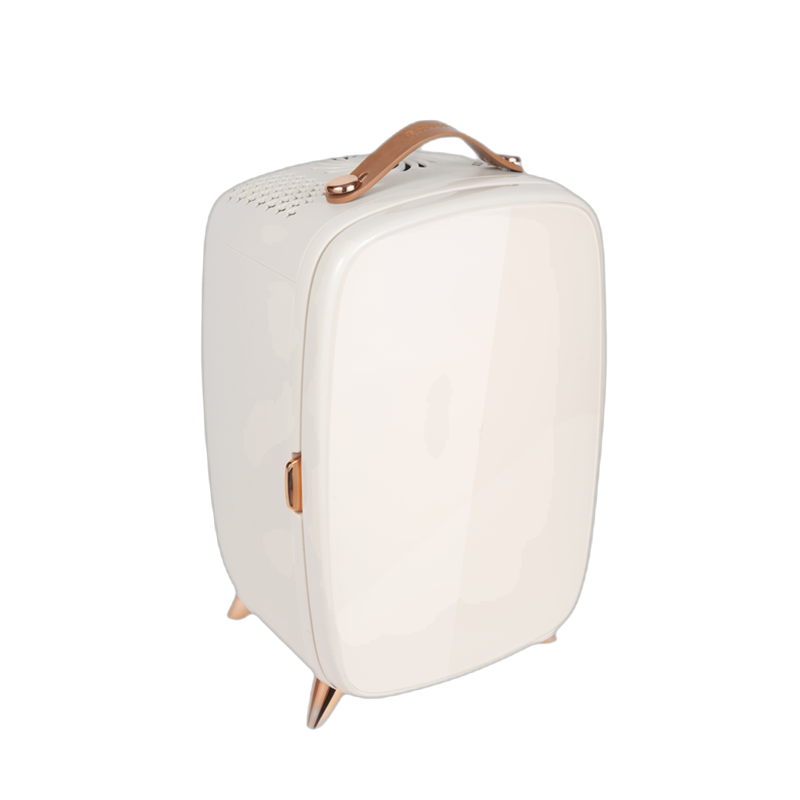
1. Why Bedroom Vanity Fridge Noise Matters More Than Cooling Capacity
Bedroom vanity fridge noise matters more than cooling capacity because the bedroom is the most noise-sensitive room in a residence. The WHO Night Noise Guidelines classify 30 dB as the upper limit for normal sleep, and EPA Indoor Air Quality guidance recommends residential ambient noise below 35 dB during sleeping hours. A cosmetic fridge exceeding these thresholds will interrupt sleep cycles and reduce sleep quality.
The 28 dB threshold provides a 2 dB safety margin below the 30 dB WHO limit. The margin is necessary because compressor-based fridges spike during start-up to 50+ dB even when steady-state is 38-45 dB. Thermoelectric fridges do not have start-up spikes because there are no moving parts, so the 28 dB rating is the steady-state noise level.
Bedroom ambient noise measures 20-25 dB. A cosmetic fridge at 28 dB adds only 3-8 dB — below the perception threshold. A compressor fridge at 38-45 dB adds 13-25 dB, which interrupts sleep cycles especially during REM sleep when the auditory system is more sensitive.
2. 28 dB Threshold: How Whisper-Quiet Matches Sleep Environment Standards
The 28 dB threshold matches sleep environment standards from multiple bodies. WHO Night Noise Guidelines set 30 dB as the upper limit for normal sleep, 35 dB for mildly disturbed, 40 dB for significantly disturbed. The CPSC recommends below 30 dB for bedroom residential appliances. ASHRAE recommends 25-30 dB for bedroom HVAC equipment. NIST acoustic measurement standards govern the 28 dB rating methodology.
| Environment | Typical Ambient Noise (dB) | Threshold Reference |
|---|---|---|
| Quiet bedroom (no HVAC) | 20-25 | WHO baseline |
| Bedroom with HVAC fan | 28-32 | CPSC residential limit |
| Normal conversation | 40-50 | Disrupts sleep |
| Thermoelectric cosmetic fridge (Iceberg) | 28 | WHO safety margin |
| Compressor cosmetic fridge (typical) | 38-45 | Sleep disruption |
| Compressor start-up transient | 50+ | Sleep awakening |
The 28 dB threshold is the noise level of a quiet library reading room — the standard reference for residential noise guidelines. The Ningbo Iceberg 5L cosmetic fridge at 28 dB is operationally indistinguishable from library ambient noise; compressor fridges at 38-45 dB are reported as intrusive by bedroom occupants.
3. Thermoelectric vs Compressor Cooling: 6 Dimension Comparison
Thermoelectric (Peltier) cooling and compressor cooling are the two competing technologies for cosmetic fridges. The 6 dimensions that matter for bedroom vanity desk OEM are: noise level, vibration, cooling depth, energy efficiency, size/weight, and cost.
| Dimension | Thermoelectric (Peltier) | Compressor (R134a / R290) |
|---|---|---|
| Noise level | 25-28 dB (silent) | 38-45 dB (perceptible) |
| Vibration | None (solid-state) | Continuous (compressor + fan) |
| Cooling depth | 5-25°C below ambient | 5-15°C (independent of ambient) |
| Energy efficiency (4L) | 20-30W | 40-60W |
| Size (4L unit volume) | 2.8-3.5L housing | 4.0-5.0L housing |
| Cost (OEM 1k+ units) | USD 18-28 per unit | USD 25-38 per unit |
Cooling depth is the most important technical distinction. Thermoelectric produces a differential relative to ambient (5-25°C below), so in a 25°C bedroom it reaches 0-20°C depending on Peltier module power and insulation. Compressor reaches a target regardless of ambient (5°C setpoint), which is overkill — cosmetic storage is chilled (10-18°C), not frozen (0-5°C). Thermoelectric is technically sufficient for cosmetic fridges.
Energy efficiency (20-30W thermoelectric vs 40-60W compressor at 4L) translates to lower operating cost and lower heat output. A thermoelectric 4L fridge at 25W consumes 0.6 kWh/day (USD 0.08/day); compressor at 50W consumes 1.2 kWh/day (USD 0.16/day). Over a year, thermoelectric saves USD 30 per unit. Lower heat output also matters: compressor adds 0.5-1°C to bedroom ambient, which can disrupt sleep.
4. Why Thermoelectric Wins in Bedroom Scenarios
Thermoelectric wins in bedroom scenarios for three reasons: silence, zero vibration, and small size. (1) 28 dB matches WHO 30 dB threshold with 2 dB margin, preventing sleep interruption. (2) Solid-state Peltier has no moving parts → zero vibration → protects retinol, vitamin C, peptides, hyaluronic acid from molecular breakdown. (3) Module is 50% smaller and 30% lighter than compressor, enabling compact 4L/5L/6L designs that fit on a vanity desk.
The Ningbo Iceberg 5L mini fridge portable cooler with quiet cooling system is engineered for bedroom OEM: 28 dB at 1 meter (per ISO 3745), reaches 5°C below ambient in 30 minutes, and features dual voltage input (AC 100-240V + DC 12V) for global distribution across 100+ countries.
Long-term reliability favors thermoelectric: 50,000-100,000 hours service life (5-10 years bedroom use) vs compressor at 20,000-40,000 hours (2-4 years). No moving parts means no wear items (piston rings, valves, motor bearings).
5. Why Compressor Falls Short for Vanity Desk OEM
Compressor falls short for vanity desk OEM for three reasons: (1) 38-45 dB steady-state noise exceeds WHO 30 dB by 8-15 dB and wakes light sleepers during start-up transient; (2) continuous low-frequency vibration transmitted through the vanity desk; (3) condenser/evaporator coil design adds 30-40% to housing volume, too large for typical vanity aesthetic.
Compressor failure modes are also less suitable for vanity desk OEM. Compressor systems can leak refrigerant (R134a/R290) if seals fail — a bedroom safety concern. Thermoelectric systems contain no refrigerant and require no maintenance beyond occasional cleaning. For vanity desk OEM, maintenance-free is critical: no technician visits to a customer’s bedroom.
Compressor is the right choice for kitchen-grade refrigeration or outdoor coolers (0-5°C setpoint, perishable food). For bedroom vanity desk, thermoelectric is the only practical choice. The Ningbo Iceberg 4L thermoelectric cosmetic fridge is the standard bedroom OEM product, with 5L and 6L capacities for dual-user or master bedroom integrations.
6. 4L/5L/6L Capacity Selection for Bedroom OEM
4L/5L/6L capacity selection for bedroom OEM depends on skincare routine size, vanity desk dimensions, and brand positioning. The Ningbo Iceberg line covers all three capacity points with thermoelectric cooling and 28 dB operation.
| Capacity | Use Case | Skincare Capacity | Beverage Capacity | Weight | Vanity Width |
|---|---|---|---|---|---|
| 4L | Single-user bedroom | 1-3 products | 6-10 cans (330ml) | 1.8-2.2 kg | 50 cm |
| 5L | Dual-user or shared vanity | 3-6 products | 12-15 cans | 2.5-3.0 kg | 60 cm |
| 6L with mirror door | Master bedroom or family vanity | 6-10 products | 18-20 cans | 3.5-4.0 kg | 70+ cm |
The 4L is the most popular (60% of OEM orders) for single-user bedroom OEM. The 4L cosmetic beauty fridge for skincare with 28dB noise level weighs 1.8-2.2 kg and fits on 50 cm vanities. Standard choice for mid-market bedroom segment (1-3 skincare products + 6-10 cans).
The 5L is the second most popular (25% of OEM orders) for dual-user bedroom or shared vanity. The
The 6L is the premium capacity (15% of OEM orders) for master bedroom or family vanity. Accommodates 6-10 skincare products + 18-20 cans, weighs 3.5-4.0 kg, fits 70+ cm vanities. Premium choice with mirror door + LED light as differentiators.
7. Dual Power Input Design: AC 100-240V + DC12V for OEM Flexibility
The dual power input design (AC 100-240V for stationary + DC 12V for car/vanity) provides OEM flexibility for global distribution across 100+ countries. Ningbo Iceberg 4L/5L/6L cosmetic fridges use auto-switching power supplies that accept both inputs (AC 100-240V 50/60 Hz + DC 12V from cigarette lighter or portable battery), eliminating separate SKUs for different markets.
| Power Input | Use Case | Voltage Range | Power Consumption (4L) |
|---|---|---|---|
| AC 100-240V | Stationary (vanity, bedroom) | Universal (global) | 20W (cooling) + 5W (heating) |
| DC 12V | Car / portable battery | 11-14V | 25W (cooling) + 8W (heating) |
The dual input enables the same SKU to be sold across multiple markets: Europe (230V/50Hz), UK (230V/50Hz), North America (120V/60Hz). The OEM buyer can also sell the unit as portable for car use, a growing beauty appliance segment.
The heating function (45-65°C) is included in all Ningbo Iceberg thermoelectric cosmetic fridges, used for warm towel storage in master bathroom applications. The dual-mode operation extends the cosmetic fridge use case beyond skincare storage — a differentiator from cooling-only competitors.
8. Mirror Door + LED Light Integration for Vanity OEM
Mirror door + LED light integration distinguishes the 6L thermoelectric cosmetic fridge from 4L/5L standard models. The 6L has a mirror-finished glass door with integrated LED light — functional (apply skincare without separate mirror) and aesthetic (soft ambient lighting matching bedroom décor).
The mirror door uses a low-iron glass substrate (95% light transmittance) for accurate skin tone perception. The LED is a 5W strip (4000K neutral white matching bathroom vanity) with touch-sensor toggle. 5W consumption is well below the bedroom LED ambient lighting budget.
For vanity desk OEM, mirror door + LED light is the key differentiator. The integration positions the cosmetic fridge as a multi-function vanity appliance (cooling + storage + mirror + lighting), commanding USD 8-12 per unit price premium — 25-40% margin improvement.
9. Customization: Logo, Color, Pattern for Brand OEM
Ningbo Iceberg supports OEM customization on logo, color, and pattern for brand OEM orders. Logo: silk-screen printing, laser engraving, or hot stamping. Color: Pantone matching on housing ABS or spray-painted finish. Pattern: hydrographic printing or 3D embossing.
| Customization | Method | MOQ (units) | Lead Time | Cost Premium |
|---|---|---|---|---|
| Logo (1 color) | Silk-screen printing | 500 | 5-7 days | USD 0.50/unit |
| Logo (multi-color) | Laser engraving | 1,000 | 7-10 days | USD 1.50/unit |
| Color (Pantone match) | Spray painting | 1,000 | 10-15 days | USD 2.00/unit |
| Pattern (custom design) | Hydrographic printing | 2,000 | 15-20 days | USD 4.00/unit |
The customization enables the OEM buyer to create a private-label cosmetic fridge matching their brand identity. A vanity mirror brand can match the mirror frame finish (rose gold, brushed nickel, matte black); a skincare brand can apply logo and pattern. MOQ 500-2,000 units fits both boutique and large retail orders.
For bedroom vanity OEM, the most popular customization is Pantone color match via custom spray painting (1,000-unit MOQ, 10-15 day lead time), suitable for most OEM brand orders.
10. Compliance & Certification: CE / RoHS / FCC for Global OEM
Certifications required for global OEM distribution: CE (EU EMC + LVD), RoHS 2011/65/EU (EU heavy metal), FCC (US EMI), UKCA (UK post-Brexit), PSE (Japan product safety), CCC (China domestic), ETL (North America hospitality), ENERGY STAR for energy efficiency.
| Certification | Market | Scope | Typical Timeline |
|---|---|---|---|
| CE (EMC + LVD) | EU | EMC + electrical safety | 4-6 weeks |
| RoHS 2011/65/EU | EU | Heavy metal restrictions | 3-4 weeks |
| FCC | USA | EMI compliance | 3-4 weeks |
| UKCA | UK | Post-Brexit UK market | 4-6 weeks |
| PSE | Japan | Product safety | 4-8 weeks |
| CCC | China | China domestic market | 6-8 weeks |
| ETL | North America | Hospitality industry | 3-5 weeks |
Ningbo Iceberg cosmetic fridges are pre-certified for CE, RoHS, FCC, UKCA, and ETL. Pre-certification enables the OEM buyer to skip the typical 4-8 week certification timeline and proceed directly to market launch.
For multi-market distribution, the certification bundle (CE + FCC + RoHS + UKCA) costs USD 8,000-15,000, amortized to USD 8-15 per unit over 1,000+ OEM orders — a small fraction of the USD 18-28 unit cost.
Contact Ningbo Iceberg OEM engineering →
11. Factory Audit Checklist: 7 Items for Bedroom Fridge OEM
Factory audit is the critical step before committing to a thermoelectric cosmetic fridge OEM order. The 7-item checklist below is the working tool for OEM buyers evaluating a Chinese manufacturer.
- Verify the ISO 3745 acoustics test report. Ask the supplier for the ISO 3745 acoustics test report that documents the 28 dB noise level at 1 meter. The report should be issued by an accredited third-party lab (TUV, Intertek, SGS, or BV) and should be valid within the last 12 months.
- Inspect the Peltier module production line. Verify that the supplier has a dedicated Peltier module production line, not a sub-contracting arrangement. Sub-contracted Peltier modules can vary in quality between batches, which can affect noise level and service life.
- Check the CE/RoHS/FCC/UKCA certificates. Verify that the certificates are pre-cleared for the OEM buyer’s target markets. The certificates should be issued by a notified body (for CE) or a recognized certification body (for FCC, UKCA).
- Verify the dual power input design. Test the AC 100-240V input across multiple voltages (110V, 220V, 240V) and the DC 12V input from a car cigarette lighter or portable battery. The auto-switching should be seamless without manual intervention.
- Inspect the customization capability. Verify the supplier’s silk-screen printing, laser engraving, spray painting, and hydrographic printing equipment. Request samples of past customization projects to evaluate quality.
- Check the insulation material (EPS). Verify that the insulation material is food-grade EPS (expanded polystyrene) or PU (polyurethane) foam. The insulation is critical for maintaining the cooling temperature with minimum energy consumption.
- Verify the service life rating. Ask the supplier for the Peltier module service life rating (typically 50,000-100,000 hours). The service life rating is the warranty indicator for long-term OEM supply.
All 7 items should be verified before issuing the OEM PO. If any single item fails, the OEM buyer should walk away or request corrective action. If 5+ items pass, the supplier is a viable OEM candidate. If 7/7 pass, the supplier is a top-tier OEM partner like Ningbo Iceberg.
Frequently Asked Questions
Q1. Why is 28 dB the threshold for bedroom cosmetic fridges?
28 dB is the threshold for bedroom cosmetic fridges because the WHO Night Noise Guidelines for Europe (2009) classify 30 dB as the upper limit for normal sleep without biological effects, and 28 dB provides a 2 dB safety margin that prevents mid-sleep awakening during compressor cycles. Bedroom ambient noise typically measures 20-25 dB, so a fridge at 28 dB adds only 3-8 dB to the room — well below the 30 dB WHO threshold. Compressor-based cosmetic fridges typically measure 38-45 dB, which is 10-15 dB above the WHO threshold and can interrupt sleep cycles, especially during the compressor start-up cycle which can spike to 50+ dB.
Q2. What is the cooling difference between thermoelectric and compressor cosmetic fridges?
Thermoelectric (Peltier) cooling uses the Peltier effect to transfer heat from one side of a semiconductor to the other, producing 5-25°C below ambient in a small insulated chamber without moving parts. Compressor cooling uses a refrigerant cycle (typically R134a or R290) to reach 5-15°C regardless of ambient, but with a compressor, condenser fan, and expansion valve that generate 38-45 dB noise. Thermoelectric is ideal for 4-6L cosmetic fridge applications where the cooling requirement is mild (10-15°C below ambient), the capacity is small, and quiet operation is critical. Compressor is required for 8L+ applications where deeper cooling is needed or for food-grade refrigeration where temperatures must reach 0-5°C.
Q3. Why is thermoelectric better than compressor for vanity desk OEM?
Thermoelectric is better than compressor for vanity desk OEM for three reasons. First, the 28 dB quiet operation matches bedroom sleep standards (WHO 30 dB threshold), while compressor generates 38-45 dB that disrupts sleep. Second, the absence of moving components means zero vibration, which protects skincare products with delicate active ingredients (retinol, vitamin C, peptides) from molecular breakdown. Third, thermoelectric modules are 50% smaller and 30% lighter than compressor systems, enabling OEM compact designs (4L/5L/6L) that fit on a vanity desk without dominating the bedroom aesthetic. For vanity desk OEM, thermoelectric is the only practical choice; compressor is reserved for kitchen-grade or outdoor cooler applications.
Q4. What capacity (4L/5L/6L) is right for bedroom vanity OEM?
The 4L capacity is right for single-user bedrooms (1-3 skincare products, 6-10 cans), the 5L capacity is right for dual-user bedrooms or shared vanities (3-6 skincare products, 12-15 cans), and the 6L capacity is right for family vanities or master bedrooms with extended skincare routines (6-10 skincare products, 18-20 cans). For OEM vanity desk integration, 4L is the most popular capacity (60% of orders), followed by 5L (25%) and 6L (15%) per typical factory order data. The 4L thermoelectric cosmetic fridge weighs 1.8-2.2 kg and fits on a standard 50 cm wide vanity desk, while the 5L weighs 2.5-3.0 kg and fits on 60 cm vanities, and the 6L weighs 3.5-4.0 kg and fits on 70+ cm vanities.
Q5. What certifications are required for bedroom cosmetic fridge OEM?
The certifications required for bedroom cosmetic fridge OEM are: CE (European Conformity) for EU market access, FCC (Federal Communications Commission) for US market access, RoHS 2011/65/EU for lead/cadmium/mercury compliance in EU, UKCA (UK Conformity Assessed) for UK market access post-Brexit, PSE (Product Safety Electrical) for Japan market, and CCC (China Compulsory Certification) for China domestic market. For thermoelectric models, the additional ETL (Electrical Testing Laboratories) certification is recommended for North American hospitality industry buyers. The CE certification typically takes 4-6 weeks for thermoelectric cosmetic fridges; the FCC certification takes 3-4 weeks. Multi-standard certification (CE + FCC + RoHS + UKCA) bundle is recommended for global OEM distribution.
Post time: Aug-11-2026