

TL;DR — Key Takeaways
- Thermoelectric (Peltier) fridges: 17–25°C below ambient, no vibration, 40–80W, 50,000–100,000h life — ideal for drinks and fresh food. Compressor fridges: true freezing (-18°C), 60–120W, for frozen food needs.
- DC voltage: 12V (passenger vehicles, standard RVs); 24V (commercial trucks, buses, long wiring runs). Dual-voltage auto-detect is available.
- AC 100–240V universal input is essential for global distribution — enables use at camp, hotel, or home, not just in the vehicle.
- Capacity: 15–20L (solo/overland), 20–30L (most popular RV/automotive), 30–50L (permanent installation, freezer capable).
- Low-voltage cutoff protection is critical for any vehicle-installed fridge — prevents battery drain when vehicle is off.
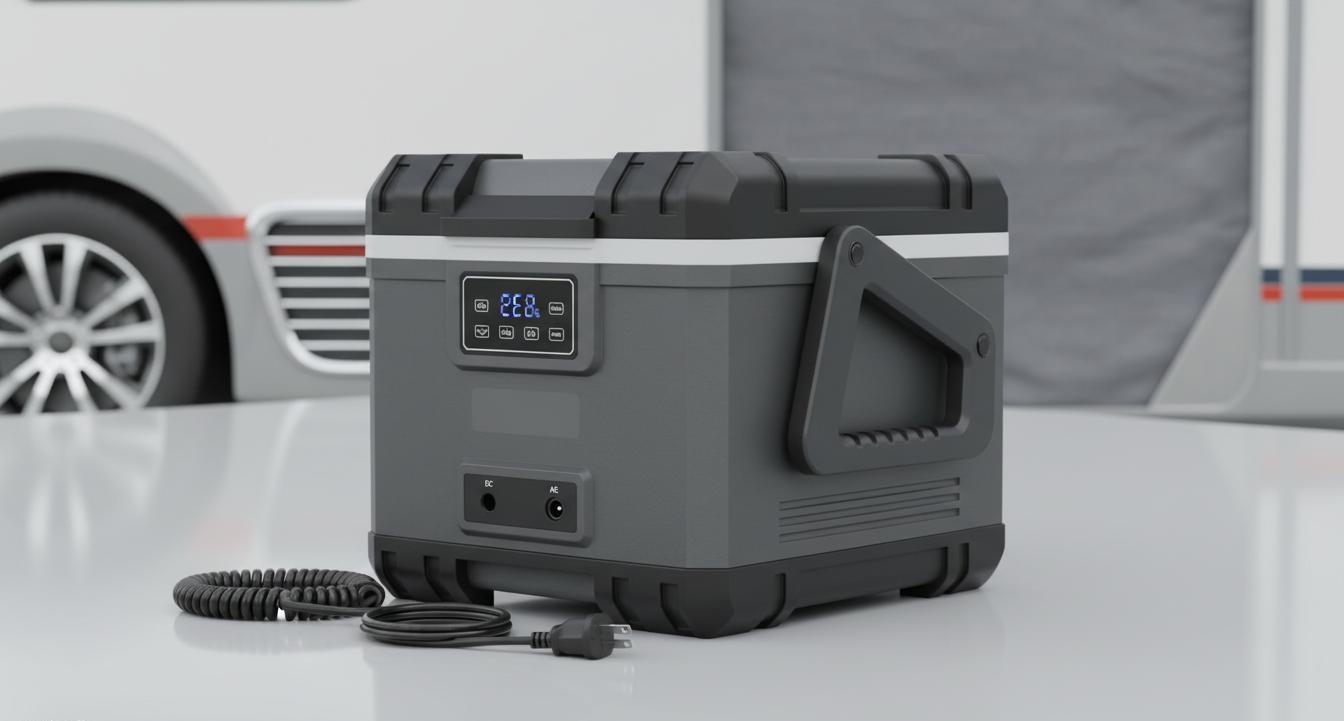
In 2022, an RV parts distributor I worked with sourced 800 thermoelectric car coolers for a new overland vehicle accessory line. They chose a supplier based on price — the units were USD 8 per unit cheaper than the market rate. By month six, they had received 340 warranty claims. The units were failing at the DC power input socket: the supplier had used a low-quality barrel connector with a contact resistance that was acceptable at room temperature but that increased dramatically at the 40°C ambient temperatures inside an overland vehicle in summer. The connector overheated, the contact fused, and the fridge stopped working. The USD 8 per unit price saving was consumed by a warranty handling operation that cost USD 47,000 in service credits and brand reputation damage.
The lesson from that failure is the organizing principle for this article: for RV and automotive distributors sourcing mini car fridges, the specification discipline you apply before the purchase order is the specification discipline that determines whether your after-sales support operation is manageable or catastrophic. In this guide, I cover the cooling technology trade-offs, the DC power system specifications, the AC dual power requirements, the capacity selection framework, and the certification landscape for international distribution.
Cooling Technology: Thermoelectric vs. Compressor
The choice between thermoelectric (Peltier) and compressor cooling is the most fundamental specification decision in mini car fridge procurement. It determines the fridge’s cooling capability, its energy consumption, its reliability profile, and its shipping classification.
Thermoelectric (Peltier) Cooling
Thermoelectric cooling uses the Peltier effect: when DC current flows through a junction of two dissimilar semiconductor materials, one side absorbs heat and the other side releases it. The heat is moved from the cold side (inside the cooler) to the hot side (outside), where a fan expels it into the ambient air. Thermoelectric coolers have no compressor, no refrigerant, and no moving parts except the cooling fans. The practical cooling performance is 17–25°C below ambient temperature. In a 25°C air-conditioned room, the cooler interior reaches 0–8°C. In a 35°C vehicle interior on a summer day, the cooler interior reaches 10–18°C — adequate to keep drinks cold and food safe for a day, but not for freezing or multi-day fresh food storage.
The advantages of thermoelectric for automotive and RV applications are: no vibration (important for quiet operation in a cab or tent), no refrigerant (eliminates dangerous goods shipping classification), low energy consumption (40–80W at steady state), long component life (50,000–100,000 hours for the Peltier module), and simple electronics with few failure modes. The disadvantages are: cooling performance is limited by ambient temperature, not all thermoelectric units can reach safe food storage temperatures in hot climates without pre-cooling, and they are slow to cool down (2–3 hours to reach operating temperature from room temperature).
Compressor Cooling
Compressor coolers use the same vapor-compression refrigeration cycle as household refrigerators. A compressor pumps refrigerant through an evaporator (inside the cooler) where it absorbs heat and vaporizes, and through a condenser (outside) where it releases heat and condenses. Compressor coolers achieve true freezing (below 0°C) and can maintain -18°C interior temperature even in 40°C ambient conditions. For consumers who need to store frozen food, insulin, or other temperature-sensitive medical products, compressor is the correct technology choice.
The trade-offs for compressor coolers are significant for automotive use: energy consumption is higher (60–120W at steady state, with a start-up surge of 3–5× rated current); the compressor generates vibration and noise; the refrigerant (R134a or R600a) is classified as a hazardous material for international shipping (UN3480 for packaged refrigerant); and the compressor is a mechanical component with a service life of approximately 5,000–10,000 hours, versus 50,000–100,000 hours for a thermoelectric module.
For most RV and automotive distributor applications — where the cooler is used primarily for drinks, snacks, and short-term food storage in passenger vehicles and Class B/C RVs — the thermoelectric option is more appropriate. For commercial truck fleets, expedition vehicles, and marine applications where frozen food is required, the compressor option is worth the performance trade-off.
DC Power Systems: 12V, 24V, and Dual-Voltage
12V DC: Passenger Vehicles and Standard RVs
Twelve volt DC is the standard electrical system in passenger vehicles, light trucks, most SUVs, and Class A/B RVs built on truck chassis. The 12V system powers the starter battery, the ignition, and the accessories (lights, radio, power outlets). The car fridge typically draws from the accessory circuit — either through the 12V accessory socket (cigarette lighter) or hardwired to the distribution panel. For a 60W thermoelectric cooler, the current draw at 12V is 5A. This is within the capacity of standard 10A accessory circuits and standard 16AWG wiring for runs up to 3 meters.
The critical specification for 12V DC fridges is the low-voltage cutoff (LVC) setting. When a vehicle’s engine is off, the battery supplies the 12V accessory circuit. If a fridge draws 5A continuously without LVC protection, it will drain a standard 60Ah starting battery to the point where the vehicle cannot start in 12–24 hours depending on battery condition and initial state of charge. A properly specified fridge includes an LVC that disconnects the fridge from the battery when the battery voltage drops below a threshold (typically 10.5V for a 12V lead-acid battery). Some advanced units have programmable LVC settings that allow the user to set the cutoff voltage based on their battery type and capacity.
24V DC: Commercial Trucks and Long-Haul Vehicles
Twenty-four volt DC systems are standard in commercial trucks, buses, most European commercial vehicles, and some Class C RVs built on truck chassis. At 24V, the same power consumption (60W) draws only 2.5A — meaning the wiring can be thinner for the same voltage drop, and the system is more efficient over longer wiring runs (which matter in truck cabs with 5–8 meter wiring runs from the battery to the rear of the cab).
For distributors serving mixed fleets with both 12V and 24V vehicles, dual-voltage (12V/24V DC) fridges that automatically detect the input voltage and configure themselves accordingly are the correct specification. These units include wide-range DC input electronics that accept any voltage from 10V to 30V DC. When specifying dual-voltage units, verify: the automatic voltage detection works reliably (some low-quality units require manual voltage selection via a switch, which is unreliable in a vehicle environment), and the LVC setting is correct for both 12V and 24V systems (the voltage thresholds should scale appropriately).
AC 100-240V: The Dual Power Requirement
For RV and automotive distributors, the fridge that only works in the vehicle is only half as useful as the fridge that also works at the destination. AC 100-240V dual power capability — where the fridge includes an integrated AC/DC power supply that accepts any mains voltage from 100V to 240V at 50Hz or 60Hz — extends the product’s use case to: the RV park with grid hookup, the hotel room, the boat with shore power, the home kitchen, or the airport waiting area.
This dual-use capability is not just a convenience feature — it is a strong product differentiation argument for distributors marketing to the overland/touring lifestyle segment. A fridge that travels with the vehicle and also works at the destination eliminates the need for a separate cooler at the destination. That narrative — “one fridge for the journey and the arrival” — sells better at retail than a pure vehicle cooler.
When specifying AC dual power, verify: the AC adapter is included in the standard kit (not as a separate SKU), the input range is truly universal (100-240V, 50/60Hz — some adapters are 110-120V only and will be damaged by 230V mains), and the AC and DC inputs can be connected simultaneously without damage (some units have a priority circuit that selects AC when available and switches to DC when AC is disconnected).
Capacity Selection: Matching Physical Size to the Application
| Capacity | Typical Use Case | Fitment | Cooling Tech | Best For |
|---|---|---|---|---|
| 15–20L | Solo traveler, overland vehicle | Between seats, small cargo area | Thermoelectric | Drinks, snacks, personal medication |
| 20–30L | Couple, small family, weekend trips | Cupholder area, cargo floor | Thermoelectric | Drinks, food containers, fresh produce |
| 30–50L | Extended travel, expedition vehicle | Permanent installation, truck bed | Thermoelectric or Compressor | Multi-day food supply, frozen food (compressor only) |
| 50L+ | Marine, commercial fleet, extended RV | Permanent installation | Compressor | Full freezer capability, commercial use |
Key Specifications to Verify Before Procurement
Low-Voltage Cutoff and Battery Protection
This is the specification most commonly missing from budget mini car fridges and the most common cause of field failures. The LVC must be present, must be adjustable or correctly set for the battery type in the target vehicle, and must have a reconnect hysteresis (the fridge should not reconnect to the battery until the battery voltage has recovered to a safe level, typically 12.8V for a lead-acid battery). Non-adjustable LVC at 10.5V is appropriate for starting batteries; for deep-cycle batteries, the LVC should be set no lower than 11.0V to avoid deep discharging the battery.
Insulation and Thermal Efficiency
The cooler body’s insulation thickness and quality determine how well the cooler maintains temperature when powered off and how quickly it recovers temperature after the door is opened. Standard thermoelectric coolers use EPS (expanded polystyrene) or PU (polyurethane) foam insulation with typical thickness of 25–40mm. Thicker insulation (40mm+) significantly improves thermal retention performance. When comparing products, the specification to look for is the “heat ingress” rate in W/K (watts per kelvin temperature difference) — lower is better. A cooler with 0.8 W/K heat ingress will perform significantly better than one with 1.5 W/K at the same cooling capacity.
DC Power Connector Quality
The DC power input connector is the failure point I see most frequently in field assessments of thermoelectric car coolers. The barrel jack connector used on most car fridges has a contact resistance that increases with temperature and with mating cycle wear. At 5A continuous current, a connector with 50 milliohms of contact resistance dissipates 1.25W at the connector — enough to cause significant heating at the contact surface, leading to oxide buildup, increased resistance, and eventual failure. To prevent this: specify fridges with high-quality locking DC connectors (not friction-fit barrel jacks), or specify fridges with hardwired DC connections (no connector at the fridge) that connect to the vehicle wiring via a terminal block.
Certifications and Regulatory Requirements
For international distribution of mini car fridges, the certification requirements fall into three categories:
- Electrical safety and EMC: CE marking (EU LVD + EMC Directives), ETL/UL listing (North America per UL 60335-1), and UKCA marking (UK). These are mandatory for market access and must cover the specific product model — request the test report, not just the certificate.
- Hazardous materials (compressor models only): Refrigerant-containing units (R134a or R600a) are classified as UN3480 dangerous goods for international maritime shipping. This significantly increases shipping costs and requires special handling documentation. Thermoelectric models without refrigerant avoid this classification entirely.
- Vehicular/automotive standards: For OEM fitment or fleet specification, some markets require e-mark or equivalent type approval under UNECE Regulation 10 (electromagnetic compatibility of vehicles). This is a procurement specification item, not a general market requirement.
The Distributor Procurement Checklist
- ☐ Cooling technology: thermoelectric (no freeze) vs. compressor (true freeze) — select based on whether the end application requires frozen food storage
- ☐ DC voltage compatibility: 12V, 24V, or dual-voltage auto-detect — match to the target vehicle fleet’s electrical system
- ☐ Low-voltage cutoff: present, adjustable, and correctly set for the target battery type — this is non-negotiable for vehicle installation
- ☐ AC power capability: 100–240V universal input included in standard kit (not a separate SKU) — verify AC/DC auto-switching behavior
- ☐ DC connector type: locking connector or hardwired preferred over friction-fit barrel jack for durability in vehicle environments
- ☐ Insulation specification: ask for heat ingress rate (W/K) — lower values indicate better thermal efficiency and longer cold retention when powered off
- ☐ Certifications for target markets: CE (EU), ETL/UL (North America), UKCA (UK) — request the specific test report for the model being ordered
- ☐ MOQ and customization: standard MOQ is 500 units; custom color or logo typically requires 1,000+ units for injection molding tooling amortization
- ☐ Sample evaluation: request 2–4 sample units for physical testing (DC connector durability, LVC behavior, AC/DC switching) before committing to volume
- ☐ Warranty scope and defect policy: standard 12 months; negotiate defect handling freight allocation and spare parts availability before signing the distribution agreement
Conclusion: The Specification Discipline That Protects Your Margin
The mini car fridge market has a wide quality spectrum, and the difference between a well-specified product and a budget product is almost entirely invisible at the point of purchase. The DC connector that fails at 18 months, the LVC that is set incorrectly for deep-cycle batteries, the AC adapter that burns out at 230V because it was only rated for 120V — these are not visible in a specification sheet comparison, but they are very visible in your after-sales support operation.
The procurement discipline that protects your margin is straightforward: verify the LVC behavior with a sample unit on a real battery, verify the DC connector durability under load at elevated temperature, and confirm the certifications cover the specific product model and the specific target market. The USD 3–5 per unit you spend on a thorough sample evaluation is the most cost-effective quality control investment you will make in the procurement cycle.
Ningbo Iceberg Electronic Appliance Co., Ltd. manufactures mini car fridges and cooler boxes including 15L–50L thermoelectric and compressor models with DC 12V/24V and AC 100–240V dual power systems. The specifications and procurement checklist in this article apply to any mini car fridge or cooler box sourcing project regardless of which supplier you select.
Disclaimer: This article provides general industry guidance for RV and automotive distributors sourcing mini car fridges and cooler boxes wholesale. Technical specifications (thermoelectric cooling technology, DC power systems, compressor refrigeration), certification requirements (CE, ETL, UL, UKCA, UN3480), and commercial parameters are based on general industry knowledge and should be verified against the specific product model and target market requirements before procurement. Low-voltage cutoff settings must be verified against the specific vehicle battery type and capacity. International shipping requirements for refrigerant-containing products must be confirmed with a qualified dangerous goods logistics provider. Product liability and warranty terms should be confirmed in the purchase agreement with the supplier.
Post time: May-26-2026