

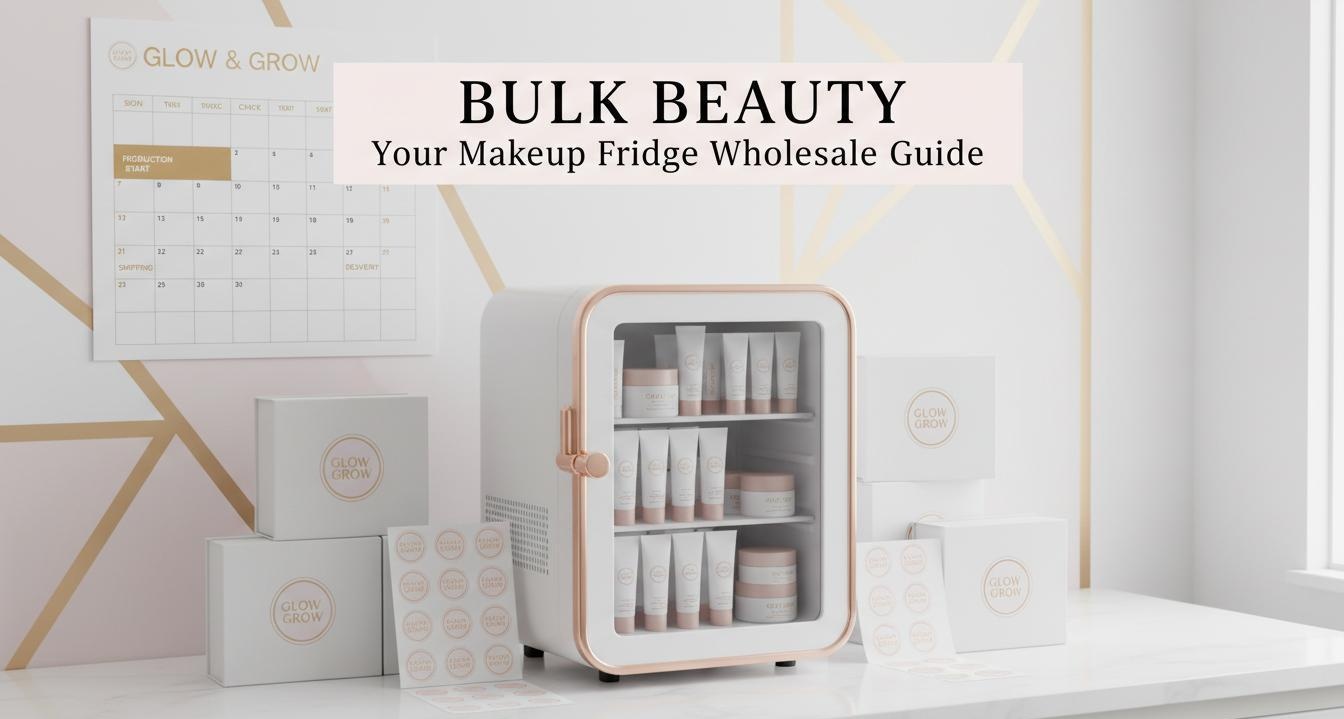
TL;DR
- MOQ ranges from 50 units for standard catalog models to 500 units for fully customized units with tooling modifications.
- Standard production lead time is 25-35 days; customized orders with packaging or specification changes require 35-45 days.
- Three packaging tiers available: color gift box (1pc/box), PDQ retail display, and export carton for bulk shipping.
- Standard payment terms structure is 30% deposit + 70% balance before shipment; Letter of Credit options available for orders exceeding $10,000.
- Design change requests must be submitted during the design confirmation phase (first 3-5 days) to avoid 10-20% premium costs and 7-15 day timeline extensions.
Procurement professionals seeking to establish reliable supply chains for makeup mini fridges face a critical challenge: translating vague order intentions into complete, executable purchase orders that factories can actually produce. The difference between a smoothly executed bulk order and a problematic one often lies not in the product itself, but in the precision of the initial inquiry and the clarity of specifications provided to the manufacturing partner. This comprehensive guide provides the operational framework necessary to execute successful bulk orders with Chinese makeup fridge manufacturers, covering the full lifecycle from initial inquiry through final delivery.
The makeup mini refrigerator market has experienced substantial growth since 2020, driven by increasing consumer awareness of proper cosmetics storage and the viral popularity of skincare routines featuring temperature-sensitive products. Professional buyers understand that successful bulk procurement requires more than simply requesting a unit price it demands mastery of minimum order quantities, production timelines, packaging specifications, and payment structures that protect both buyer and seller throughout the transaction.
Why “I Want 100 Units” Is Not a Complete Purchase Order The Information a Factory Needs
A purchase order for makeup mini fridges must contain specific technical and commercial details to initiate production. The factory requires precise model specifications, exact quantity requirements, packaging preferences, destination market compliance requirements, payment terms, and shipping instructions. Without this complete information package, factories cannot provide accurate quotations, schedule production slots, or commit to delivery timelines.
The first critical piece of information is the exact model or specification of the makeup fridge being ordered. Buyers must determine whether they want a standard catalog model from the manufacturer’s existing tooling or a customized variant with modifications to dimensions, temperature range, voltage specifications, or cosmetic features. Standard models offer faster lead times and lower prices because tooling costs have already been amortized across previous production runs. Customized models require new tooling development or modifications to existing tooling, which adds 10-15 days to the timeline and typically requires higher minimum order quantities to justify the setup investment.
According to industry standards established by the UNECE Trade Facilitation body, clear product specifications prevent the majority of production disputes. The specification sheet should include the following elements: rated voltage and frequency (typically 220-240V for European markets or 110-120V for North American markets), temperature range specification (typically 5-20C for makeup refrigerators, distinguishable from standard refrigeration at 2-8C), internal capacity in liters, exterior dimensions in millimeters, door type (solid door versus transparent door), and frost-free or manual defrost preference.
The second required element is the destination market and any compliance requirements applicable in the buyer’s territory. Different markets mandate different certifications: products destined for the United States require UL or ETL listing, the European Union requires CE marking and RoHS compliance, Japan mandates PSE certification, and Australia requires SAA approval. Providing destination market information allows the factory to incorporate appropriate certification testing into the production timeline and pricing structure. Ordering without specifying destination requirements risks receiving products that cannot clear customs in the target market, resulting in costly returns or inventory write-offs.
The third essential specification is packaging requirements. The factory needs to know whether the buyer requires retail-ready gift box packaging for direct consumer sale, bulk export cartons for distributor fulfillment, or PDQ (Pop-Up Display Quick) units for countertop retail display. Each packaging type carries different unit costs, minimum order requirements, and implications for shipping volume calculations. The factory cannot provide accurate pricing without understanding the final packaging format required.
Finally, the purchase order must specify the shipping terms and destination. The Incoterms 2020 standards published by the International Chamber of Commerce define the allocation of risk and costs between buyer and seller at various points in the delivery chain. Standard options include Ex Works (EXW) where the buyer arranges all transportation from the factory gate, Free On Board (FOB) where the seller delivers goods onto the vessel at the named port of departure, or Cost Insurance and Freight (CIF) where the seller pays for transportation and insurance to the destination port. Each incoterm carries different cost implications and buyer responsibilities for customs clearance, inland transportation, and risk transfer timing.
MOQ Structure Explained: Why Some Models Start at 50 Units and Others at 500
Minimum Order Quantity (MOQ) represents the smallest production run a factory will accept for a specific product configuration. The MOQ structure exists because every production run involves setup costs including component procurement, production line configuration, quality inspection sampling, and packaging setup that must be absorbed across the units produced to achieve viable economics. Factories set MOQs to ensure that each order generates sufficient margin to justify the production slot allocation and setup overhead.
Standard catalog models with existing tooling typically carry MOQs of 50-100 units per model. These models represent products where the factory has already invested in molds, jigs, and production configurations, and those investments have been partially or fully amortized. The lower MOQ reflects the reduced setup burden the factory can produce these models with minimal reconfiguration between different orders. However, even standard models may carry higher MOQs if components are sourced from specialized suppliers with minimum purchase requirements or if the model requires temperature control systems with specific component configurations.
Customized models with specification modifications typically require MOQs of 200-500 units. Because customized orders require tooling modifications, supplier coordination for non-standard components, and potentially new quality inspection protocols, factories need sufficient volume to justify the additional administrative and technical overhead. The specific MOQ for a customized model depends on the extent of modifications required. Minor modifications such as custom color spraying or logo printing require lower MOQs (typically 100-200 units), while substantial modifications including altered dimensions, non-standard voltage configurations, or modified temperature ranges require higher MOQs (300-500 units) to offset engineering and retooling costs.
Private label and brand customization specifically typically starts at 200-300 units for established factories with private label programs. Private label orders often require tooling modifications to accommodate different brand elements, modified packaging production runs, and documentation updates all of which represent setup costs that must be absorbed across the production volume. Buyers seeking to test new branding with smaller quantities should consider ordering standard catalog units initially and applying custom stickers or packaging in their destination market as a lower-risk alternative.
The relationship between MOQ and unit pricing follows a generally inverse correlation: larger orders command lower per-unit pricing because fixed setup costs are distributed across more units and production line efficiency improves with longer runs. The pricing break typically occurs at tier thresholds of 200, 500, and 1,000 units per model. Buyers can optimize procurement economics by consolidating requirements across multiple models or timing orders to achieve volume tier pricing, or by discussing pricing incentives for first-time orders that establish long-term supply relationships.
According to US Commercial Service trade guidance, buyers should always negotiate MOQ terms directly with factories, because volume commitments often create opportunities for MOQ flexibility. Factories value repeat orders and long-term relationships, and may offer reduced MOQs for buyers demonstrating serious intent to establish ongoing procurement programs.
Lead Time Breakdown: Design Confirmation, Mold Setup, Production, QC and Shipment
Understanding the production lead time structure allows buyers to plan procurement programs that align with market windows, retail seasons, and promotional calendars. Standard makeup mini fridge production requires 25-35 days from deposit confirmation to shipment readiness, while customized orders extend to 35-45 days, and new mold development can require 45-60 days.
The design confirmation phase consumes 3-5 days for standard orders and 5-10 days for customized orders. This phase involves finalization of technical specifications, packaging design approval, quality inspection protocols, and documentation requirements. The factory prepares internal production work orders and procurement requests for components, while the buyer confirms specifications, approves packaging proofs, and provides final artwork files. Delays in design confirmation directly extend the overall timeline buyers who provide complete specifications with initial inquiries substantially accelerate this phase and often reduce overall lead times by 5-7 days.
The mold fabrication or modification phase applies only to orders requiring tooling changes and adds 10-15 days to the timeline. New mold development for substantially customized products requires 20-30 days, while modifications to existing tooling require 10-15 days. During this phase, the factory procures or modifies the tooling that defines product dimensions, creates component interfaces, and establishes overall construction. Tooling quality directly impacts production consistency rushing tooling development often results in production issues that cause downstream quality problems and delays.
Main production run typically requires 15-20 days for standard orders of 200-500 units. This phase includes component procurement (typically overlapping with design confirmation), assembly, wiring, temperature control system installation, and interior finishing. Production scheduling depends on factory capacity allocation larger factories with multiple production lines can often compress timelines, while smaller factories with constrained capacity may require longer lead times during peak seasons. Production typically operates on 2-3 shifts during high-volume periods, with single-shift production during slower periods.
Quality control inspection requires 2-3 days and should never be compressed or skipped. The inspection protocol includes functional testing of the temperature control system at various ambient temperatures, electrical safety testing per destination market standards, visual inspection for cosmetic defects, packaging integrity verification, and documentation review. Factories typically perform inspection on a statistical sampling basis (AQL 2.5 is standard for this product category), with 100% inspection available for higher-risk orders at additional cost. Pre-shipment inspection by third-party services like SGS or Intertek provides additional assurance for buyers unfamiliar with specific factories.
Final packaging and shipment preparation requires 2-5 days depending on packaging complexity. Standard gift box packaging requires 2 days, while PDQ display units and gift sets with multiple components require 3-5 days. This phase includes packaging assembly, unit insertion, carton sealing, palletizing, and export documentation preparation. Completed units await shipment instructions and release authorization before loading onto containers.
Ocean freight time varies substantially by destination, adding 7-35 days to door delivery. Shipping from Ningbo or Shanghai to major West Coast US ports requires 15-18 days, East Coast US ports require 25-30 days, European ports require 25-35 days, and Australian ports require 18-25 days. Air freight reduces shipping time to 3-7 days but increases costs by 4-6 times versus ocean freight, making air freight practical only for sample orders or urgent replenishments.
Packaging Customization Options: Color Box, PDQ Display, and Export Carton Designs
Packaging represents a critical differentiator in retail markets, directly impacting consumer perception, retail acceptance, and brand positioning. Chinese manufacturers offer three primary packaging tiers for bulk makeup fridge orders, each serving different market channels and carrying distinct cost and minimum order implications.
Color gift box packaging represents the premium tier, suitable for department stores, specialty retailers, and e-commerce fulfillment. Standard specifications include 4-color offset printing on 350g duplex cardstock, matte or gloss lamination for durability and premium appearance, spot UV treatment on logo areas for visual differentiation, and custom foam or blister inserts securing the unit and accessories. Color box tooling (printing plates) requires a one-time setup fee typically ranging from $300-500 for 4-color processing, which is amortized across the order volume. Color box packaging adds $2-4 per unit to the product cost depending on specifications and volume.
The PDQ (Pop-Up Display Quick) format represents the retail execution tier, designed for immediate retail placement without additional shelf display requirements. PDQ units are self-standing countertop displays with integrated header card, window cutouts displaying the product, and hang-tag provisions for retail scanning systems. These displays typically accommodate 4-12 units per display and include branded header cards carrying product features and benefits. PDQ packaging typically adds $1.50-3.00 per unit compared to export carton packaging and may carry minimum order requirements of 200-500 units to justify display tooling fabrication.
Export carton packaging represents the most economical tier, designed for distributor fulfillment and retail repacking. Standard specifications include 5-layer corrugated cardboard with moisture-resistant coating, unit cradle packaging with cardboard supports, and pallet-stacking compatibility for efficient freight. Export cartons typically accommodate 2-4 units per carton depending on unit dimensions, with each carton weighing 15-25kg including product weight. Export packaging is included in standard product pricing and requires no additional setup fees or minimum order quantities.
Customization options extend beyond the basic packaging tier to include specific features. Brand label application involves either paper labels (applied to unit or packaging) requiring $50-100 setup per design, or metal/plastic badges requiring $200-500 tooling per badge design. Color customization of the unit itself involves either standard color options from existing spray-paint lines (typically no additional cost for standard colors like white, pink, or silver) or custom color matching requiring $500-1,000 setup for color matching and potentially 200+ unit minimums.
According to ISO quality management standards for packaging, buyers should request packaging specifications and sample packaging prior to bulk production. Packaging failures result in in-transit damage, retail returns, and brand damage problems that are substantially more expensive to remedy after production than to prevent through specification and inspection.
Accessory packaging represents a frequently overlooked specification area. Standard accessories include power cord, instruction manual, and sometimes sample cosmetic organizers or removable shelves. Custom accessory sets (branded cosmetics bags, premium organizers, etc.) add 2-5 days to packaging lead times and typically carry $1-3 per unit cost premiums. Buyers targeting premium retail channels should consider custom accessory packaging as a brand differentiation mechanism.
Payment Terms That Protect You: 30% Deposit, 70% Before Shipment, and Letter of Credit Options
Payment terms represent the commercial framework governing financial exchanges between buyer and factory. Standard payment terms for bulk makeup fridge orders follow a 30% deposit + 70% balance structure before shipment, with the deposit securing production scheduling and raw material procurement while the balance is paid after pre-shipment inspection approval.
The 30% deposit serves multiple protective functions for the buyer. First, it demonstrates serious purchase intent, preventing factories from holding production slots for buyers who may not follow through. Second, it provides working capital for raw material procurement many specialized components require advance payment to suppliers and the deposit enables the factory to procure these components. Third, it creates financial commitment that incentivizes the factory to complete production on schedule. Deposits are typically non-refundable under standard terms, reflecting the costs the factory incurs upon order confirmation.
The 70% balance payment is made after pre-shipment quality inspection and before bill of lading release. This structure protects the buyer by ensuring products pass inspection before final payment, while also protecting the factory by ensuring payment before releasing the goods. Standard practice involves the factory providing inspection report with photographs and test results, followed by buyer approval or rejection, followed by balance payment, followed by factory releasing goods to the shipping line.
Letter of Credit (LC) arrangements provide additional security for larger orders typically exceeding $10,000. An LC is a bank guarantee that payment will be made upon presentation of compliant shipping documents, adding bank verification to the payment process and reducing buyer counterparty risk. LC options include Sight LC (payment upon document presentation, 1-5 days processing), Time LC (payment at 30 or 60 days after shipment, providing buyer float), and Revolving LC (establishing a credit line for ongoing orders). LC costs typically range from 0.5-1.5% of the order value depending on bank relationships and LC terms.
Escrow services like Payoneer or Alibaba Trade Assurance provide third-party payment hold for buyers without established factory relationships. These services hold payment in a secure account, releasing funds to the factory only upon buyer approval of inspection documentation or receipt of goods. Escrow fees typically range from 1-3% of transaction value and represent effective insurance against factory non-delivery or quality disputes for first-time buyers.
Payment method specifications vary by order size and buyer preference. Telegraphic Transfer (T/T) represents the most common method for bulk orders, with the buyer initiating bank transfer directly to the factory’s account. PayPal accepts orders under $500 but carries 4-5% transaction fees making it impractical for bulk orders. Western Union applies only to sample orders and carries substantial fraud risk for larger orders.
According to global export procedures, buyers should always request pre-shipment photo and video documentation before balance payment, regardless of payment method. Professional buyers require inspection photographs showing serial numbers, packaging labels, and unit condition, accompanied by temperature test readings documenting operational performance. Third-party inspection services like SGS or Bureau Veritas provide additional verification at costs typically ranging from $300-600 per inspection day.
Payment timing creates natural leverage dynamics that both parties should understand. Factories prefer higher deposits and earlier balance payments because these reduce collection risk. Buyers prefer lower deposits and balance payments upon receipt or after inspection approval because these increase control. Negotiated payment terms reflect the relative bargaining power of the parties established buyers with track records and volume commitments secure more favorable terms, while first-time buyers typically accept more conservative structures until relationships develop.
Change Order Management: How to Handle Revisions Without Killing Your Timeline
Design and specification changes during production represent one of the most common sources of procurement disputes and timeline disruptions. Effective change order management requires understanding the factory’s change request procedures, the cost and timeline implications of different change timing, and the documentation practices that protect both parties.
The critical principle is that change request timing directly determines the cost and timeline impact. Changes submitted before production commencement typically incur minimal or no fees (5-10% of order value at most) because the factory has not yet committed production resources. These changes affect documentation and procurement only, with minimal impact on production timelines. The window for these changes closes rapidly typically within 3-5 days of deposit confirmation, before the factory finalizes component procurement and production scheduling.
Changes submitted during active production create substantial impacts. Production line reconfiguration requires stopping active production, retooling, and restarting each step consuming time and creating opportunity costs. Engineering changes require modified components, potentially requiring second procurement runs for substitute parts while holding existing components in inventory. Factory labor must be reassigned from productive work to change implementation. Changes during production typically add 7-15 days to the timeline and cost 10-20% of order value as a change premium.
Changes submitted after production completion and before shipment are typically impractical to implement. The product has been completed, inspected, and packaged disassembling and modifying completed units typically costs more than production itself and may damage finished goods. Post-production changes require factory agreement and substantially higher premiums (25-50% of order value), with no guarantee of satisfaction.
The change order formalization process protects both parties. Professional factories require written change order documentation specifying the change description, agreed cost impact, agreed timeline impact, and buyer signature acknowledging acceptance. The change order should reference the original purchase order number and specify effective dates. Verbal discussions create ambiguity and dispute potential written confirmation provides clarity and reference.
Best practices for minimizing change order impacts include the following: thoroughly reviewing specifications during the initial inquiry phase rather than assuming factory defaults, requesting pre-production samples for final specification approval before bulk production, maintaining written (email) documentation of all specification discussions, and building timeline buffers into the procurement calendar to provide cushion for unforeseen changes without missing market windows.
According to US Export.gov guidance, foreign suppliers often resist change requests after production begins because these disrupt scheduling, potentially affecting other orders and factory reputation with other buyers. Professional buyers understand that the cost to make changes before production is minimal compared to the cost of changes during production specification precision during the design confirmation phase represents both cost control and timeline protection.
Last updated: 2026-05-20
For bulk order execution, buyers can compare Aisberg’s beauty fridge, skincare mini fridge, and car mini fridge ranges, while using Incoterms 2020, SGS inspection services, and Intertek inspection services to confirm shipping terms and pre-shipment verification.
Post time: May-20-2026