

TL;DR — Key Takeaways
- A standard Chinese factory purchase order template typically protects the factory, not the buyer — it contains clauses that limit the factory’s liability to a maximum of the order value (US$5,000 liability cap on a US$50,000 order), exclude liability for consequential damages (lost profits, customer claims, brand damage), and require disputes to be resolved in the factory’s local court under Chinese law, 10,000km from the buyer’s jurisdiction.
- The Acceptable Quality Level (AQL) sampling standard is the most misunderstood and most consequential contract clause — a buyer who specifies AQL 2.5 (industry standard for general products) is accepting up to 2.5% defective units as normal, which means a 1,000-unit order could contain 25 defective units at no legal recourse for the buyer, while an AQL 1.0 specification reduces the acceptable defect count to 10 units and costs only US$0.50-1 per unit more in inspection fees.
- The ten contract provisions every mini fridge buyer must include are: written product specification with acceptable tolerance ranges, AQL sampling plan and defect classification criteria, warranty scope and return logistics cost allocation, defect remediation sequence (repair/replace/refund timeline), third-party inspection right, IP protection clause, audit right for production records, minimum production capacity guarantee, force majeure definition, contract termination clauses, and confidentiality provisions.
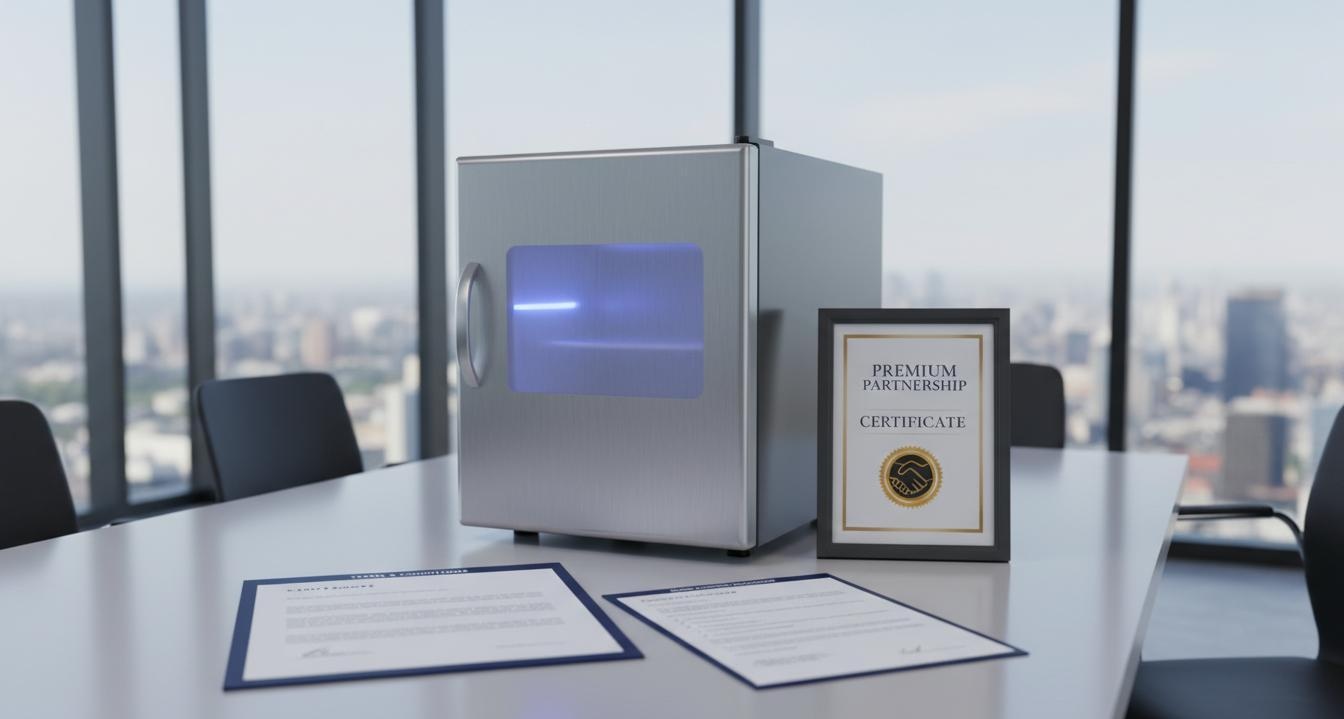
Why a Standard Purchase Order Is Not a Contract — The Clauses That Actually Protect You
I have managed OEM contract negotiations at Aisberg Electric for twelve years, and the most expensive lesson I have seen a first-time international buyer learn is that a Chinese factory’s standard Purchase Order (PO) template is a document designed to protect the factory — not the buyer — and that signing it without understanding its implications exposes the buyer to liability that cannot be recovered after the goods ship. The factory’s standard PO typically contains provisions that are unfavorable to the buyer in ways that are not obvious: a liability cap that limits the factory’s total liability to the value of the order (meaning a factory that delivers 500 defective units causing US$100,000 in customer returns is legally liable for no more than the US$50,000 they received for the order), a consequential damages exclusion that eliminates the factory’s liability for the buyer’s lost profits, customer claims, and brand reputation damage (the exact losses that dwarf the value of the defective goods themselves), a dispute resolution clause that requires all disputes to be resolved in the factory’s local court in Ningbo, China, under Chinese law — meaning the buyer must hire Chinese lawyers, travel to China, and navigate the Chinese legal system to enforce any judgment, and a governing language clause that makes the English version of the contract non-binding if there is any discrepancy with the Chinese version (which the factory will always interpret in their favor).
The negotiation before signing is not adversarial — it is a standard part of international OEM business, and any reputable factory expects it. At Aisberg Electric, we provide our clients with a buyer’s contract review checklist before negotiations begin, and we walk our clients through each clause and explain what it means in practical terms. The key principle: every clause that limits the factory’s liability also limits the buyer’s recourse. A contract that makes disputes easy to resolve (neutral arbitration, English-language proceedings, buyer’s local jurisdiction) costs the factory nothing — it simply makes the contract fairer for both parties. If a factory refuses to negotiate on a clearly one-sided clause, that refusal itself is a red flag about the factory’s reliability. At Aisberg Electric, our standard contract templates have been reviewed by international trade law specialists and include balanced provisions that protect both parties — because we have found that buyers who feel fairly treated by their supplier are more likely to be long-term, repeat-order clients.
Warranty Terms: Factory Standard (1 Year) vs Extended (2-3 Years) and Who Pays for Returns
The standard warranty offered by Chinese mini fridge factories is 12 months from the date of shipment — this is a manufacturer warranty that covers the repair or replacement of defective components, but it typically excludes all shipping costs for warranty returns, which means that a buyer in the US or EU who receives a defective unit must pay US$20-40 to ship it back to the factory in China for repair. For a 1,000-unit order with an expected defect rate of 1-2%, the buyer can anticipate approximately 10-20 defective units over the warranty period. At US$30 average return shipping cost per unit, the total warranty return shipping cost is US$300-600 — not a catastrophic amount, but a cost that is rarely anticipated at the order stage and that must be factored into the total cost of ownership. The factory’s warranty also typically does not cover: damage caused by the buyer (incorrect voltage, physical damage, unauthorized modification), wear-and-tear items (door seals, light bulbs, scratches), or defects caused by third-party logistics damage — the buyer must prove the defect existed before shipment, which requires pre-shipment inspection documentation.
An extended warranty of 24 or 36 months costs approximately 3-5% of the unit price added to the order — on a US$50 unit, this is an additional US$1.50-2.50 per unit, or US$1,500-2,500 on a 1,000-unit order. The extended warranty is commercially justified when: the buyer is selling the product with their own brand warranty to end customers (extended warranty protects the buyer from claims during the customer warranty period), the product is installed in a commercial environment with high usage intensity (hotel mini bar, office kitchenette, medical facility) where failure rates are higher than consumer use, and the buyer has limited technical repair capability and needs the factory to handle all warranty claims. At Aisberg Electric, we offer 12-month standard warranty, 24-month extended warranty (adds 3% to unit price), and 36-month comprehensive warranty (adds 5% to unit price). All warranty terms include: free replacement of defective components (parts and labor), factory pays return shipping for defective units confirmed to have manufacturing defects (verified by our QC team with photographic documentation before return authorization is issued). Warranty claim process: buyer submits claim with photos and serial number, factory issues return authorization within 48 hours, defective unit shipped to factory’s repair center, repaired unit returned within 14 days of receipt.
AQL Sampling Standards: 2.5 vs 1.5 vs 1.0 and What Each Level Means for Defect Rates
The Acceptable Quality Level (AQL) is the cornerstone of quality control in international manufacturing — it defines the maximum percentage of defective units that the buyer will accept as “normal” in a production run, and it determines the sample size used in the pre-shipment inspection. The AQL system (based on ISO 2859-1 / ANSI Z1.4) works as follows: for a given lot size (e.g., 1,000 units), the inspection sample size is determined from a sampling table (sample size code letter, e.g., “G2″ for a lot of 1,201-3,200 units, which corresponds to a sample of 50 units). The AQL level specifies the acceptance number (Ac) — the maximum number of defective units in the sample that will still allow the lot to pass inspection. For AQL 2.5 (the standard for general-use products), a sample of 50 units allows 3 defects (Ac=3, Re=4 — if 4 or more defects are found, the lot fails). For AQL 1.5 (a stricter standard used for electronics and higher-value products), the same sample of 50 units allows only 2 defects (Ac=2, Re=3). For AQL 1.0 (very strict, used for medical devices and safety-critical products), a sample of 50 units allows only 1 defect (Ac=1, Re=2).
Here is the practical meaning: at AQL 2.5 on a 1,000-unit order, you are legally accepting up to 2.5% defective units as normal — 25 units on a 1,000-unit order. At AQL 1.5, you accept up to 15 defective units as normal. At AQL 1.0, you accept up to 10 defective units as normal. Critically, these are “acceptable” defect levels under the contract — if the defect rate is within the AQL, the buyer has no contractual recourse to reject the lot or claim compensation. The cost of AQL 1.0 versus AQL 2.5 is approximately US$0.50-1 per unit more in inspection fees (because the inspector must be more thorough and the inspection takes longer), but it reduces the maximum acceptable defect rate from 2.5% to 1.0% — saving the buyer from approximately 15 defective units per 1,000 on average. At a US$30 cost per defective unit (shipping, replacement, administration), 15 defects represents US$450 in avoided costs per 1,000 units — more than offsetting the US$500-1,000 additional inspection cost. At Aisberg Electric, we recommend AQL 1.5 for standard consumer products and AQL 1.0 for medical-grade and commercial-use products, and we provide the complete AQL sampling plan table as part of the contract documentation package. For more on quality management, see our article on compressor car fridge 12V/24V specifications.
Defect Classification: Critical vs Major vs Minor and How Each Triggers Different Remedies
The AQL system alone is insufficient — the contract must also define a defect classification system that distinguishes between defect types and assigns different remedies based on severity, because not all defects have equal impact on the product’s functionality, safety, and marketability. The standard defect classification for consumer electronics and appliances: Critical defects are safety hazards that could cause injury or property damage — a compressor with a cracked housing that could cause electrical short-circuit and fire, a 120V product with reversed polarity wiring that could shock a user, a door glass that could shatter unexpectedly. Critical defects require immediate lot rejection regardless of AQL — the entire lot cannot be shipped, and the factory must correct and re-inspect at its own cost before the lot can be released. Major defects are functional failures that prevent the product from performing its intended function — a compressor that does not cool, a door that does not close properly, a thermostat that is inaccurate by more than 3C. Major defects are counted against the AQL limit and trigger lot rejection if the acceptance number is exceeded. Minor defects are cosmetic or functional issues that do not materially affect the product’s usability — a visible scratch on the rear panel that is not visible when installed, a color variation between the door and cabinet within the specified tolerance, a screw that is not fully tightened. Minor defects are typically counted against a separate minor AQL limit (often AQL 4.0 or 6.5) that is less stringent than the major defect limit.
The contract must specify the defect classification criteria with concrete examples so that both parties have a shared understanding — without this, a factory will classify every defect as minor, and a buyer will classify every defect as critical. At Aisberg Electric, we provide a defect classification matrix as part of the contract documentation: each defect type (compressor failure, door seal failure, electrical safety failure, cosmetic damage) is pre-classified as Critical, Major, or Minor, with photographic examples and the corresponding remedy (lot rejection, individual replacement, price reduction). This matrix becomes part of the binding contract and eliminates the classification disputes that typically arise after an inspection report is issued. For a full review of international commercial terms, see our article on product quality management standards.
QC Inspection Clauses: Pre-Shipment Inspection Rights and Third-Party Inspector Options
The pre-shipment inspection (PSI) is the buyer’s primary quality assurance mechanism in an international order — it is the final opportunity to identify defects before the goods are loaded onto the shipping container and disappear beyond the buyer’s reach. The contract must specify the buyer’s right to conduct a PSI, the timeline and notice requirements (the factory must provide at least 5 working days notice of the ready-for-inspection date, so the buyer can arrange an inspector), the inspection standards (AQL level, defect classification criteria, test procedures), and the consequences of PSI failure (if the lot fails PSI, the factory must correct all identified defects and present the lot for re-inspection at the factory’s cost). The PSI typically covers: product (exterior inspection — packaging, markings, visible damage), functional testing (cooling performance, noise level, electrical safety), and quantity verification (unit count per carton, packaging integrity). The inspector uses a randomized sampling plan based on the AQL level specified in the contract.
The third-party inspector options for buyers sourcing from China: SGS (Société Générale de Surveillance), Intertek, Bureau Veritas, and TÜV Rheinland or TÜV SÜD — these are the four largest international inspection companies with offices in all major Chinese manufacturing cities and inspectors available within 48 hours of booking. The inspector’s report is an independent, internationally recognized document that can be used as evidence in disputes with the factory. The cost of a PSI for a 1,000-unit order is approximately US$300-600 (depending on inspection company, inspection duration, and whether special testing (electrical safety, EMC) is required). The contract should specify: the buyer has the right to appoint any third-party inspection company, the factory must provide reasonable access to the goods for inspection during normal business hours, the factory must make available a representative to accompany the inspector during the inspection, and the factory must retain a representative sample of at least 5 units from the production lot for a period of 90 days after shipment for potential re-testing in case of field complaints. At Aisberg Electric, we maintain a pre-shipment inspection protocol as standard practice for all orders above 200 units — we notify the buyer 7 days before the inspection, we welcome third-party inspectors, and we provide a video inspection option (live-streamed by our QC team to the buyer’s designated inspector) for clients who cannot travel to China in person.
The 10 Contract Provisions Every Buyer Should Include: Complete Checklist
The ten essential contract provisions for international mini fridge OEM contracts, with specific language targets for each provision:
1. Product Specification with Tolerances: The contract must attach a detailed product specification sheet defining all dimensions, materials, performance parameters (cooling capacity in watts, temperature stability in °C, noise level in dBA), and acceptable tolerance ranges (e.g., internal capacity: 4.0L ±0.1L, not just “4.0L”). Any change to the specification requires a written change order signed by both parties before production.
2. AQL Sampling Plan and Defect Classification: Specify the AQL level (recommend 1.5 for mini fridges), the sample size table reference (ISO 2859-1), the defect classification matrix (Critical/Major/Minor with examples), and the inspection procedures (ANSI Z1.4 sampling procedures). Include the specific inspection checklist as an attachment.
3. Warranty Scope and Return Logistics: Define warranty period (recommend 24 months minimum for commercial products), what is covered (manufacturing defects in materials and workmanship), what is not covered (buyer-caused damage, wear items, third-party logistics damage), and critically — who pays for return shipping on defective units under warranty. Recommend: factory pays return shipping for confirmed manufacturing defects, buyer pays return shipping for no-defect returns (misuse by end customer).
4. Defect Remediation Sequence: Define the sequence of remedies when defective units are identified: (1) factory repair at buyer’s location (for minor defects), (2) factory repair at factory (for major defects, factory pays return shipping), (3) replacement of defective units with conforming units (for Critical defects or repeat Major defects), (4) price reduction (for minor cosmetic defects, typically 5-15% of unit price), (5) refund (only for complete non-conformity or repeated failure). Define timelines for each step (repair: 14 days, replacement: 30 days).
5. Third-Party Inspection Right: Buyer has the right to appoint a third-party inspector (SGS, Intertek, Bureau Veritas, or equivalent) for pre-shipment inspection. Factory must provide 5 working days notice of ready-for-inspection date. If inspection fails, factory corrects all defects at factory cost and presents for re-inspection.
6. Intellectual Property Protection: The buyer’s brand name, logo, product designs, and custom specifications are confidential and may not be disclosed to third parties or used by the factory for any purpose other than fulfilling the buyer’s orders. This provision survives contract termination by 5 years.
7. Production Audit Right: Buyer has the right to audit the factory’s production records for the buyer’s orders, including component sourcing records, QC inspection records, and production output data, upon 14 days written notice. This prevents the factory from substituting components (e.g., using a cheaper compressor than specified) without the buyer’s knowledge.
8. Minimum Production Capacity Guarantee: For buyers with long-term supply agreements, the contract should specify the factory’s minimum monthly production capacity commitment for the buyer’s product model — preventing the factory from dropping the buyer’s product in favor of higher-margin orders during peak production periods.
9. Force Majeure and Termination: Define force majeure events (earthquake, government actions, pandemic) that excuse either party from performance. Define termination rights: buyer may terminate with 30 days notice and 50% deposit refund if production has not started, or with partial refund based on stage of completion if production is underway. Factory may not subcontract the order without buyer’s written consent.
10. Dispute Resolution and Governing Law: Specify ICC (International Chamber of Commerce) arbitration in a neutral location (Singapore or Hong Kong recommended) under ICC Rules — faster, more neutral, and more enforceable internationally than local court litigation. Governing law: UN Convention on Contracts for the International Sale of Goods (CISG), which provides a balanced framework for international sales contracts without favoring either party’s domestic law.
Frequently Asked Questions
- Q1: What warranty terms should I negotiate when ordering mini fridges from China?
- Minimum 24 months for commercial-use products (hotels, offices). Warranty must cover manufacturing defects in materials and workmanship — specify that the factory pays return shipping for confirmed manufacturing defects (this is the most commonly disputed clause). Define what is not covered (buyer misuse, unauthorized modification, third-party logistics damage) and include a defect classification matrix (Critical/Major/Minor) so both parties agree on what triggers warranty coverage.
- Q2: What is AQL sampling and what level should I require for mini fridge inspections?
- AQL (Acceptable Quality Level, ISO 2859-1/ANSI Z1.4) defines the maximum defect rate the buyer legally accepts as normal in a production lot. AQL 2.5 accepts up to 2.5% defects (25 per 1,000 units). AQL 1.5 accepts up to 1.5% defects (15 per 1,000). AQL 1.0 accepts up to 1.0% defects (10 per 1,000). Recommend AQL 1.5 for standard consumer products, AQL 1.0 for medical-grade or commercial-use products. The difference in inspection cost is US$0.50-1 per unit — the defect reduction saves far more in avoided warranty costs.
- Q3: How do I structure QC clauses to protect my mini fridge order?
- Five essential QC clauses: (1) AQL 1.5 minimum, with ISO 2859-1 sampling tables and a defect classification matrix (Critical/Major/Minor) attached as a contract exhibit. (2) Pre-shipment inspection right — buyer appoints third-party inspector (SGS, Intertek, Bureau Veritas) with 5-day notice from factory. (3) If PSI fails, factory corrects all defects at factory cost and presents for re-inspection. (4) Factory retains 5 units as reference samples for 90 days post-shipment. (5) Production audit right — buyer can audit factory’s production records for the buyer’s orders upon 14 days notice.
- Q4: What defect rate should I accept in mini fridge bulk orders?
- AQL 1.5 means up to 1.5% Major/Critical defects are contractually acceptable (15 per 1,000 units). AQL 1.0 is stricter (10 per 1,000). Minor defects (cosmetic, cosmetic scratches) are typically governed by a separate AQL 4.0 (40 per 1,000) — do not apply the general AQL to minor cosmetic defects or you will be contractually accepting a very high cosmetic defect rate. Always include a defect classification matrix in the contract so both parties agree on what is Critical, Major, and Minor before production begins.
- Q5: What contract provisions protect buyers in Chinese mini fridge OEM agreements?
- Ten essential provisions: (1) Detailed product spec with tolerance ranges as contract attachment. (2) AQL 1.5 with ISO 2859-1 sampling plan and defect classification matrix. (3) 24-month warranty with factory pays return shipping on manufacturing defects. (4) Defect remediation sequence (repair/replace/refund timeline). (5) Third-party inspection right (SGS/Intertek/Bureau Veritas). (6) IP protection clause (5-year survival). (7) Production audit right. (8) Minimum production capacity guarantee. (9) Force majeure and termination rights. (10) ICC arbitration in neutral location (Singapore/Hong Kong) under CISG governing law.
External References: ICC International Arbitration · CISG UN Sales Convention · ISO 2859-1 Sampling · ANSI Z1.4 Sampling · SGS Inspection · Intertek Testing
Post time: May-20-2026