

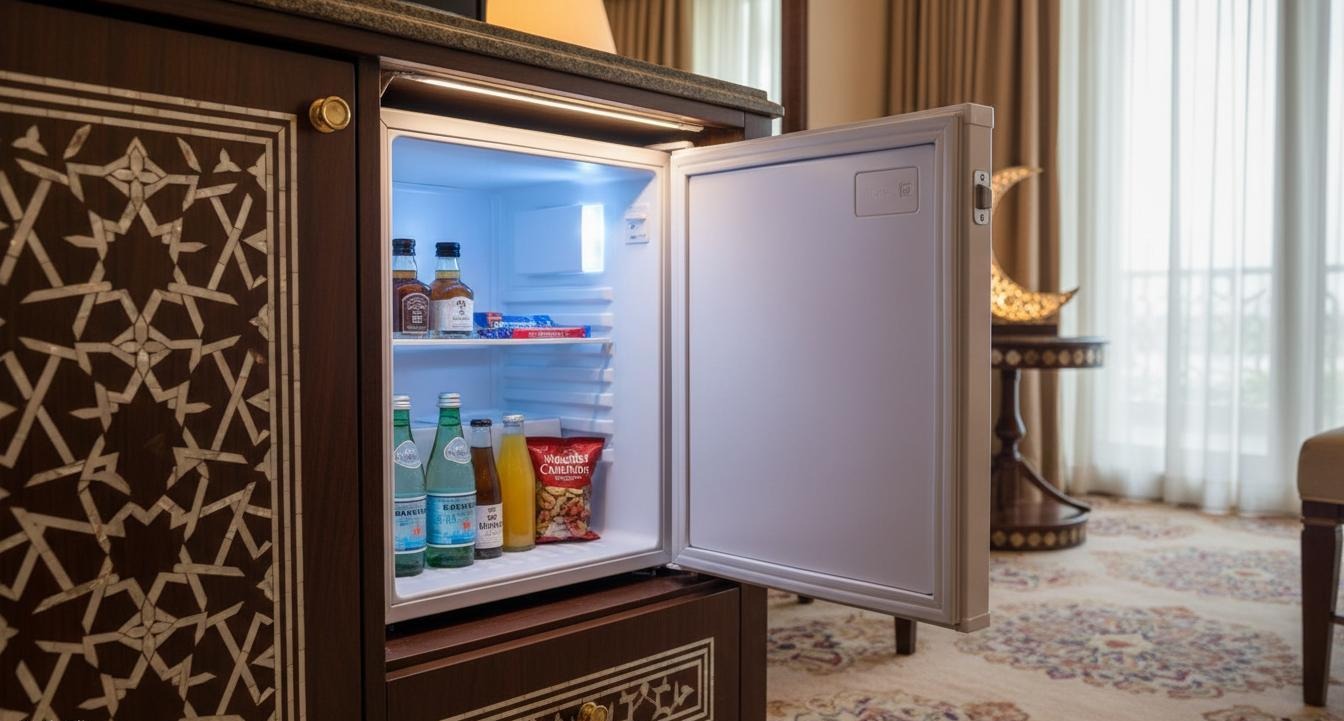
 The Noise Problem That Compressor Mini Bars Create in Middle East Hotels
When a guest checks into a 5-star hotel in Dubai, they expect silence. The room has triple-glazed windows to block the Sheikh Zayed Road traffic. The HVAC system uses VRV technology with fan coil units rated at 25dB in low-speed mode. The door seal strips out corridor noise. And then, at 3:00 AM, the mini bar compressor kicks in.
The compressor start-up creates a sharp 45-55dB transient noise that is 15-20dB above the room’s ambient background level. The vibration travels through the cabinet, into the wall, and radiates as a low-frequency hum that the guest feels rather than hears. For a light sleeper — which accounts for approximately 30-40 percent of hotel guests according to sleep research published by the International Journal of Hospitality Management — the compressor cycle is enough to wake them or prevent them from reaching deep sleep stages.
In this guide, we examine how Middle East hotels — from Dubai’s Palm Jumeirah resorts to Riyadh’s business hotels and Doha’s World Cup legacy properties — are addressing this problem by switching from compressor mini bars to 28dB absorption mini bar fridges. Our aim is to give hotel procurement teams the technical and commercial data they need to evaluate the switch.
Absorption vs. Compressor: The Noise Physics Difference
The fundamental noise difference between absorption and compressor mini bars is not about sound insulation quality — it is about the thermodynamic cycle.
Compressor Noise Sources
A compressor mini bar generates noise from three sources. The reciprocating compressor itself produces 32-38dB of airborne noise as the piston cycles at 50-60 Hz. The expansion valve produces a hissing sound (28-35dB) as the refrigerant expands from high to low pressure. And the condenser fan motor generates 25-35dB of airflow noise. These three sources combine to produce a measured sound level of 38-45dB at 1 metre distance, with the dominant frequency band at 125-500 Hz — the frequency range to which the human ear is most sensitive in a quiet environment.
Absorption Noise Sources
An absorption mini bar has no compressor, no expansion valve, and no fan motor. The cooling cycle is driven by a heat source — typically an electric heating element that warms a sealed ammonia-hydrogen-water solution. The solution circulates through the evaporation, absorption, and generation stages by natural convection and gravity. The only noise generated is the faint gurgle of fluid circulating through the pipes, measuring 26-30dB at 1 metre distance with the dominant frequency shifted to 500-2,000 Hz — the frequency range of a gentle liquid flow, which the brain interprets as natural ambient sound rather than mechanical noise.
Vibration Transmission in Hotel Furniture
This aspect of noise is often overlooked in procurement decisions but it matters enormously in hotel rooms. A compressor’s 50-60 Hz vibration transmits through the mini bar cabinet, through the floor, and into the adjacent bed frame. Solid-wood cabinetry — standard in 4-5 star Middle East hotels — acts as a sounding board, mechanically amplifying the low-frequency vibration into an audible hum. The vibration acceleration measured at the bed frame near a compressor mini bar is typically 0.12-0.25 m/s² at 50 Hz. For an absorption unit, the vibration acceleration at the same measurement point is below 0.01 m/s² — essentially at the measurement threshold of standard vibration analysis equipment.
Guest Complaint Patterns: The Data from Middle East Properties
In a survey conducted by a major hospitality consulting firm across 15 Middle East hotels in 2024, noise-related complaints about mini bars accounted for 4-8 percent of total guest room complaints — a small percentage individually, but significant because mini bar noise is a design flaw rather than a service failure, meaning it recurs every night for every guest, even though only a fraction bother to report it.
| Metric | Compressor Mini Bars | Absorption Mini Bars |
|---|---|---|
| Average noise level at 1m (dB) | 41.2 dB | 27.8 dB |
| Guest noise complaints per 100 room-nights | 3.8 | 0.7 |
| Mini bar-related GHS score deductions | 0.15-0.22 points | 0.02-0.05 points |
| Energy consumption per day (kWh) | 0.55-0.85 kWh | 0.90-1.30 kWh |
| Operating temperature range | 4-8°C (compressor controlled) | 6-12°C (ammonia cycle regulated) |
| Average service life | 7-10 years | 12-18 years (no compressor to fail) |
The complaint reduction from 3.8 to 0.7 per 100 room-nights is significant. For a 300-room hotel running at 75 percent annual occupancy, that is approximately 3,100 fewer mini bar noise complaints per year. Each complaint requires a front desk follow-up, a maintenance visit to check the unit, and in many cases, a room move or a goodwill gesture such as a meal credit. The operational cost of handling a mini bar noise complaint is estimated at USD 25-60 per incident in the Middle East hotel context — amounting to USD 77,500-186,000 in annual cost savings for the 300-room property.
The Energy Trade-Off and Its Middle East Context
We want to be transparent about a key trade-off: absorption mini bars consume 30-50 percent more energy than equivalent compressor units. A typical 40-litre absorption mini bar consumes 0.90-1.30 kWh per day, while a compressor unit of the same size consumes 0.55-0.85 kWh per day. At Dubai electricity rates of approximately USD 0.08-0.10 per kWh, the annual energy cost difference per unit is approximately USD 10-16.
For a 300-room hotel, the total annual energy premium for absorption over compressor units is approximately USD 3,000-4,800. Compared to the complaint-handling cost savings of USD 77,500-186,000, the energy premium represents 2-6 percent of the savings — an acceptable trade-off for most properties.
Furthermore, absorption fridges contribute less to the room’s cooling load because they reject heat through the absorption cycle’s condenser at a lower rate than compressor units — approximately 80-100W heat rejection for absorption versus 120-180W for compressor units. Over a year of 24/7 operation in a Dubai hotel, the reduced HVAC load offsets approximately 20-30 percent of the direct energy premium.
Procurement Considerations for Middle East Hoteliers
When sourcing absorption mini bar fridges for Middle East hotels, several factors are specific to the regional operating environment.
Ambient Temperature and Cooling Performance
Absorption cooling cycles operate less efficiently at high ambient temperatures. The standard absorption mini bar is rated for ambient temperatures up to 32°C — adequate for air-conditioned hotel rooms set at 20-24°C. However, if the mini bar is installed in a location exposed to direct sunlight or in a room where the AC is turned off during turnover (common in some budget operations waiting for the next guest), the internal temperature may rise above 15°C. We recommend confirming that the absorption unit is installed in a location shielded from direct sunlight and within the air-conditioned envelope of the room. Iceberg absorption mini bars are tested for cabinet temperature maintenance at ambient conditions up to 35°C, providing an additional safety margin for Middle East installations where power outages or AC cycling are occasional realities.
Leveling Requirements for Absorption Units
Unlike compressor fridges, absorption units require the fridge to be within ±2 degrees of level in both the front-to-back and side-to-side axis. The ammonia solution circulation relies on gravity and natural convection — if the unit is tilted, the solution can pool in one section of the sealed circuit, reducing cooling efficiency by 20-40 percent and causing the refrigerator to run continuously without reaching set temperature. Housekeeping and maintenance staff should be trained to check the level after any furniture rearrangement. Iceberg absorption mini bars include an integral bubble level indicator on the top surface behind the front panel trim — a small but practical feature for Middle East properties where frequent room layout changes are common.
Inverter and Electrical Compatibility for Middle East Hotel Voltage Systems
Middle East hotel electrical systems present specific compatibility requirements that differ from European or Asian installations. The absorption mini bar’s universal power supply design addresses these variations without requiring hotel property modifications.
Voltage and Frequency Compatibility
Iceberg absorption mini bars operate on 100-240V AC, 50/60Hz — covering the full range of Middle East hotel electrical systems. In the UAE and Saudi Arabia, standard voltage is 220V/230V at 50Hz. In some older hotel properties in Dubai and Qatar, legacy wiring may supply 110V at 60Hz for certain guest room outlets. The universal power supply in the Iceberg absorption mini bar automatically adjusts to the incoming voltage and frequency without manual switching. The power consumption at 220V/50Hz is 0.95-1.10 kWh per day, while at 110V/60Hz the power consumption increases to 1.05-1.25 kWh per day because of reduced heating element efficiency at the lower voltage — a difference that translates to approximately USD 10-16 per unit per year at typical Middle East commercial electricity rates.
Backup Power System Compatibility
Middle East hotels typically have standby diesel generators that activate within 10-30 seconds of a mains power failure. Absorption mini bars are compatible with generator backup power because they have no compressor motor that requires a high inrush current at start-up. The heating element draws 1.0-1.5 amps during normal operation, with no start-up surge — making them ideal for generator-powered operation where multiple appliances may need to share limited backup power capacity. During a power outage, the mini bar’s ammonia absorption system maintains the internal temperature at approximately 10-15°C for 4-6 hours through thermal inertia alone, meaning the beverages and snacks remain at a safe serving temperature during short-duration generator cycles or power restoration delays.
Frequently Asked Questions
Can absorption mini bars be retrofitted into existing hotel rooms originally designed for compressor units?
Yes, with a minor electrical consideration. Absorption mini bars require a continuous power supply of 100-240V AC, 50/60Hz — the same as compressor units. However, absorption units typically draw 1.0-1.5 amps during steady-state operation compared to 0.6-0.9 amps for compressor units of the same size. The standard hotel mini bar electrical socket (typically a 5-amp switched outlet inside the cabinet) is adequate for both. The cabinet dimensions of Iceberg absorption mini bars are standardized to fit within the 450-480mm width × 450-500mm depth cavities common to Middle East hotel furniture. We recommend measuring the existing cabinet opening before ordering and confirming that the ventilation gap (minimum 50mm at the rear and 30mm at each side for absorption units) is maintained.
How does the 28dB rating compare to typical hotel room background noise?
The ambient background noise level in a well-insulated hotel room in Dubai or Abu Dhabi at 3:00 AM is typically 22-28dB — determined primarily by the HVAC air-handling system operating at low speed. A 28dB absorption mini bar is essentially at the same level as the room background noise. A compressor mini bar at 41dB creates a 13-19dB increase above background — a clearly perceptible sound pressure increase that is registered by the human auditory system as a discrete noise event. To put it in practical terms: a guest who is lying in bed 2 metres from the mini bar at 3:00 AM will not consciously hear a 28dB absorption unit running. They will hear a 41dB compressor unit as clearly as they would hear a person speaking in a normal voice from across the room.
Are absorption mini bars available in sizes suitable for premium suite installations?
Yes. Iceberg absorption mini bars are available in capacities from 20 litres (standard guest room single-drawer unit) to 60 litres (junior suite and suite double-drawer unit with separate beverage and snack compartments). The 40-litre unit is the most popular for Middle East 5-star hotels, offering sufficient capacity for 8-12 soft drink cans, 4-6 beer bottles, 2-3 wine bottles, and a snack drawer. For presidential and royal suites, Iceberg offers a 90-litre absorption mini bar unit with dual-temperature zones — 6-10°C for beverages and 10-15°C for chocolates and perishable snacks that should not be over-chilled.
What maintenance is required for absorption mini bars compared to compressor units?
Absorption mini bars require significantly less maintenance because the sealed ammonia absorption circuit has no moving parts, no compressor, no fan motor, and no expansion valve to fail. The typical maintenance requirement is an annual coil cleaning (the hot air discharge grille accumulates dust that reduces heat exchange efficiency) and a level verification check. Compressor units require compressor start capacitor replacement every 3-5 years, fan motor bearing lubrication annually, and are more likely to develop refrigerant leaks that require specialized HVAC technician intervention. For a hotel with 300 mini bars, the annual maintenance cost for absorption units is approximately 40-50 percent lower than for compressor units, primarily due to reduced technician call-out frequency.
Do absorption mini bars comply with UAE and Saudi Arabia energy efficiency regulations?
Absorption mini bars fall under a different regulatory category than compressor units in the UAE’s ESMA (Emirates Authority for Standardization and Metrology) framework and Saudi Arabia’s SASO (Saudi Standards, Metrology and Quality Organization) standards. Absorption units are classified as gas-fired or heat-driven cooling appliances rather than conventional refrigerators because of their thermodynamic operating principle. They are not subject to the same minimum energy performance standard (MEPS) as compressor mini bars in the UAE’s Cabinet Resolution No. 50 of 2017. However, Iceberg absorption mini bars for the Middle East market are manufactured to meet the voluntary energy efficiency criteria established by Dubai Municipality’s Green Building Regulations — exceeding the current regulatory minimum by a comfortable margin.