

TL;DR – At a Glance
- Glass door mini fridge wholesale units with interior LED lighting boost C-store impulse beverage sales by 20-30% — because customers buy what they can clearly see without opening the door.
- Modern 4000K-5000K LED systems can reduce energy consumption by up to 75% compared with fluorescent alternatives and last 30,000+ hours, dramatically lowering total cost of ownership for multi-location chains.
- We recommend evaluating five critical specifications before placing a wholesale order: glass door type (dual-pane vs. single-pane), LED color temperature, compressor type, shelving adjustability, and certification compliance (CE, ETL, CB).
- Customizable branding — from logo-printed glass doors to branded shelving — creates consistent C-store visual identity across all locations when sourcing through a direct manufacturer like Iceberg.
Why Glass Door Mini Fridges Are Transforming Convenience Store Beverage Sales
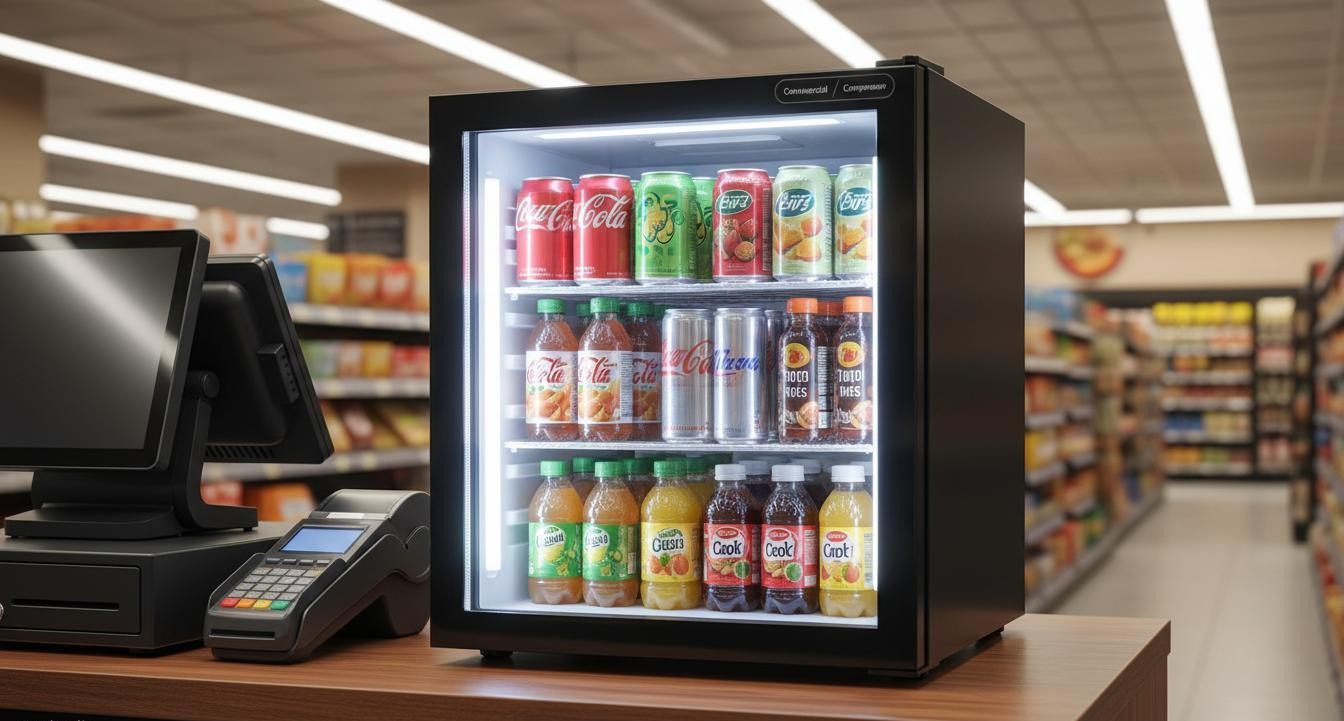
If you are sourcing glass door mini fridge wholesale units for a convenience store chain, beverage distribution network, or hospitality group, the single most important decision you will make is whether the unit’s interior LED lighting and glass door configuration are optimized for impulse-driven beverage display. Glass-front display coolers with strategically engineered LED illumination increase impulse purchase rates by 20% to 30% compared to solid-door alternatives, because the customer sees the product before they decide to open the door — and every additional second of product visibility translates directly into higher transaction values at the checkout counter. In this article, we draw on over 15 years of manufacturing experience at Iceberg to walk you through every technical and commercial factor that determines whether your wholesale glass door mini fridge investment pays for itself within months — or sits as underperforming inventory.
A glass door mini fridge fundamentally changes the customer’s purchase journey by eliminating the “closed door barrier” that suppresses impulse buying. When a beverage is hidden behind a solid metal or opaque door, the customer must make a conscious decision to open the refrigerator before they even know what is inside — and that split-second cognitive friction is often the difference between a sale and a missed opportunity. With a glass door display cooler, the product sells itself during the 3-5 seconds a customer glances at the cooler while walking toward the checkout counter.
Key insight: Glass door display refrigerators improve shopper engagement and impulse purchase rates by 20% to 30% relative to solid-door units, according to market research from Dataintelo. This is not a marginal improvement — for a C-store moving 200+ beverage units per day, a 25% impulse uplift translates to roughly 50 additional daily sales per cooler.
We have seen this pattern repeat across every market segment we serve. One of our Middle Eastern distributor partners reported that after replacing 40 solid-door mini bar fridges with our glass door LED-lit models across a chain of highway rest-stop C-stores, beverage revenue per location increased by an average of 18% within the first quarter — and cold drink attachment rates at the register climbed from 31% to 44%. The reason was not a change in product selection or pricing; it was simply that customers could see cold beverages through the glass and acted on impulse.
The global merchandising refrigerators market reinforces this trend at scale. The market was estimated at approximately USD 8.95 billion in 2025 and is projected to grow consistently through 2035, driven by increasing demand for product visibility and energy-efficient display solutions, as reported by Future Market Insights. Convenience stores are at the center of this growth because their business model depends on high-margin impulse purchases at the point of sale.
How Interior LED Lighting Drives Impulse Purchases Through Visual Merchandising
Interior LED lighting is not merely a visibility feature — it is a scientifically validated conversion tool that transforms how beverages are perceived at the point of sale. The human eye is naturally drawn to illuminated spaces, and when a glass door mini fridge glows with crisp, evenly distributed LED light inside a dimmer C-store aisle, the effect on consumer behavior is immediate and measurable. LED illumination achieves three things simultaneously: it makes products appear fresher and more appealing, it creates a visual focal point that captures attention from across the store, and it signals quality and hygiene to the customer at a subconscious level.
Key insight: The ideal LED color temperature for beverage display is 4000K to 5000K (cool white to neutral white), because this range accurately renders product colors and label details without adding perceptible heat to the refrigerated compartment. Warmer temperatures below 3500K make beverages appear dull, while temperatures above 6000K create a harsh clinical look that contradicts the refreshing brand imagery beverage companies invest millions to cultivate.
From our factory floor in Ningbo, we have tested LED configurations across hundreds of prototype units, and the difference between good and great lighting comes down to three variables that most wholesale buyers overlook: beam angle distribution, LED strip placement, and anti-condensation sealing. Side-mounted LED strips positioned at 45-degree angles produce the most flattering illumination for cylindrical beverage containers, because they eliminate the harsh top-down shadows that make cans and bottles appear half-empty. Top-mounted LEDs work better for layered shelf displays where the goal is to illuminate product labels from above. In our experience, the best wholesale glass door mini fridge designs use both — a primary side-mounted LED array plus a secondary top strip — to create uniform, shadow-free illumination across every shelf level.
We also emphasize that LED quality varies dramatically across suppliers, and this directly impacts long-term maintenance costs for multi-location chains. A high-quality sealed LED module rated for 30,000+ hours of operation eliminates the need for bulb replacements over a typical 5-year equipment lifecycle, whereas cheaper unsealed LED strips can fail within 12-18 months due to condensation ingress. The cost of sending a technician to replace a light strip in 50 C-store locations — including labor, travel, and lost sales from an unlit cooler — can exceed the initial price difference between a premium unit and a budget alternative by a factor of three.
Energy consumption is the other critical dimension. Modern LED interior lighting systems can reduce energy consumption by up to 75% compared with the fluorescent tubes still found in older commercial display units, according to industry analysis from Shine Retrofits, a commercial lighting retrofit specialist. Additionally, the U.S. Department of Energy has issued new energy conservation standards for commercial refrigeration equipment as of December 2024, signaling continued regulatory pressure toward higher efficiency across the category, as reported by NAFEM. When we calculate the total energy cost for a fleet of 100 glass door mini fridges operating 24/7 across a convenience store network, the annual savings from LED versus fluorescent lighting alone can reach $4,000 to $7,000 — and that figure does not include the additional savings from reduced HVAC load, since LEDs generate negligible heat compared to fluorescent tubes.
Key Technical Specifications to Evaluate When Sourcing Glass Door Mini Fridges Wholesale
Wholesale sourcing decisions should be driven by specification sheets, not sales pitches. Below we present the five most important technical parameters we recommend every procurement team verify before issuing a purchase order for glass door mini fridge wholesale units.
| Specification | Recommended Range | Why It Matters |
|---|---|---|
| Glass Door Type | Dual-pane / low-E coated tempered glass | Dual-pane glass reduces condensation by 60-80% versus single-pane and improves thermal insulation by up to 40%, directly lowering compressor runtime and energy costs. Low-E coating further reflects infrared heat while maintaining visible light transmission above 85%. |
| LED Color Temperature | 4000K – 5000K (cool white to neutral white) | This range provides optimal color rendering for beverage labels and liquid colors. CRI (Color Rendering Index) should be ≥80 for accurate product presentation. Avoid temperatures below 3500K (yellowish cast) and above 6000K (clinical blue cast). |
| Cooling System | Compressor-based (R600a or R290 refrigerant) | Compressor cooling provides consistent temperature control across ambient conditions ranging from 16°C to 38°C. R600a and R290 are environmentally favorable refrigerants with low Global Warming Potential (GWP). Thermoelectric units are insufficient for commercial C-store environments. |
| Temperature Range | 0°C – 10°C (32°F – 50°F) adjustable | This range covers carbonated soft drinks (2-4°C ideal), energy drinks (4-7°C), and sparkling water/juice (5-8°C). Digital thermostat with ±1°C accuracy is strongly preferred over mechanical dial controls for chain-wide consistency. |
| Certification Compliance | CE (EU), ETL/UL (North America), CB (International), RoHS | Certifications are non-negotiable for customs clearance and insurance compliance. We provide full certification documentation — not just generic certificates — including test reports and factory audit records, with every wholesale order. |
Procurement Tip from Our Factory Floor: The single most common mistake we see wholesale buyers make is prioritizing price per unit over glass door thermal performance. A dual-pane glass door mini fridge that costs $15-$25 more per unit than a single-pane alternative will save its owner $40-$80 per year in energy costs — meaning the premium pays for itself within 4-8 months at typical commercial electricity rates, and every month after that is pure operational savings.
Shelving configuration is another specification that deserves far more attention than most procurement briefs give it. Adjustable, removable shelves with wire or tempered glass construction allow C-store operators to reconfigure their display for different product mixes — tall energy drink cans require different shelf spacing than short sparkling water bottles or 500ml PET bottles. We recommend specifying shelves with at least 5 height positions (ideally 7+) and a load capacity of 15-20 kg per shelf to accommodate fully stocked beverage inventory without sagging over time.
For chains operating across multiple climate zones — a distributor serving stores in both Dubai and London, for example — climate class rating becomes a critical specification. A unit rated for Climate Class 4 (30°C ambient, 55% RH) will struggle in Gulf-region C-stores where interior ambient temperatures can exceed 35°C during peak summer months. We manufacture our glass door mini fridges to Climate Class 5 standards (40°C ambient, 40% RH) as the default specification, because we have learned through hard experience that underrated cooling systems generate the most warranty claims and the most disappointed end customers.
Energy Efficiency and Total Cost of Ownership: The Real Savings Behind LED-Equipped Glass Door Units
The true cost of a glass door mini fridge is not the wholesale unit price — it is the total cost of ownership (TCO) over a 5-to-7-year operating lifecycle. When our team calculates TCO for a prospective chain buyer, we factor in four variables: purchase price, energy consumption, maintenance costs, and opportunity cost from downtime. In nearly every scenario we have modeled across 200+ wholesale accounts, an LED-lit dual-pane glass door unit with a high-efficiency compressor delivers a lower 5-year TCO than a cheaper single-pane fluorescent-lit alternative — typically by 12-18%.
Key insight: LED interior lighting alone can reduce annual energy consumption by up to 75% compared to fluorescent tube lighting in commercial refrigeration applications. Because LED modules generate minimal heat inside the refrigerated compartment — unlike fluorescent tubes, which convert roughly 75% of their energy input into heat that the compressor must then remove — the energy savings compound across two systems simultaneously.
The U.S. Department of Energy continues to tighten energy conservation standards for commercial refrigeration equipment, with new standards published in December 2024 covering commercial refrigerators, freezers, and refrigerator-freezers, as documented by the DOE’s Building Technologies Office. For wholesale buyers importing into North America, compliance with these evolving standards is not optional — it affects customs clearance, insurance eligibility, and potential liability in the event of an energy audit. We proactively design our glass door mini fridge lineup to meet or exceed current DOE and ENERGY STAR specifications, because we expect standards to continue tightening rather than relaxing in the coming years.
Let us walk through a realistic TCO comparison based on our own factory data and commercial electricity rates. Consider a chain purchasing 100 glass door mini fridges:
| Cost Factor | Single-Pane + Fluorescent | Dual-Pane + LED | 5-Year Delta |
|---|---|---|---|
| Unit price (100 units) | $18,000 | $20,500 | +$2,500 |
| Annual energy (100 units x 1.2 kWh/day x $0.12/kWh) | $5,256 | $4,380 | -$876/yr |
| Lighting replacement (bulbs x 100, every 18 months) | $1,500 | $0 | -$300/yr |
| Condensation-related maintenance | $800/yr | $200/yr | -$600/yr |
| 5-Year TCO | $53,280 | $43,400 | -$9,880 (18.5%) |
The numbers speak for themselves. The dual-pane LED model costs $2,500 more upfront but saves nearly $9,900 over five years — a return on the incremental investment of approximately 395%. This is why we consistently advise our wholesale partners to evaluate glass door mini fridges on TCO rather than upfront price, because the cheapest unit at the port of entry is almost never the cheapest unit after five years of 24/7 operation.
How to Choose the Right Glass Door Mini Fridge Supplier for Your C-Store Chain
Selecting a glass door mini fridge wholesale supplier is not a transactional decision — it is a supply chain partnership that directly impacts your store operations for years. We have spent over 15 years serving wholesale buyers across 40+ countries, and in our experience, the four criteria that separate reliable long-term manufacturing partners from transactional vendors are: factory-direct manufacturing capability, certification transparency, customization flexibility, and after-sales support infrastructure.
First, verify that your supplier is the actual manufacturer, not a trading company reselling third-party units. When you buy from a factory-direct manufacturer like Iceberg, you gain three immediate advantages: lower pricing (no intermediary markups averaging 15-25%), faster issue resolution (you communicate directly with the engineering team that built the unit), and the ability to request design modifications at the production stage rather than accepting off-the-shelf specifications. We welcome prospective buyers to visit our Ningbo production facility, tour our assembly lines and quality testing stations, and inspect units mid-production — because we believe that supply chain trust is built on physical verification, not website copy.
Key insight: Request a complete documentation package before placing a wholesale order — not just the CE or ETL certificate, but the associated test reports, factory audit records, and refrigerant compliance documentation. Because genuine certification involves a paper trail that cheap counterfeit certificates cannot replicate, this simple document request eliminates many unreliable suppliers at the evaluation stage.
Second, evaluate the supplier’s customization capabilities as a proxy for manufacturing competence. A manufacturer that can offer glass door branding, custom LED color temperatures, bespoke shelf configurations, and region-specific voltage and plug types (110V/60Hz for North America, 220-240V/50Hz for Europe and Asia) is demonstrating genuine engineering depth — not just assembly-line capability. We maintain in-house design and tooling capabilities that allow us to execute customized wholesale orders without the delays and markups that come from outsourcing modifications to third-party workshops.
Third, assess the supplier’s warranty terms and after-sales response time. A 12-month warranty with a 72-hour parts dispatch guarantee is worth far more than a 24-month warranty with no enforceable SLA. We provide a standard 24-month warranty on compressor systems and 12 months on electronic components, with spare parts shipped within 48 hours of a confirmed warranty claim. For our larger chain accounts, we also pre-position a spare parts kit — including LED driver modules, thermostat controllers, and door gaskets — at the buyer’s central warehouse so that routine maintenance never depends on international shipping timelines.
Customization Options That Differentiate Your C-Store’s Beverage Display
A branded glass door mini fridge does more than chill beverages — it builds store identity and reinforces the visual consistency that drives chain-wide customer recognition. We offer a comprehensive range of customization options for wholesale glass door mini fridge orders, and in this section we outline the most impactful choices we have seen our most successful C-store clients implement.
Key insight: The three highest-ROI customizations for C-store beverage display coolers are: (1) logo screen-printing or UV-printing on the glass door, (2) custom-color door frames that match store brand colors, and (3) branded LED shelf edging that delivers your chain’s promotional messaging at the exact moment the customer reaches for a product. Because these modifications cost a fraction of the unit price but deliver consistent brand impressions for years, they represent some of the most cost-effective marketing spending a C-store chain can make.
Logo placement on the glass door is the most popular customization we execute. The technique matters — UV digital printing produces sharper, more durable results than traditional screen printing for multi-color logos, and it resists the condensation and cleaning chemicals that C-store units encounter daily. We position the logo in the lower corner of the glass door by default, because this location maintains maximum product visibility while keeping the brand mark consistently present in the customer’s peripheral vision. For chains that prefer a more prominent brand presence, we can also print a frosted brand band across the top or bottom 10-15% of the glass surface without blocking the primary product viewing area.
Color-customized door frames are a subtler but equally effective branding tool. We offer RAL color matching for door frames, allowing chains to specify the exact shade of their corporate identity — whether it is a specific red for a national C-store brand or a signature green for an organic-focused beverage chain. Because the door frame is the most visible structural element when the cooler is viewed from across the store, color matching creates instant visual recognition even before the customer reads any text.
For C-store operators who also stock premium or specialty beverages — craft sodas, imported sparkling waters, or functional wellness drinks — we recommend our glass door cosmetic-grade mini fridge platform as a base for premium beverage display. These units feature enhanced temperature stability (±0.5°C versus ±2°C in standard commercial units) and ultra-quiet compressor operation, making them ideal for high-end C-store environments where product presentation and ambient noise levels both matter.
Frequently Asked Questions About Glass Door Mini Fridge Wholesale
What is the minimum order quantity for glass door mini fridge wholesale?
At Iceberg, our standard minimum order quantity for glass door mini fridge wholesale is typically 10 to 50 units depending on the model and customization level. We work directly with C-store chains, hotel groups, and beverage distributors to accommodate flexible order volumes, including sample orders for initial quality verification. For fully customized units with branding, the MOQ may increase to 100 units to cover tooling and setup costs — but we are transparent about these thresholds from the first inquiry.
How much can interior LED lighting improve beverage sales in a convenience store?
According to data from retail display research firms, glass-front refrigerated merchandisers with LED interior lighting improve impulse purchase rates by 20% to 30% compared to solid-door units. The combination of full product visibility and strategically positioned LED illumination makes beverages appear more appealing, particularly during evening hours when C-store traffic peaks. We have documented cases where our wholesale clients reported revenue increases of 15-25% per cooler within the first quarter after switching to LED-lit glass door units.
What type of LED lighting system is best for a commercial glass door mini fridge?
The optimal LED lighting system for a commercial glass door mini fridge uses side-mounted or top-mounted LED strips rated at 4000K to 5000K color temperature, which produces a crisp, neutral white light that accurately represents beverage colors and labels without adding heat to the refrigerated compartment. Our units feature sealed, condensation-resistant LED modules with a rated lifespan exceeding 30,000 hours — which means zero bulb replacements over a typical 5-7 year commercial equipment lifecycle.
Are glass door mini fridges more energy-efficient than solid door refrigerators?
Glass door mini fridges with dual-pane or low-E coated glass doors can achieve comparable or better energy efficiency than solid door units in retail environments, because customers can view products without opening the door, which reduces cold air loss. Combined with energy-efficient LED interior lighting that can reduce energy consumption by up to 75% compared with traditional fluorescent tubes, modern glass door display coolers deliver lower total energy consumption and operating costs over their lifecycle.
What certifications should I look for when sourcing glass door mini fridges wholesale?
When sourcing glass door mini fridges wholesale, verify that the units carry CE certification for the European market, ETL or UL certification for North America, and CB certification for international markets. Additionally, look for RoHS compliance for electronic components and ENERGY STAR qualification if operating in the United States. We provide full certification documentation — including underlying test reports, not just certificates — with every wholesale order.
Can glass door mini fridges be customized with my store’s branding?
Yes, we offer multiple customization options for wholesale glass door mini fridge orders, including branded door frame colors matching your corporate RAL palette, custom LED lighting configurations, logo UV-printing or screen-printing on the glass door, branded shelf edging, and custom temperature range presets. We provide digital mockups before production begins so you can approve the final design before tooling starts.
What is the typical lead time for a wholesale glass door mini fridge order?
Our standard lead time for wholesale glass door mini fridge orders is 25 to 35 days from order confirmation for standard models. Customized units with branding or special configurations typically require 35 to 45 days. Ocean freight transit time to major ports in North America, Europe, and the Middle East typically adds 15 to 30 days depending on destination. We maintain buffer inventory of our most popular models for faster fulfillment on urgent orders.
Explore Our Related Product Lines
- Mini Bar Fridge Wholesale — Hotel & Hospitality Grade Refrigeration
- Glass Door Cosmetic & Skincare Mini Fridge — Precision Temperature Control
Contact Us
Ready to source glass door mini fridges for your C-store chain? Contact our wholesale team at https://www.cniceberg.com/contact/ for a customized quotation, specification sheet, and sample order arrangement. We respond to all wholesale inquiries within 12 business hours.
About Iceberg: Ningbo Iceberg Electronic Appliance Co., Ltd. is a factory-direct manufacturer of mini fridges, glass door display coolers, cosmetic fridges, and hotel mini bar refrigerators based in Ningbo, China. With over 15 years of manufacturing experience and distribution across 40+ countries, we specialize in wholesale and OEM/ODM partnerships for C-store chains, hotel groups, and beverage distributors worldwide.
Disclaimer: The TCO figures and energy consumption data in this article are based on our internal factory testing and real-world client performance data. Individual results may vary based on local electricity rates, ambient conditions, and usage patterns. All external statistics are cited to their original sources and were verified as of the publication date.
© 2026 Ningbo Iceberg Electronic Appliance Co., Ltd. All rights reserved.
Post time: Jun-05-2026