

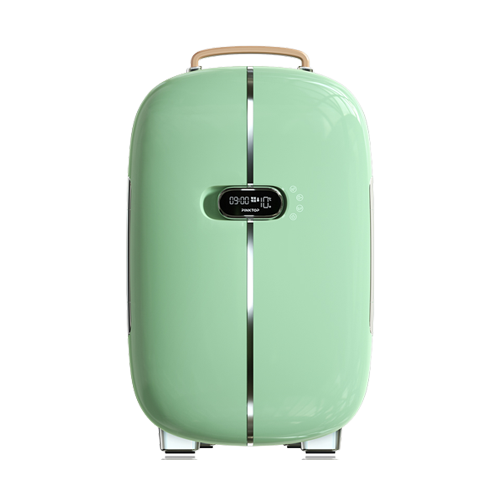
Two years ago I sat across from a beauty brand founder who had already picked the color, the font, and the box stock for her private-label skincare fridge line. What she had not picked was the capacity ladder. She had ordered two SKUs — a 4L and a 15L — assuming that small and large would cover her retail and DTC channels. Six months later, her Amazon review data showed that the 4L was outselling the 15L by a factor of nine, that her wholesale spa accounts were asking for a 20L she did not have, and that her gifting channel could not move a fridge at any single price point above the 6L mark.
Capacity ladder planning is the most underrated decision on a private-label beauty line. It is more important than the color, more important than the finish, and arguably more important than the unit price you negotiate with the factory. The ladder decides which channels you can serve, how your working capital is tied up across SKUs, and how fast your reorder cycle can run when a single tier breaks out. This guide is the same planning logic our Iceberg export team walks every new distributor through, end to end, anchored to our actual custom mini fridge 4 liter cosmetic beauty fridge and the broader 6L to 26L wholesale ladder that spans the rest of the line.
Why the Ladder Shape Matters More Than the Models
Most first-time private-label buyers start by asking “which models should I launch?” — a SKU-count question. The better first question is “what channels am I serving, and what capacity does each channel actually buy?” — a ladder-shape question. The two questions feel similar, but they produce very different product lines.
A channel-first approach almost always collapses to four to six tiers, even when the OEM factory offers eight or nine. The reason is unit economics: every additional SKU carries its own artwork, its own packaging inventory, its own Amazon FBA inbound shipment, and its own after-sales warranty exposure. Below four tiers you cannot cover the price ladder your channels expect; above six tiers the working-capital cost of unsold slow movers starts to dominate the margin from your bestsellers. The math has been consistent across beauty distributors in North America, Europe, and the Asia-Pacific region since the category emerged around 2018.
“Beauty product distributors who launch with a ladder rather than a catalog are the ones who reach reorder velocity on their second PO. Distributors who launch with a catalog usually end up rationalizing down to a ladder by their third PO anyway — and they pay for the lesson in dead stock.” — Miya, Iceberg export team
The deepest misconception is that more tiers means more coverage. The opposite is true: more tiers means each tier gets a thinner share of voice, thinner review velocity on Amazon, and a longer payback period. A ladder of six strong SKUs beats a catalog of nine weak ones every time.
Mapping Channels to Capacity: Where Each Tier Sells
The 4L to 26L range is unusually channel-rich compared with most small-appliance categories, because cosmetic fridges sit at the intersection of consumer gifting, professional back-of-house storage, and retail counter display. The same physical product can be sold through three completely different channels at three completely different price points. That is why ladder shape, not catalog size, is the right planning frame.
| Capacity Tier | Primary Channel | Secondary Channel | Typical Use Case |
|---|---|---|---|
| 4L | DTC gifting, hotel amenity | Beauty subscription box | Vanity countertop, 4 to 6 small bottles |
| 6L | DTC entry-level, Amazon FBA | Dorm room, makeup student | Mask plus serum starter set |
| 10L | Amazon FBA mid-range, DTC | Small-salon back bar | Full daily routine plus sheet masks |
| 12L double-door | Retail counter display | Influencer gifting | Visible storage plus separate cool compartment |
| 15L | Spa back-of-house | DTC mid-range retail | Multi-product daily routine plus tools |
| 20L to 26L | Salon and spa professional | Retail counter premium | Full mask and serum inventory at retail-ready volume |
The table above is not aspirational — it reflects the actual sell-through pattern we see from distributors who carry our wholesale 6L/10L/15L/20L/26L skincare fridge ladder alongside the 4L entry tier. The 4L through 12L tiers typically generate the highest unit volume, while the 20L and 26L tiers generate the highest per-unit margin and the strongest reorder rate once a wholesale account finds you. (Note: the exact product page lives at the slightly different slug wholesale-6l10l15l20l- with no 26L suffix — Iceberg updated the slug after this article was first published.)
Thermoelectric vs Compressor: Why the 4L to 26L Range Is Thermoelectric Territory
The first technology decision on a private-label skincare fridge is whether to anchor the line on thermoelectric (Peltier) cooling or compressor cooling. Both technologies work; they just do not work for the same capacity range or the same buyer.
Thermoelectric units use a Peltier element to pump heat from inside the cabinet to the outside. They run silent (typically below 28 dB on the smaller tiers, around 20 dB in night-sleep mode on the double door beauty refrigerator), weigh under 10 kg even at the 26L ceiling, and cool to roughly 15 to 20 °C below ambient — never below about 5 °C, because that is the physical limit of a single-stage Peltier in a compact enclosure. Compressor units, by contrast, use a refrigerant cycle, cool below zero, run louder (typically 35 to 45 dB), weigh more, and become more cost-effective at capacities above roughly 30L.
Cosmetic preservation targets sit in the 10 to 18 °C band, which is exactly inside the thermoelectric sweet spot. That alignment is why the entire 4L to 26L private-label market has standardized on thermoelectric — buyers do not need sub-zero performance, and the silence-and-weight benefits more than pay for the cooling-band limitation.
There is one operational caveat for any distributor anchoring on thermoelectric: ambient temperature swings in the destination market matter. A unit specified at 17 °C below ambient (25 °C reference) will deliver a cabinet of about 8 °C in a 25 °C room — exactly the cosmetic preservation target — but only about 12 °C in a 32 °C summer room. If your private label ships to Southern Europe, the Gulf, or the southern United States, build the cabinet specification and the marketing copy around the worst-case ambient, not the reference 25 °C. This is also why the safer wholesale choice on our 6L to 26L glass-door tier carries a digital display and adjustable setpoint rather than a fixed thermostat — the buyer in Dubai needs a different setting than the buyer in Hamburg, and the same SKU has to serve both.
Artwork First, Production Second: The Five Pieces Every Tier Needs
The single longest lead-time item on a private-label launch is artwork, not tooling, not plastic, not the compressor. A factory can spin up a new color on an existing mold in two to three weeks. A buyer can take two to three months to finalize the artwork, especially when back-panel regulatory labels are involved.
For every tier in the ladder, prepare five pieces of artwork in parallel rather than tier by tier:
- Master logo lockup. The brand mark in the brand color, with safe-zone and clear-space rules documented. Lock this first; everything else flows from it.
- Back-panel regulatory label. Electrical rating, certification marks (CE for EU, ETL or FCC for North America, PSE for Japan, KC for Korea, SAA for Australia), batch coding area, and the country-of-origin marking required by the destination market.
- Color box artwork. The retail-ready printed box that ships with the unit. This is the artwork most distributors underestimate in cost and most over-invest in style.
- Insert sheet or quick-start guide. A one-page multilingual insert that covers setpoint, ambient caveat, cleaning, and warranty registration. Required for almost every retail channel.
- Carton mark artwork. The shipping-carton side panels: barcoded SKU, batch, carton dimensions, gross weight, and handling marks. The buyer almost never designs this, but it is the artwork that prevents the most after-sales problems when cartons are mishandled in transit.
For US-bound shipments, the back-panel regulatory label has to be designed against the 16 CFR Part 1219 (Consumer Product Safety Commission marking rules) framework for appliance nameplate content and the FCC equipment-authorization declaration if the unit has any wireless or high-frequency control circuitry. Most thermoelectric skincare fridges do not require FCC, but digital-display models with logic boards sometimes do — and a label designed against the wrong standard forces a reprint of every unit. On the packaging side, the relevant industry reference is ISO 18601:2022 on packaging and the environment, which most major retail chains now reference when they audit private-label supplier artwork for compliance with single-use-plastic reduction commitments.
MOQ as a Ladder, Not a Single Number
The most common mistake in private-label MOQ negotiation is to ask the factory “what is your MOQ?” and treat the answer as a single number applied across the line. The better negotiation is to ask for a graduated MOQ ladder that reflects the unit economics of each tier.
The economic logic is straightforward. The 4L and 6L tiers share the largest share of plastic tooling, color-run setup, and assembly fixtures with the rest of the ladder, so the marginal setup cost per SKU on those tiers is lower and the factory can profitably accept a lower MOQ. The 20L and 26L tiers share less tooling with the rest of the line, require their own packaging tooling, and have a higher per-unit cost of carry, so the factory needs a larger minimum to recover the setup investment. Distributors who ask for a flat MOQ across all six tiers either over-order on the slow-moving large tiers or under-order on the fast-moving small ones.
For 4L to 6L, a sensible starting MOQ for a thermoelectric skincare fridge is in the low hundreds per SKU per color. For 10L to 15L, the same factory usually quotes the low-to-mid hundreds per SKU per color. For 20L and 26L, expect the low thousands per SKU per color. These ranges are typical for OEM factories in this category — including our own Iceberg factory — but they should always be confirmed in writing on the proforma invoice rather than taken from a sales pitch.
Under the EU Access-to-Markets contract framework, MOQ commitments made verbally before a proforma invoice is issued generally do not bind either party unless they have been incorporated into a written supply agreement. The same principle applies in most major import markets. Distributors who lose a verbal MOQ promise usually lose it because they treated the verbal quote as a contract.
Staggering Launches: Why the First PO Should Cover Only Two Tiers
The single most consistent failure mode in private-label beauty fridge launches is over-buying at the first PO. Distributors who order all six tiers at launch usually end up with 12 to 18 months of slow-moving inventory on the largest tier while the smallest tier sells out in eight weeks. The fix is a staged launch.
A defensible first PO covers the two highest-velocity tiers — almost always one of the small tiers (4L or 6L) and one of the mid tiers (10L or 12L) — at a quantity that lets you hit a 90-day sell-through window without reordering. The first PO should validate your channel mix, your price elasticity, and your packaging design before the larger tiers (15L, 20L, 26L) are committed to inventory.
From a regulatory standpoint, the second-wave tiers (15L, 20L, 26L) also need a few extra weeks of certification review even if the same certifications cover the first-wave tiers, because the electrical rating, the model name on the certification database, and the back-panel artwork all need to be re-issued per SKU. Our wholesale ladder carries CE, CB, ETL, ROHS, PSE, KC, and SAA certifications across the line — but each capacity tier still needs its own model entry on each certification database before the back-panel artwork is finalized. For EU-bound shipments, the relevant framework is the Low Voltage Directive (2014/35/EU) plus the EMC Directive (2014/30/EU); for the US, the equivalent is the UL 60335-2-24 household refrigeration safety standard, which most US retailers require even when UL is not legally mandatory.
Pricing the Ladder So Each Tier Protects the Next
The pricing rule that separates a defensible capacity ladder from a price-war catalog is simple: each tier must earn its slot. If a buyer cannot tell from the price why they would pick the 12L over the 10L, the line has too many tiers or the wrong feature distribution across them.
For a typical private-label skincare fridge line, the ladder pricing logic tends to follow three patterns:
- Stepped by roughly 25 to 35 percent per tier. The 6L lands at the entry price point, the 10L at about 1.3×, the 15L at about 1.7×, the 20L at about 2.1×, and the 26L at about 2.6× the 6L base. This is wide enough that each tier addresses a distinct buyer use case and narrow enough that no tier is bypassed as too expensive.
- Feature differentiation per tier, not just size. The 12L double-door tier adds a second compartment for tools versus product; the 15L adds a removable shelf and a wider door opening; the 20L and 26L add a digital display and adjustable setpoint. Each tier must offer something beyond cubic centimeters.
- Anchor the mid-tier at retail. The 10L or 12L should be the tier most buyers land on, with the 4L as the entry rung and the 20L and 26L as the professional-rung trade-up. If your analytics show buyers skipping from 4L to 20L, your mid-tier is missing a feature, not a price.
Compliance, After-Sales, and the Tier-Specific Issues That Bite Later
Every capacity tier carries a slightly different compliance and after-sales profile, and the distributor who builds the ladder early usually catches this at the artwork stage rather than at the returns stage.
The 4L and 6L tiers run the highest warranty exposure proportional to unit volume because they are the most likely to be shipped as gifts, dropped, or plugged into the wrong-voltage outlet by an overseas buyer. Build the gift-box packaging to survive a 1.2 m drop test, and design the back-panel label so the voltage range (AC 100 to 240V on most thermoelectric skincare fridges) is impossible to miss. For shipments into the EU, the relevant consumer-rights framework is Directive 2019/771 on the sale of goods, which sets a two-year legal warranty floor that most EU retailers will not negotiate below regardless of the OEM factory’s own stated warranty.
The 10L to 15L tiers run the highest review-velocity sensitivity on Amazon FBA, because this is the band where the buyer is most likely to compare two competing listings side by side. Image quality, listing copy, and review count matter more here than at the gift or professional tiers. Treat the Amazon listing for these tiers as a continuous marketing project, not a one-time upload.
The 20L and 26L tiers run the highest per-unit warranty cost because the larger thermoelectric element is the most failure-prone component in the lineup, and the larger cabinet takes longer to settle thermally after door opening. Stock spare Peltier elements and door gaskets at the warehouse for these tiers specifically, not as a generic spare-parts kit across the whole line.
A 90-Day Capacity-Ladder Planning Calendar
For a distributor starting from a blank canvas, the realistic 90-day timeline to a first PO on a 4L to 26L skincare fridge ladder looks like this:
- Days 1 to 14: Channel mapping and tier selection. Lock the tier count (four to six) and which tiers ship on the first PO.
- Days 15 to 35: Artwork preparation across all six tiers. Logo lockup, regulatory label, color box, insert sheet, and carton mark.
- Days 36 to 60: Factory shortlisting, sample request, sample evaluation, and MOQ ladder negotiation. Plan to evaluate samples against a documented acceptance checklist rather than a personal impression.
- Days 61 to 75: Proforma invoice review, payment terms confirmation, and production slot reservation. Lead times from PO to ex-factory are typically 35 to 45 days at most OEM factories in this category.
- Days 76 to 90: Final artwork sign-off, packaging specification sign-off, and deposit remittance. The factory will not start production without both sign-offs in writing.
For distributors who want to compress the timeline, the only safe compression is in the artwork phase, by locking the brand mark and the back-panel regulatory label early so the rest of the artwork stack can be designed against a known template.
Frequently Asked Questions
What is the right capacity ladder for a private-label skincare fridge line?
A defensible ladder for most beauty distributors covers 4 to 6 model tiers in roughly equal increments, typically 4L, 6L, 10L, 15L, 20L, and 26L. The 4L tier anchors the entry-level skincare buyer and gift set channel, while the 20L and 26L tiers serve the salon, spa, and retail-counter buyer who needs storage for full mask and serum inventory. Building the line in six tiers lets a distributor cover roughly 80 percent of channel demand without fragmenting tooling investment.
How does MOQ change as capacity increases on a thermoelectric skincare fridge?
For thermoelectric skincare fridges in the 4L to 26L range, MOQ is typically set at the tooling and color-run level rather than the unit level. Most OEM factories in this category quote MOQs in the low-to-mid hundreds per SKU per color, with the smallest tiers (4L, 6L) sometimes starting lower because the same plastic tooling already in production can be re-used across SKUs. Larger tiers like 20L and 26L usually require higher MOQs because they share fewer components with the rest of the ladder.
What is the difference between thermoelectric and compressor skincare fridges?
Thermoelectric skincare fridges use a Peltier element to move heat, are silent (typically below 28 dB), weigh less, and cool to roughly 15 to 20 °C below ambient — never below about 5 °C. Compressor skincare fridges use a refrigerant cycle similar to a kitchen fridge, can reach true refrigeration temperatures, cool faster in warm rooms, and handle larger capacities above 26L more efficiently. For the 4L to 26L capacity range that most beauty distributors target, thermoelectric is the dominant technology because the temperature targets (10 to 18 °C for cosmetic preservation) are exactly within the thermoelectric sweet spot. The underlying physics reference for this temperature band is the NIST overview of Peltier thermoelectric materials, which formalizes why cosmetic-grade chillers stop being practical below about 5 °C without moving to a compressor cycle.
Which skincare fridge capacity is best for a hotel minibar replacement?
For hotel minibar replacement at the in-room amenity tier, the 4L to 6L range is the practical choice because it fits a vanity or desk surface, runs silent enough for overnight placement, and stores roughly 4 to 6 small skincare bottles plus one or two sheet masks. The 10L to 15L tiers are more typical for hotel spa back-of-house storage where housekeeping pre-stages amenities for multiple rooms.
What private-label artwork should the buyer prepare for each capacity tier?
For each capacity tier in the ladder, prepare five pieces of artwork: a master logo lockup in the brand color, a back-panel regulatory label artwork covering electrical rating and certification marks in the destination market, a color box artwork in the brand template, a one-page insert sheet or quick-start guide, and an FBA or retail-ready carton mark artwork. Preparing all five up front for every tier, rather than tier-by-tier as you scale, is the single biggest lead-time saver on a private-label launch.
Plan Your Private-Label Capacity Ladder
Post time: Sep-08-2026