

Cooler Box 12V 24V Wholesale: AC/DC Dual Power Systems for Global Markets
- Dual-voltage 12V/24V DC cooler boxes work with both car cigarettes and stationary power—perfect for multi-market wholesale orders.
- True global voltage compatibility requires auto-switching circuits that detect 110V vs 220V input automatically.
- Most factories offer three power configurations: 12V DC only, 24V DC only, or AC/DC hybrid with the universal input range of 100V-240V.
- Power cord MOQ typically ranges from 200-500 pieces per cord type—plan inventory accordingly.
- UL (US), CE (EU), CCC (China), and PSE (Japan) certifications are non-negotiable for their respective markets.
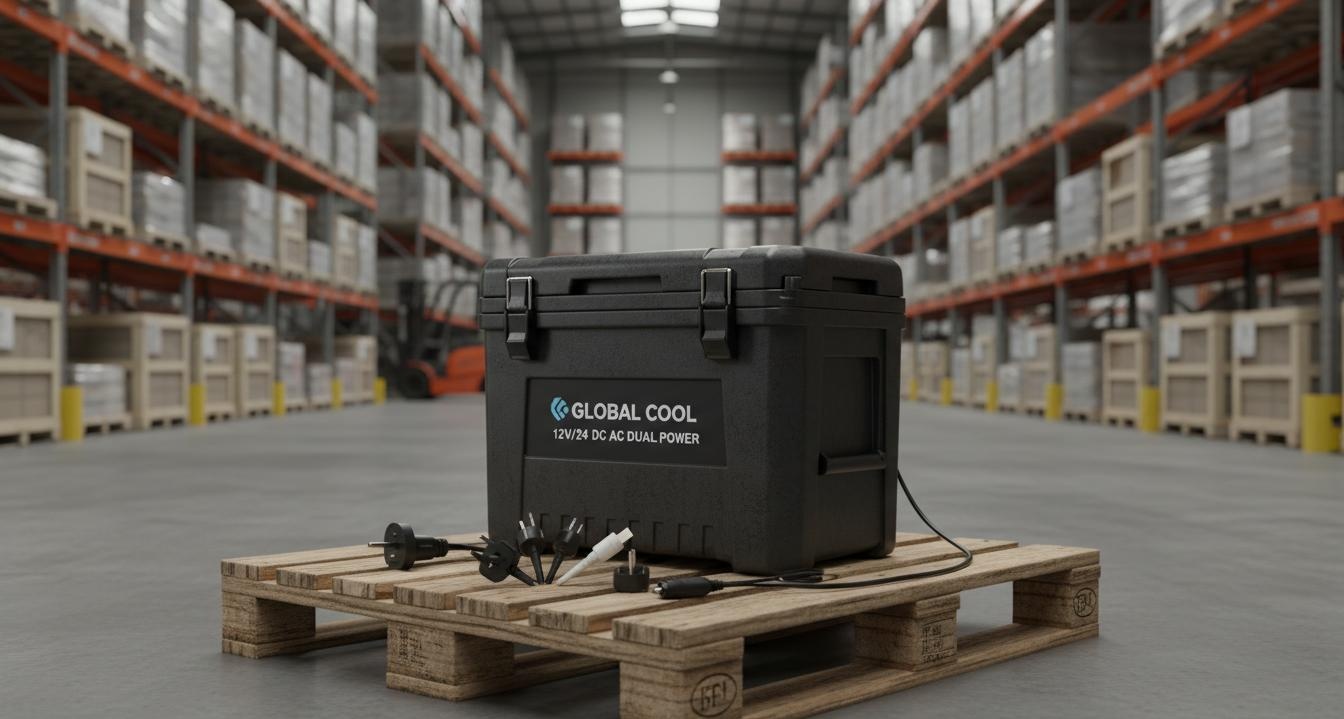
When sourcing cooler boxes (also called portable refrigerators or thermoelectric coolers) for wholesale export to global markets, one of the most critical—and frequently misunderstood—specifications is the power system. A cooler box that works perfectly in the United States may be completely incompatible in Germany or Australia, because different countries operate on different voltages and use different plug types. This gap between markets creates significant procurement challenges for B2B buyers ordering container quantities for multiple regions.
This comprehensive guide explains how dual-voltage 12V/24V AC/DC power systems actually work, which markets use which voltage standards, and how to specify the correct power configuration for your wholesale orders. Whether you’re a distributor ordering for a retail chain or a brand owner sourcing under your own label, understanding these technical distinctions will prevent costly mistakes and ensure your products work in every market you serve. Our B2B sourcing blog provides additional guidance on global product specifications.
For buyers comparing available models before specification, Aisberg’s cooler box product catalog is the most relevant starting point because it keeps power-system choices tied to actual product configurations rather than abstract voltage claims.
The core reality: there is no such thing as a truly “universal” power system. However, most factories now build intelligent auto-switching circuits that detect input voltage and adapt automatically—which effectively achieves universal compatibility across 110V, 220V, and 240V markets. The key is understanding what’s actually inside the unit versus what marketing claims promise.
Why “Universal Power” Claim Is Often False — The Reality of Global Voltage compatibility
The marketing term “universal power” is technically meaningless in most contexts. When a factory claims their cooler box has “universal power,” they typically mean the unit accepts a wide input voltage range (such as 100V-240V AC), not that it will work seamlessly in every market without consideration.
The confusion arises because “universal” is used loosely in product descriptions. According to IEC (International Electrotechnical Commission) standards, true universal compatibility would require the device to automatically handle all global power configurations without damage or performance degradation. Most mid-range factories achieve a more limited form: they build units that accept 100V-240V AC input, but this doesn’t automatically solve the plug type problem or guarantee optimal performance across all voltage ranges.
Because different markets have fundamentally different power infrastructure, the same cooler box may perform differently depending on the source voltage. For example, a thermoelectric cooler rated at 12V DC will draw approximately 4-5 amps when connected to a 12V car cigarette lighter, but when connected to a 220V AC mains through a step-down transformer, it may pull only half the current and operate at reduced cooling capacity. Therefore, simply stating “100V-240V compatible” doesn’t guarantee identical performance in all markets—this is the reality manufacturers don’t always communicate clearly.
In practice, there are three power system tiers:
- Tier 1 (Basic): Single-voltage DC only (12V DC or 24V DC)—designed specifically for vehicle use.
- Tier 2 (Mid-Range): Dual-voltage DC (12V/24V DC switchable)—user manually selects the voltage via a physical switch.
- Tier 3 (Premium): Full AC/DC hybrid with auto-switching—accepts 100V-240V AC and 12V/24V DC, automatically detecting and configuring without user intervention.
For B2B wholesale orders targeting multiple markets, Tier 3 systems offer the greatest flexibility—but they also carry the highest unit cost. Understanding which tier your products actually use prevents mismatched expectations when your customers in different countries receive the same SKU but have different experiences.
Voltage Map: Which Markets Use 110V, 220V, and 240V — And Why It Matters for Your Order
There are only three major voltage standards globally: 100V-120V (primarily in the Americas and Japan), 220V-240V (in most of Asia, Europe, Africa, and Oceania), and a small number of 110V markets in certain developing regions.
When specifying orders for different markets, matching the voltage is non-negotiable—a 220V-powered cooler box will burn out when connected to 110V mains, and a 110V unit will either not function or produce severely reduced cooling when connected to 220V. Here is the practical voltage map for major markets:
| Region/Market | Nominal Voltage | Frequency | Plug Type |
|---|---|---|---|
| United States, Canada | 110V-120V AC | 60Hz | NEMA 5-15 |
| Japan | 100V AC | 50Hz/60Hz | NEMA 5-15 (JIS C 8303) |
| European Union (most) | 220V-240V AC | 50Hz | Type F (SCHUKO) |
| United Kingdom | 230V AC | 50Hz | Type G (BS 1363) |
| Australia, New Zealand | 230V-240V AC | 50Hz | Type I (AS 3112) |
| China | 220V AC | 50Hz | Type A/B (Grounded) or Type I |
| South Korea | 220V AC | 60Hz | Type C/F (KSC 8303) |
| India, parts of Asia | 220V-240V AC | 50Hz | Type C/D/M |
This matters for your wholesale order because specification errors are expensive to correct. If you order 2,000 units configured for 110V and ship them to a 220V market like Germany, you face three bad options: return shipping at your cost (typically $15-25 per unit), retrofit each unit with a new power supply ($8-12 per unit), or write off the entire shipment. Conversely, configuring for 220V and shipping to the US market requires transformers that most consumers won’t purchase, resulting in poor reviews and returns.
The practical solution factories use is the auto-switching power supply (a wide-voltage design called “universal input” or “switching mode power supply” / SMPS). An SMPS rated at AC 100V-240V will accept virtually any mains voltage globally, making one SKU usable across all markets. If your order volume exceeds 500 units per configuration, most factories will build this as a standard option without significant price premium.
At this stage, buyers should also request factory certification documentation so the claimed AC 100V-240V compatibility can be checked against the supplier’s existing compliance files before tooling or packaging decisions are locked.
Plug Type Standards: NEMA, SCHUKO, BS and AS configurations and their physical incompatibilities
Even when voltage is correct, the physical plug type determines whether your cooler box can be connected at all. This is the second major compatibility gap after voltage, and unlike voltage (which can theoretically be designed around with auto-switching technology), plug types are fundamentally regional and physically incompatible.
There are approximately 15 recognized plug types globally, defined by the IEC (International Electrotechnical Commission) system. For portable cooler boxes, four types cover the majority of markets:
- NEMA 5-15 (Type A/B) — North America, Japan: The familiar flat-blade plug with two or three prongs. Rated for 15A at 125V. This plug type uses a different pin configuration than European round pins, so adapters exist but permanent use of adapters is discouraged due to grounding and current capacity concerns.
- Type F (SCHUKO) — Continental Europe: The “Schuko” design with two round pins and side clips for grounding. Technically called CEE 7/4. This design is recessed and uses a different hole configuration than the US Type F; it cannot accept Type C/E plugs without an adapter, and vice versa.
- Type G (BS 1363) — UK, Ireland, parts of the Middle East: The distinctive triangle of flat prongs with a built-in fuse. Uses BS 1363 standard, rated at 13A maximum. One of the most physically distinct designs globally—no other plug type can be forced into a Type G socket without an adapter.
- Type I (AS 3112) — Australia, New Zealand, China, Argentina: Similar to US plugs but with angled configuration and different pin dimensions. As per AS/NZS 3112, rated at 10A. The angled design prevents insertion of other plug types.
Because plug types cannot be auto-converted (unlike voltage), the practical wholesale solutions are either:
- Ship market-specific power cords: The cooler box comes with an IEC C13/C14 socket (the standard computer-style power input), and you include a market-specific cord in the box. This reduces inventory complexity because you only stock the main unit (one SKU for all markets) plus 4-5 cord SKUs. This is the approach taken by most major brands.
- Ship market-specific units: Factory builds different SKUs for each market plug type. Simpler for the end user but more complex for your inventory management—each country may legally require specific plug types to meet national safety standards.
- Include a universal travel adapter (not recommended for B2B): Some budget factories bundle cheap adapters. These rarely pass CE/UL safety requirements and create liability exposure.
The IEC C13/C14 power cord approach is now the industry standard for medium and high-end cooler boxes. The unit has a fixed, recessed power socket, and the user plugs in the cord specific to their market. This keeps the main unit SKU unified while allowing regional customization through the cord—a critical insight for efficient wholesale procurement.
Dual Voltage Design Options: How Factories Build 110V/220V Auto-Switching Systems
The underlying technology that makes dual-voltage (also called wide-voltage or universal input) systems work is called a Switching Mode Power Supply (SMPS). Unlike the traditional linear power supplies used in older electronics, which have a heavy transformer that converts one specific voltage to one specific output, SMPS uses electronic circuitry to accept a wide range of input voltages and deliver stable output.
Here are the core design options factories use for dual-voltage cooler boxes:
Option 1: Passive Voltage Selection (Budget Level)
This uses voltage-selection jumpers or switches inside the unit. A physical switch allows the user or installer to select between 110V and 220V mode before use. While functional, this introduces human error—customers may forget to check or incorrectly set the switch, causing damage. This design is declining in popularity for consumer products and is mostly seen in industrial equipment.
Option 2: Electronic Auto-Switching (Standard Level)
This circuit automatically detects input voltage and adjusts internal operation accordingly—no user intervention required. When connected to 110V, the SMPS draws more current to produce the same output; when connected to 220V, it draws less current. This is the current industry standard for portable cooler boxes from Grade A manufacturers.
The auto-switching circuit uses integrated circuits (ICs) specifically designed for this application. A typical SMPS board in a 12V DC thermoelectric cooler box uses a voltage sensing IC that monitors input and adjusts the power conversion stage accordingly. The technical specification commonly listed is “AC 100V-240V, 50/60Hz” or “DC 12V/24V auto-detect.”
Option 3: True Dual-Path Architecture (Premium Level)
This design has completely separate input paths for AC and DC power. The unit can be powered by either a 12V/24V DC source (like a car cigarette lighter) or 100V-240V AC mains, using independent conversion pathways inside the unit. When both are connected simultaneously, a priority circuit determines which source receives priority (usually AC mains, as it provides more stable long-term power).
This architecture is required for professional/commercial cooler boxes that must operate continuously in either mobile (vehicle) or stationary (mains) configurations. If your use case involves both in-vehicle and in-office/home use, this dual-path design is the correct specification.
In my experience reviewing customer projects, the most common misunderstanding is assuming “12V/24V” automatically includes AC mains compatibility. The specification “12V/24V DC” specifically refers to direct current (like a car battery or battery bank), not alternating current from wall outlets. For true global AC compatibility, always specify “AC/DC hybrid with auto-switching” rather than just “12V/24V”—otherwise you may receive DC-only units that cannot be plugged into home mains.
Power Cord Options: IEC C13/C14 vs Country-Specific Cords and MOQ Implications
The power cord is often where buyers unexpectedly incur costs and complexity. Understanding the cord ecosystem and minimum order quantities (MOQ) prevents unpleasant surprises in large orders.
Understanding IEC C13/C14
The IEC C13/C14 connector is the standard power input for most modern electronics (computers, monitors, printers, and indeed, modern cooler boxes). The socket is the female C14 (the one with holes), and the cord ends in the male C13 (the one with prongs). The other end of the cord is country-specific.
This modular approach means one cooler box SKU can serve all markets—you simply package a different cord for each destination market. The cords are cheap (typically $1.50-3.00 per unit in bulk), but the MOQ and inventory logistics require planning.
Typical MOQ for Power Cords
| Cord Type | Typical MOQ | Price Range (per unit in 1K+ orders) |
|---|---|---|
| US NEMA 5-15P (Type B) | 500-1,000 pcs | $1.20-2.00 |
| EU SCHUKO (Type F) | 500-1,000 pcs | $1.50-2.50 |
| UK BS 1363 (Type G) | 200-500 pcs | $2.00-3.50 |
| AU/AS 3112 (Type I) | 300-500 pcs | $1.80-3.00 |
| Universal IEC C13 only (no plug) | 1,000-2,000 pcs | $0.80-1.50 |
Note: These are representative ranges as of 2026 Q1. Actual pricing varies with copper prices, factory relationships, and order volume. UK cords have higher per-unit cost because of the required fuse (BS 1363 mandates a 3A or 13A fuse in the plug).
Because cord MOQs matter practically, there are four procurement strategies for wholesale buyers:
- Single-market focus: Order only for your primary market. No cord switching required but limits distribution flexibility.
- Country-specific SKU strategy: Place orders with complete SKUs for each target market. Each SKU includes the correct pre-packaged cord. Higher manufacturing complexity but easiest for end customers.
- IEC socket + bulk cord strategy: Order main SKU with IEC C14 socket, order cords separately in full MOQ quantities. Lower total inventory but more SKUs to manage.
- Mixed pallet strategy: Order a mixed container with proportional cord quantities (e.g., 60% EU cords, 30% US cords, 10% UK cords). Requires factory cooperation and exact forecasting but optimizes for multi-market containers.
If you’re ordering full containers (typically 20-foot or 40-foot containers), the mixed pallet strategy typically produces the best economics. Work with your factory’s procurement team to calculate the optimal mix based on your target markets.
Market-by-Market Compliance: CE/FCC/CCC/PSE Certifications Required Per Country
Certification is not optional—or transferable between markets. Each major market has its own mandatory certification requirements, and selling an uncertified product (or one certified for the wrong market) can result in customs seizure, fines, product recalls, and legal liability.
Here are the major certification requirements for cooler boxes by market:
| Market | Required Certification | Scope | Typical Timeline |
|---|---|---|---|
| United States | UL / ETL + FCC Part 15 Class B | Safety testing for electrical products + electromagnetic compatibility | 4-8 weeks |
| European Union | CE (LVD + EMC) + RoHS | Low Voltage Directive, EMC directive, Restriction of Hazardous Substances | 3-6 weeks |
| China | CCC (CQC certification) | Compulsory certification for products in the CCC catalog | 6-10 weeks |
| Japan | PSE ( DENAN ) | Electrical product safety under the Electrical Appliance and Material Safety Act | 4-8 weeks |
| Australia | RCM + AS/NZS standards | Regulatory Compliance Mark with Australian/New Zealand standards | 3-6 weeks |
| South Korea | KC (KTC) certification | Korean Electrical certification | 4-8 weeks |
Understanding certification scope prevents duplicate testing: CE testing in Europe does not qualify a product for US sale, and vice versa. Each certification requires separate testing, documentation, and factory inspection (in most cases). However, some test reports can be shared between markets if the underlying standards are harmonized (e.g., IEC 60335 for household appliances is the basis for both UL and CE testing).
For B2B buyers sourcing for a brand, plan certification as follows:
- For single-market brands: Only certify for your market. Don’t pay for certifications you don’t need.
- For multi-market brands: Request the factory hold all required certifications. Some factories (like Ningbo Iceberg) maintain certifications for major markets in parallel, which reduces per-unit cost versus certifying separately for each order.
- For private label (OEM) orders: Clarify in your purchase agreement whether certifications transfer with the order or must be re-issued under your brand name. This has significant cost and timeline implications.
In practical procurement terms, the certification timeline must be built into your production schedule. Adding 4-10 weeks for certification to an already tight timeline often creates delays that cost more than the certification itself, especially for seasonal retail products.
If the order needs market-specific labels, plugs, or certificate alignment, contact the B2B specification support team before placing the purchase order so voltage, plug type, and certification scope are confirmed together.
Frequently Asked Questions
Q1: Can I use a 12V DC cooler box with 220V AC mains power?
No, not without additional equipment. A 12V DC-only cooler box is designed specifically for direct current input (like a car cigarette lighter or battery). Connecting it directly to 220V AC mains will damage the unit permanently. For dual AC/DC capability, you must order a unit with AC/DC hybrid auto-switching (typically specified as “AC 100V-240V / DC 12V-24V”). Alternatively, you can use an external AC-to-DC power adapter (like a laptop-style power brick) to convert 220V AC to 12V DC, but this adds cost, complexity, and a separate component to track. The cleaner solution for global markets is the AC/DC hybrid unit.
Q2: What’s the difference between 12V and 24V cooler boxes?
The primary difference is the operating voltage and resulting current draw. A 12V cooler box draws approximately twice the current (in amps) as a 24V unit to produce the same cooling power, because power (watts) equals voltage times current (P = V × I). For vehicle use, 12V is the standard (the cigarette lighter socket is 12V in most vehicles). For stationary or commercial applications with access to 24V power systems (some RVs, trucks, boats), 24V units offer efficiency advantages because lower current means thinner wiring and less heat generation in the power system. If you’re ordering for both vehicle and stationary markets, dual-voltage 12V/24V units or AC/DC hybrid units best serve both applications.
Q3: Can I ship the same SKU to both 110V and 220V markets?
Yes, if the unit has auto-switching capability (wide-voltage SMPS rated at 100V-240V AC). This is now standard for Grade A and B factories. However, even with correct voltage, you still need to address plug types (NEMA for US, SCHUKO for EU, etc.). The most practical approach is ordering units with IEC C14 power sockets and including market-specific cords in each package. This gives you one main SKU while satisfying regional requirements. For markets with specific labeling requirements (CE marking for EU, CCC marking for China), the unit must have completed certification testing specifically for that market—certifications are not interchangeable.
Q4: How do I know if a cooler box from a factory actually meets the voltage specifications they claim?
Request three things: first, the power supply/transformer specifications from the manufacturer’s datasheet (the SMPS IC model number and its rated input range); second, a factory test report showing the unit tested at both 110V and 220V input; and third, hold a pre-shipment inspection (ESI / EN 10204 3.1 inspection certificate) where the inspector uses a variac to test the units across the full claimed voltage range. Many factories quote specifications they don’t fully test—insist on verification. For critical orders, third-party testing agencies (SGS, Bureau Veritas, Intertek) offer verification services at reasonable cost ($300-500 per day).
Q5: What certifications do I need for my brand name to appear on the cooler box?
This depends on OEM vs. ODM structure: In OEM (Original Equipment Manufacturing), you provide your brand to be printed on existing certified products. The factory transfers their existing certifications to your brand (or the certifications are already in your company’s name). In ODM (Original Design Manufacturing), you commission a custom design from the factory. Certification must be newly obtained under your brand name, which adds 4-12 weeks and typically $3,000-8,000 per market in testing and documentation fees. The faster path is OEM with certification transfer—but verify the factory’s certifications allow brand licensing (some do not). Clarify this explicitly before placing orders.
Conclusion: Matching Power Systems to Your Target Markets
Sourcing cooler boxes for global wholesale distribution requires matching three variables: voltage, plug type, and certification. The simplified approach is ordering units with auto-switching AC/DC hybrid power supplies (100V-240V input) and IEC C14 power sockets, then including market-specific cords for each destination. This strategy minimizes SKU complexity while maximizing market coverage.
The cheapest approach is not always the most cost-effective when you factor in returns, customs holds, and customer complaints from incompatible products. Investing in proper specifications upfront—whether you sell 100 units or 10,000—pays dividends in customer satisfaction and operational simplicity.
Post time: May-20-2026