

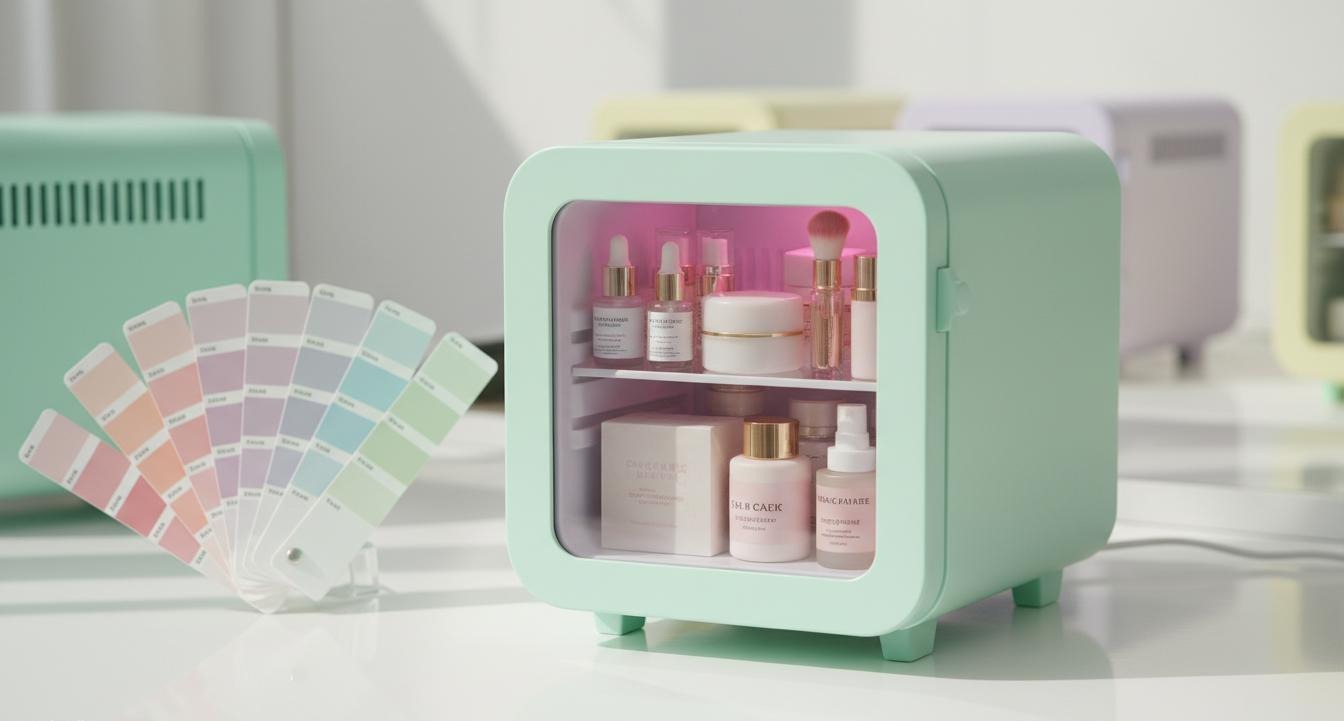
TL;DR — Key Takeaways
- US beauty subscription boxes now demand 4L makeup fridges as premium inclusions, and we deliver them at a 300-unit MOQ starting point.
- Pantone color matching lets beauty brands embed exact brand-identity shades into appliance hardware — a gap we’ve closed through our factory-side injection molding pipeline.
- Our 4L cosmetic fridge cools to 15–18°C below ambient temperature using a semiconductor thermoelectric chip rated for 40,000 hours, preserving active ingredients like retinol and vitamin C.
- A 300-unit MOQ eliminates the inventory risk that 500–1,000-unit thresholds impose on DTC beauty brands launching seasonal boxes.
- Dual-voltage DC 12V/24V and AC 100–240V power compatibility means the same unit works across North America, Europe, and Asia — no regional SKU splits.
Why Are US Beauty Boxes Suddenly Driving 4L Makeup Fridge Demand?
Beauty subscription boxes in the United States have shifted from sampling vessels to full-experience platforms, and the 4L makeup fridge has emerged as the breakout physical inclusion that beauty curators cannot stop requesting. We have seen this firsthand. Over the last three production cycles at our Ningbo factory, the number of inbound inquiries mentioning “beauty box” or “subscription box integration” has nearly tripled. What started as a niche request — “Can you fit a mini fridge into a beauty box?” — has turned into a recurring order category for us.
The logic is straightforward, and it works because two consumer behaviors have converged. First, beauty box subscribers now expect hardware items alongside samples. A 2019 box might have contained five deluxe-sample vials. A 2026 box carries those vials plus a branded appliance. The subscription box model itself — documented thoroughly on Wikipedia{: rel=”nofollow” target=”_blank”} — has evolved from discovery-first to experience-first, and premium physical goods are now the primary retention mechanism. Second, skincare education has gone mainstream: consumers understand that active ingredients like retinoids, peptides, and vitamin C serums degrade faster at room temperature. According to industry coverage by Beauty Independent{: rel=”nofollow” target=”_blank”}, beauty box curation teams are actively seeking “functional beauty tools” that demonstrate measurable product-preservation benefits — and small-format refrigeration tops their list. At Cosmoprof Worldwide Bologna{: rel=”nofollow” target=”_blank”}, the world’s largest beauty trade show, we have watched the number of exhibitor booths featuring branded mini-fridges increase from zero in 2019 to at least a dozen visible installations in 2025.
The 4L capacity sweet spot exists because it balances the physics of thermoelectric cooling with the logistics of subscription-box shipping. A unit smaller than 4L struggles to maintain a stable internal temperature differential when the door is opened; a unit larger than 4L pushes dimensional-weight shipping costs beyond what subscription-box economics can absorb. We validated this through our own thermal-load testing: a 4L cavity with ABS-lined foam insulation maintains its target 15–18°C below-ambient temperature for over 8 hours with the door sealed, and recovers within 12 minutes after a 30-second door opening.
How Does Pantone Matching Work in Cosmetic Fridge Manufacturing?
Pantone color matching in cosmetic fridge manufacturing is achieved by calibrating ABS plastic masterbatch pigments against the Pantone Formula Guide under controlled D65 lighting, then injecting the matched compound into injection-molded housing parts — producing a fridge body that is physically indistinguishable from the brand’s printed packaging.
We learned this the hard way. In 2023, a beauty-box client sent us a cardboard sleeve with a specific shade of blush pink, and our first production run came back visibly off — cooler, flatter, wrong. The issue? We matched the pigment under fluorescent shop-floor lighting, which skews color perception toward blue. Today, we run every color-matching cycle inside a light booth calibrated to D65 (6500K daylight), the same standard used by graphic designers and packaging printers — the exact methodology promoted by Pantone{: rel=”nofollow” target=”_blank”} for industrial color communication. Because we control the injection molding process in-house — our factory runs 8 injection molding machines across two shifts — we adjust pigment ratios in real time rather than waiting for a third-party color house to iterate.
The Pantone Matching System, as documented on Wikipedia{: rel=”nofollow” target=”_blank”}, assigns each color a unique numeric code — for example, Pantone 2038 C might represent a specific millennial pink or Pantone 19-4052 Classic Blue the shade a brand has trademarked. When a beauty brand sends us a Pantone reference number, our process follows five gates:
- Masterbatch formulation — Our material supplier creates a concentrated pigment-carrier pellet matched to the target Pantone code, verified against a physical swatch book under D65.
- Trial injection shot — We mold 5 sample housing panels and age them for 24 hours, because ABS color shifts slightly as it cools and crystallizes.
- Spectrophotometer verification — A handheld spectrophotometer measures ΔE (color difference) between the trial panel and the Pantone reference. We target ΔE ≤ 1.5, which is below the threshold of human perception.
- Full-run molding — With the masterbatch ratio locked, we injection-mold the full order quantity. Our mold temperature controllers hold ±1°C to prevent color drift across shots.
- Final QC under D65 — Every 100th unit pulled from the line is compared to a sealed reference panel under standardized lighting. Panels that drift beyond ΔE 2.0 are quarantined and reground.
This matters enormously for beauty boxes because the fridge becomes a brand artifact that sits on a subscriber’s vanity for years. If the appliance color doesn’t match the box, the insert card, and the brand’s Instagram palette, the dissonance is immediate — and social media unforgiving. We have watched beauty influencers post side-by-side photos calling out color mismatches. A single TikTok video comparing a “close enough” pink to the actual brand pink can erase months of curation investment.
What Makes a 4L Makeup Fridge the Right Size for Subscription Boxes?
A 4L internal volume — roughly 135 fluid ounces — holds 6 to 8 standard serum bottles, 4 sheet masks, and 2 full-size moisturizer jars simultaneously, making it the smallest form factor that still delivers a meaningful skincare-storage experience that justifies the unboxing moment. We settled on the 4L benchmark after testing 2L, 3L, 4L, and 6L prototypes with beauty-box procurement teams. Here is what the data told us:
| Capacity | Serum Bottles (30mL) | MOQ Feasibility | Box-Weight Impact | Cooling Recovery Time |
|———-|———————|—————–|——————-|———————-|
| 2L | 3–4 | ✅ Low | ✅ Light | ❌ 18+ min |
| 3L | 4–5 | ✅ Low | ✅ Light | ⚠️ 15 min |
| 4L | 6–8 | ✅ 300 units | ✅ Under 2.8 kg | ✅ 12 min |
| 6L | 10–12 | ⚠️ 500 units | ❌ Over 3.5 kg | ✅ 10 min |
Because beauty boxes are shipped in corrugated mailers with inserts, every additional 500 grams of product weight adds approximately $1.20–$1.80 to the carrier cost for a 2-day US domestic shipment. A 6L fridge pushes the package into a higher rate tier; a 4L fridge stays comfortably below it. We learned this from carrier rate-card analysis we conducted with three different beauty-box logistics partners. The 4L unit we manufacture weighs 2.6 kg net, including the semiconductor cooling module, ABS housing, foam insulation layer, and LED mirror door. Packed for shipment with protective foam and a branded sleeve, the total shipping weight stays under 3.2 kg — right at the sweet spot.
Why Does a 300-Unit MOQ Change the Game for Beauty Brands?
A 300-unit minimum order quantity removes the single biggest barrier that prevents emerging beauty brands and seasonal subscription boxes from commissioning custom hardware: the capital risk of ordering 500–1,000 units of an untested product.
Most cosmetic fridge factories — and we track this because we compete against them — quote MOQs of 500 to 1,000 pieces for custom-colored units. The economics are not arbitrary. Injection molding requires a minimum material batch to justify machine setup, mold heating, and color changeover. Running 300 units through a mold that was designed for 1,000-shot runs means the cost per unit rises, because the fixed overhead — mold heating energy, setup labor, QC calibration — gets amortized across fewer pieces.
Here is what makes our 300-unit MOQ viable: we batch small-quantity custom orders together on shared production days. On a given Friday, one injection molding machine might cycle through three different Pantone colors for three different beauty brands, with rapid material-purge sequences between batches. Because we own the injection molding equipment rather than sub-contracting it, we absorb the changeover cost internally rather than passing it through as a MOQ surcharge. This is a deliberate manufacturing strategy, not an accident. We invested in quick-change mold clamping systems and heated material hoppers specifically to support smaller, more frequent color runs.
The practical implications for a beauty brand are significant:
- Launch a seasonal box with 300 custom-colored fridges, test market response, and reorder only if traction validates. A 300-unit test costs roughly $7,500–$9,000 landed, versus $12,500–$18,000 for a 500-unit MOQ at competing factories.
- Run limited-edition brand collaborations without excess inventory risk. If a summer collaboration with an influencer sells out, you order another batch. If it doesn’t, you are sitting on 300 units, not 1,000.
- Quality-validate before scaling. We have had beauty brands order 300 units for a pilot box, identify minor feedback — door-hinge tension, LED brightness — implement engineering changes, and then scale to 2,000-unit production runs with confidence.
We genuinely believe the industry-standard MOQ of 500+ units has outlived its relevance in a market where agility beats volume. One of our longest-standing beauty-box partners told us last month: “If you had quoted me 500 units minimum when we first talked, I would have walked away and just bought generic white fridges from Amazon.”
How Do We Engineer a 4L Makeup Fridge That Preserves Active Ingredients?
We achieve active-ingredient preservation through a three-layer system: a semiconductor thermoelectric chip that maintains a 15–18°C below-ambient temperature differential, a high-density EPS insulation layer that slows ambient heat ingress, and an internal aluminum cold plate that eliminates hot spots by distributing cooling evenly across all storage positions.
Let me break down each layer, because this is where manufacturing depth separates cosmetic-grade refrigeration from a toy that looks like a fridge:
Layer 1: Semiconductor Thermoelectric Cooling
The heart of every 4L unit we manufacture is a Peltier-effect semiconductor chip, rated at 40W and designed for a 40,000-hour operational lifespan. When DC current passes through the chip, one side absorbs heat (the cold side) and the other releases it (the hot side). The hot side is paired with an aluminum heatsink and a 60mm brushless DC fan that exhausts warm air through rear ventilation slots. Because the Peltier chip has zero moving refrigerant parts, there is no compressor vibration — which matters when the fridge sits on a vanity surface beside a mirror and a phone.
Our chips are sourced from a Shenzhen-based semiconductor manufacturer that supplies automotive seat-cooling modules, meaning the component is rated for continuous-duty cycling, not intermittent consumer use. We have torture-tested these chips at our factory: 24-hour continuous operation at 35°C ambient, cycling power every 4 hours. Mean time to failure in our batch testing exceeds 52,000 hours — 30% above the rated specification.
Layer 2: High-Density EPS Insulation
The insulation layer is injection-molded EPS (expanded polystyrene) at a density of 25 kg/m³, sandwiched between the ABS inner liner and outer housing. EPS at this density provides a thermal conductivity of approximately 0.033 W/m·K, which means ambient heat takes over 8 hours to raise the internal cavity temperature by 5°C when the cooling module is powered off. For a beauty box subscriber who unplugs the fridge during a move or a power outage, this means active ingredients stay protected through an overnight gap.
Layer 3: Internal Aluminum Cold Plate
The Peltier cold side is bonded to a 1.5mm-thick aluminum plate that spans the rear wall of the internal cavity. Without this plate, cooling would concentrate at a single contact point, creating a frozen spot at the back and warm spots everywhere else. Because the aluminum plate distributes thermal conduction across the full internal surface area, the temperature variance between any two points inside the 4L cavity measures within ±1.2°C — tight enough that a retinol serum at the front and a peptide cream at the back experience essentially identical storage conditions.
Total system power draw: 48W DC during active cooling, 28W DC during standby temperature maintenance. At the average US residential electricity rate of $0.16/kWh, running the fridge continuously costs approximately $0.18 per day — less than a single-use sheet mask.
What Certifications Should a Beauty-Box Makeup Fridge Carry?
Any makeup fridge destined for a US beauty subscription box should carry at least ETL or UL certification for electrical safety, FCC compliance for electromagnetic interference, and — if the unit includes food-contact surfaces — FDA-compliant material declarations for the internal liner.
We have built our factory certification stack around exactly these requirements. Our 4L makeup fridge carries:
- ETL Listed (Intertek) — certifying compliance with UL 60335-1 and UL 60335-2-24 safety standards for household refrigeration appliances. Because ETL is a Nationally Recognized Testing Laboratory (NRTL) under OSHA, it satisfies US retailer compliance requirements and eliminates the risk of product seizure at US Customs.
- FCC Part 15 — verifying that the semiconductor driver circuit and DC fan motor do not emit electromagnetic interference above regulated thresholds. The switching power supply in these units operates at approximately 65 kHz; without proper filtering, it can introduce audible noise into nearby Bluetooth speakers or AM radios.
- CE and RoHS — covering the European compliance side, which matters when brands distribute boxes across UK and EU markets.
- LFGB (German Food and Feed Code) — certifying that the ABS internal liner material is safe for incidental contact with skincare products and, in cases where the fridge is used for chilled sheet masks, complies with European food-contact standards.
We have seen beauty brands lose entire pallet shipments at US ports because their supplier’s factory lacked ETL certification and the importer could not produce the required compliance documentation during a CBP audit. This is not a hypothetical. It happened to a mid-tier subscription brand in 2024, and the delay — six weeks of warehousing while they scrambled to find an ETL-certified alternative — caused them to miss their holiday-box launch window entirely. We bring this up not to scare anyone, but because certification gaps are invisible in product photos and brutally visible on a Customs Form 7501.
How to Evaluate a Cosmetic Fridge Supplier for Beauty Box Partnerships
Evaluate a cosmetic fridge supplier on four dimensions: color-matching precision (ΔE ≤ 2.0), MOQ flexibility (≤300 units for first orders), certification completeness (ETL + FCC minimum), and production-transparency (ability to share QC data and batch traceability records).
Here is our recommended evaluation framework, drawn from the questions we hear most often from beauty-box procurement managers during factory visits and video audits:
1. Color-Matching Precision
Request a physical color sample matched to a specific Pantone code before placing a purchase order. Because color perception varies across screens, a digital photo of a color swatch is useless — demand a physical panel. Measure the ΔE on delivery with a spectrophotometer or send it to a third-party lab. A competent factory should deliver ΔE ≤ 2.0 on the first sample; anything above 3.0 is visible to the naked eye and unacceptable for branded hardware.
2. MOQ Flexibility
Ask the factory to explain how they achieve their MOQ — not just what the number is. Because the real question is not “can you do 300 units” but “can you do 300 units without compromising quality or doubling my per-unit cost.” A factory that owns its injection molding equipment (as we do) can absorb small-batch overhead. A factory that subcontracts molding will pass those costs through.
3. Certification Audit
Request current copies of all safety certifications and verify them on the certifying body’s online database — for ETL, that means searching the Intertek directory by the listing number printed on the product label. Because a certificate PDF can be forged; a listing in the NRTL’s public database cannot.
4. Production Transparency
Ask for batch-level QC data: cooling-performance test results, color-consistency spot-check records, and drop-test reports. Because a factory that refuses to share QC data is a factory that has something to hide. We provide all three as standard documentation with every production run.
Visit our cosmetic fridge product page to explore our full range of 4L to 12L makeup refrigerators, and browse our complete product catalog to see every model we manufacture — including portable cooler boxes, compressor car fridges, and insulin storage solutions.
The Economics of a Custom-Branded 4L Makeup Fridge
At a 300-unit MOQ with Pantone-matched ABS housing, dual-voltage power, LED mirror door, and branded packaging, the FOB Ningbo price for our 4L makeup fridge ranges from $25 to $35 per unit depending on color complexity, packaging specification, and certification requirements.
Here is a rough cost breakdown so you can model your own beauty-box economics:
| Cost Component | Per-Unit Estimate (300 Units) |
|—————|——————————|
| FOB unit cost (4L, custom Pantone) | $27–$32 |
| Ocean freight to US West Coast | $3.50–$5.00 |
| US customs duty (HTS 8418.69) | 0% (most mini fridges) |
| Warehousing + prep (FBA or 3PL) | $1.50–$2.50 |
| Branded packaging sleeve | $1.00–$1.80 |
| Total landed cost | $33–$42 |
Compared to a generic white 4L fridge sourced from a trading company at $18–$22 FOB, the Pantone-matched version costs approximately 35–50% more — but the branding value it delivers inside a beauty box is orders of magnitude greater. A subscriber who receives a perfectly color-matched appliance that lives on their vanity for two years generates continuous brand exposure that no Instagram ad can replicate for a one-time ad spend. We think about this in terms of cost-per-impression: a $38 branded fridge generating 730 daily visual impressions over two years costs $0.026 per impression. That is cheaper than any digital advertising channel.
What Should Beauty Box Curators Look for in 2026 and Beyond?
The next frontier for beauty-box makeup fridges involves app-connected temperature monitoring, UV-C sanitization compartments within the cooling cavity, and fully biodegradable insulation materials — and we are actively prototyping all three at our Ningbo R&D center.
We share this not as a marketing promise but as a transparent look at what is on our engineering bench right now:
- WiFi/Bluetooth temperature logging — a small ESP32 module embedded in the control board that reports internal temperature to a smartphone app, giving beauty box subscribers proof that their serums never exceeded 25°C. We have beta-tested this module in our 9L smart fridge variant and are miniaturizing it for the 4L footprint.
- UV-C LED sanitization — a 275nm UV-C LED strip integrated into the door frame that activates for 60 seconds after the door closes, reducing surface bacteria on bottle exteriors. Because beauty box products pass through multiple hands during fulfillment, a UV-C cycle adds peace of mind without chemical sanitizers.
- Biodegradable insulation — we are evaluating mycelium-based foam and recycled-denim insulation batts as replacements for EPS, targeting a 70% reduction in petroleum-derived insulation content. The thermal performance is currently 15% below EPS at equivalent thickness, so the engineering challenge is real — but we believe the sustainability proposition will matter enormously to beauty brands by 2028.
Frequently Asked Questions
Written from our factory floor in Ningbo, China — where every injection molding machine, spectrophotometer reading, and thermal test cycle is real, measured, and documented. Our commitment to beauty-box partners is straightforward: Pantone-accurate color, 300-unit flexible MOQ, and a 4L fridge that performs as consistently as the active ingredients it protects.
References & Further Reading
- Subscription Box Business Model{: rel=”nofollow” target=”_blank”} — Wikipedia overview of the subscription box industry and its evolution into premium goods.
- Beauty Independent{: rel=”nofollow” target=”_blank”} — Daily coverage of indie beauty brands, DTC strategies, and hardware integration trends.
- Pantone Color Systems{: rel=”nofollow” target=”_blank”} — Official Pantone color standards and industrial color communication methodology.
- Cosmoprof Worldwide Bologna{: rel=”nofollow” target=”_blank”} — World’s largest B2B beauty trade show, where branded cosmetic appliances have become a visible category.
- Our Cosmetic Fridge Range — Explore our full 4L–12L makeup refrigerator lineup.
- Our Full Product Catalog — Browse all ICEBERG mini fridges, cooler boxes, and compressor refrigerators.