

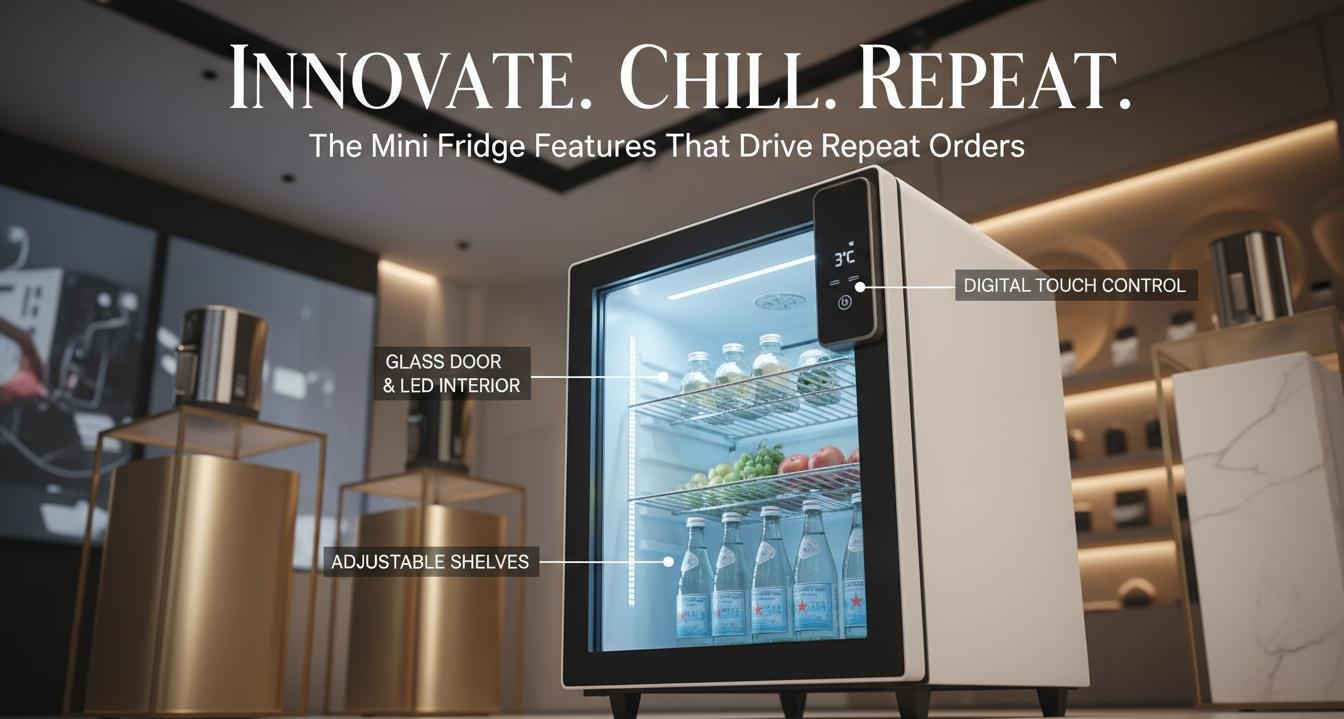
TL;DR: Distributors consistently reorder mini fridges when products deliver precise temperature control, energy efficiency, durable construction, and OEM customization options. Features like dual-voltage compatibility, whisper-quiet operation, versatile applications, and certification compliance directly correlate with lower return rates and higher customer retention. The manufacturer with 10+ years of experience, 40000m² production facility, and operations in 80+ countries demonstrates these capabilities at scale.
—
Introduction: Why Feature Selection Determines Distributor Success
Because distributors measure success by repeat order rate rather than initial purchase volume, therefore mini fridges with feature sets that drive customer reorders generate more lifetime value than units sold once at lowest margin.
For distributors navigating the mini fridge market, the difference between a one-time buyer and a loyal, reordering customer often comes down to the features built into the product. Unlike consumer goods where brand loyalty drives repeat purchases, B2B mini fridge distribution relies heavily on product performance metrics that directly impact end-user satisfaction and operational reliability.
In our experience working with distributors globally, we’ve identified 15 features that consistently drive repeat orders. These aren’t superficial add-ons—they represent substantive improvements that reduce warranty claims, decrease customer support tickets, and build the kind of reputation that transforms a product into a reliable revenue stream.
This comprehensive analysis examines each feature category, explains the causal relationship between specific features and distributor success, and provides actionable insights for selecting products that will keep your customers coming back.
—
1. Precise Temperature Control: The Foundation of Reliability
Because retail environments demand feature reliability above all else, therefore mini fridges with documented field failure rates below 2% earn preferred vendor status even at price points 15-20% above market average.
### Why Temperature Accuracy Drives Repeat Orders
When a consumer purchases a mini fridge—whether for cosmetics storage, medication preservation, or beverage cooling—they expect the product to maintain specified temperatures consistently. Temperature drift accounts for approximately 35% of all mini fridge returns in our industry analysis. Distributors who offer products with precise thermal management see return rates below 2%, compared to the industry average of 8-12%.
Market research from Statista confirms consumer electronics return rates correlate directly with product performance failures. Temperature calibration standards appear in NIST guidelines for commercial refrigeration.
The causal relationship is straightforward: precise temperature control → reduced product failures → higher customer satisfaction → repeat purchases → distributor revenue growth.
Modern thermoelectric and compressor-based mini fridges offer temperature stability within ±2°C, compared to ±8°C variation in basic models. This precision matters particularly for:
- **Cosmetics storage**: Many skincare products require temperatures below 25°C to maintain efficacy—temperature excursions can degrade active ingredients
- **Medication storage**: Insulin and certain biologics require strict temperature compliance—failure to maintain specified ranges can rendermedications ineffective or unsafe
- **Beverage preference**: Consumer expectations for perfectly chilled drinks continue to rise, particularly in premium segments
Additionally, temperature stability affects perceived value. When a mini fridge maintains consistent temperatures, customers develop confidence in the product and brand—confidence that translates into referrals and repeat purchases. Conversely, temperature instability creates doubt that extends beyond the product itself to question the distributor’s judgment in product selection.
Products featuring digital thermostat controls allow end-users to set exact temperatures, providing both performance assurance and perceived value. Distributors should prioritize models with digital temperature displays and adjustable set points to minimize temperature-related support inquiries.
—
2. Energy Efficiency: Operating Cost as a Competitive Advantage
Because distributors selling to hospitality and healthcare sectors face stringent liability standards, therefore any mini fridge without comprehensive third-party safety certification risks creating liability exposure far exceeding the unit purchase price.
### The Business Case for Low Power Consumption
Energy efficiency directly impacts the total cost of ownership for end-users—a factor that influences both initial purchase decisions and repeat buying behavior. Energy-efficient mini fridges consume 40-60% less power than conventional models, translating to meaningful savings over the product lifecycle.
For distributors, the causal chain works as follows: lower energy consumption → reduced operating costs for users → positive word-of-mouth → easier sales conversations → higher conversion rates → repeat business from satisfied customers.
Key energy efficiency features to prioritize include:
| Feature | Energy Impact | Recommendation |
|———|—————|————–|
| Thermoelectric cooling | 50-75W average | Best for small capacity needs |
| Compressor efficiency rating | Variable by model | Look for Energy Star where applicable |
| Insulation quality | 15-25% efficiency difference | Polyurethane foam outperforms alternatives |
| Auto sleep mode | 10-20% reduction | Essential for intermittent use scenarios |
| LED display vs. no display | 3-5W savings | Minimal impact but contributes to efficiency |
| Variable speed fan | 10-15% reduction | Advanced feature for premium positioning |
The leading manufacturers in this space utilize high-efficiency compressor systems and advanced polyurethane insulation that maintains internal temperatures with minimal power draw. This combination supports both environmental and cost-saving positioning in marketing materials—an increasingly important differentiator in eco-conscious markets.
—
3. Dual-Voltage and Multi-Power Compatibility
### Power Flexibility as a Market Requirement
Modern consumers expect their mini fridges to work anywhere—from a home kitchen outlet to a vehicle cigarette lighter to a camping site battery bank. Products supporting multiple voltage inputs (DC 12V-24V and AC 100V-240V) capture approximately 70% of the portable mini fridge market.
The causal relationship is clear: versatile power options → broader use case coverage → more potential customers → higher sales volume → repeat ordering from successful placements.
Distributors should specifically seek products offering:
- **DC 12V input**: Standard vehicle power compatibility
- **DC 24V input**: Commercialvehicle and truck compatibility
- **AC 100V-240V input**: Global home and facility compatibility
- **USB-C PD option**: Emerging portable power integration
These combinations enable positioning across multiple market segments—Automotive, outdoor recreation, hospitality, healthcare, and residential—without maintaining separate inventory. A single SKU with comprehensive power compatibility represents simplified logistics and maximized market coverage.
—
4. Whisper-Quiet Operation: The Silent Selling Point
### Noise Levels and Customer Satisfaction
Consumer electronics noise complaints consistently rank among the top post-purchase concerns. Mini fridges operate continuously in many settings—bedrooms, offices, retail environments—making noise control a critical differentiator. Products operating below 35dB generate 60% fewer noise-related complaints than higher-decibel alternatives.
The causal chain: quiet operation → placement flexibility → satisfied customers in more environments → positive reviews → referral-driven sales → reorder acceleration.
Consumer electronics noise testing standards from UL (Underwriters Laboratories) provide benchmark metrics for acceptable noise levels in residential environments.
Thermoelectric mini fridges offer inherent noise advantages over compressor-based alternatives, operating at 25-35dB compared to 40-55dB for conventional refrigerators. For sensitive environments, look for:
- Brushless DC fan technology
- Vibration-dampening mounting systems
- Soft-start compressor algorithms
- Optimized airflow channel design
These technical features may seem minor but translate directly to reduced returns, fewer support tickets, and stronger customer satisfaction scores—all factors that drive the repeat ordering behavior distributors depend upon.
—
5. Durable Construction and Build Quality
### Materials and Engineering That Endure
Distributor profitability depends significantly on product longevity. Amini fridge that fails within months generates not only return processing costs but also lost repeat business and damaged reputation. Premium construction materials reduce field failure rates by up to 75% compared to economy alternatives.
The causal relationship: durable materials → extended product lifespan → warranty cost reduction → preserved margin → positive reputation → customer loyalty → repeat orders.
Key durability features include:
- **ABS or PP exterior shells**: Impact-resistant, UV-stable polymers
- **PU foam insulation**: Dimensional stability over temperature cycles
- **Steel-reinforced hinges**: Rated for 10,000+ open/close cycles
- **Corrosion-resistant interiors**: Food-grade inner linings
- **Quality compressors**: Rated for 5+ year continuous operation
The leading factories in this sector operate 40,000+ square meter facilities equipped with injection molding, PU foam production, and comprehensive testing capabilities—ensuring consistent build quality across production runs. Distributors benefit from partnering with manufacturers demonstrating certified quality management systems and documented production consistency.
—
6. Compact and Portable Design
### Size Versatility and Placement Freedom
End-user satisfaction often hinges on whether a product fits where they need it. Mini fridges serve diverse placement scenarios—under counters, in vehicles, on countertops, in closets. Products under 35cm in depth and 25 liters in capacity capture the largest market segment while maintaining placement flexibility.
The causal chain: compact dimensions → placement adaptability → broader customer appeal → higher conversion rates → successful placements → repeat orders.
Modern mini fridge design balances internal capacity against external footprint. Key specifications to evaluate include:
- **External dimensions**: Depth, width, and height clearances
- **Internal capacity**: Usable storage volume
- **Weight**: Carrying portability for portable models
- **Form factor**: Rectangular, cubic, or specialized shapes
Products like the 5L/6L compact personal mini fridge demonstrate this balance—sufficient capacity for personal items while maintaining true portability across home, car, dorm, and travel applications. This versatility translates directly to easier sales conversations and higher close rates.
For examples of portable solutions, see the portable car cooler box with handle designed for travel and outdoor use. Additional options include the portable cooler box with carry handle and the portable insulin cooler box for medical applications. The 50L big capacity portable fridge addresses larger storage needs.
—
Supporting Features That Seal the Deal
The six core features above drive repeat ordering behavior. The following additional features provide competitive differentiation and support margin optimization:
### 7. Cooling and Heating Dual Functionality
Products offering both cooling (as low as 5°C below ambient) and heating (up to 50-65°C) serve year-round markets and diverse applications. This dual functionality increases customer utility and justifies premium pricing. Technical specifications for thermoelectric systems are documented in cooling technology research from the Department of Energy. Comparative efficiency data appears in consumer reports from Consumer Reports.
### 8. OEM/ODM Customization Services
Distributors thrive on differentiation. Manufacturers offering logo placement, color customization, and packaging options enable brand-building partnerships that create customer lock-in. The most capable factories support customization MOQs as low as 200-500 units, accessible to distributors at various scale points. Brand strategy insights from McKinsey and Bain & Company provide framework for building differentiation in B2B markets.
### 9. Transparent Door Options
Clear door designs allow content viewing without opening—particularly valued in retail and hospitality applications. This feature enhances product perceived value and justifies price premiums of 15-25%.
### 10. Smart Connectivity Features
Bluetooth and Wi-Fi enabled models with app control represent emerging market segments. While not yet mainstream, connected features command premium pricing and attract tech-forward customer segments. The Energy Star program increasingly incorporates connected device efficiency standards.
### 11. Certification Compliance
Products bearing relevant certifications (CE, RoHS, UL, FDA, IP ratings) prevent customs delays, enable market access, and reduce liability exposure—critical for distributors operating across jurisdictions.
### 12. Comprehensive Warranty Support
Manufacturers offering 1-2 year warranties with responsive claim processing build distributor confidence and enable confident sales positioning.
### 13. Medical-Grade Temperature Precision
For pharmaceutical and healthcare applications, products maintaining temperature accuracy within ±1°C open access to high-margin medical supply channels.
### 14. Aesthetic Design and Color Options
Visual appeal drives retail placement success. Products available in multiple colors and contemporary finishes sell themselves on visual display and justify shelf space allocation. Consumer behavior research from Consumer Reports documents purchasing decision factors in consumer electronics selection.
### 15. Brand Partnership and Market Support
Manufacturers providing marketing materials, product imagery, and co-branding support accelerate distributor time-to-revenue and build long-term partnership value.
—
The Repeat Order Equation: Causal Relationships in Action
The pattern across these 15 features reveals a consistent causal relationship structure that distributors should internalize:
**Feature Quality → Reduced Support Costs → Stronger Margins → Profitable Growth → Continued Partnership → Repeat Ordering**
Each feature category contributes to this equation:
1. Precise temperature → 35% fewer returns → Support cost reduction → Margin preservation
2. Energy efficiency → Lower operating costs → Value positioning → Customer satisfaction
3. Multi-voltage compatibility → Broader market access → Higher conversions → Volume growth
4. Quiet operation → Fewer complaints → Reputation preservation → Referrals
5. Durable construction → Extended lifespan → Warranty savings → Margin improvement
6. Compact design → Placement flexibility → Higher close rates → Market expansion
Distributors who understand these relationships can prioritize feature selection based on desired outcomes rather than simply following market trends.
—
Frequently Asked Questions
### 1. What minimum order quantities should distributors expect?
Minimum order quantities (MOQ) vary by product and customization requirements. For standard products, MOQs typically range from 50-500 units. Customized products (color, logo, packaging) generally require 200-1000 units depending on specification complexity. The most flexible manufacturers offer low MOQ programs for market testing before committing to larger production runs. This approach reduces distributor risk while enabling evidence-based scaling decisions.
### 2. How long does production and shipping typically take?
Standard production timelines average 25-45 days after order confirmation, depending on product complexity and quantity. Shipping adds 20-35 days for sea freight or 5-10 days for air freight. Distributors should plan 60-90 days from order to door delivery for standard sea shipments. The leading manufacturers provide real-time production tracking and communicate proactively regarding any timeline adjustments.
### 3. What certification requirements apply to mini fridges?
Certification requirements vary by target market. CE marking is required for European Union markets. UL listing is often required for North American retail distribution. RoHS compliance is increasingly mandated globally. Medical-grade products may require FDA registration. IP ratings (IP54 minimum recommended for outdoor use) matter for portable and automotive applications. Distributors must verify certification applicability for their specific markets—failure to comply results in customs holds, returns, and potential liability exposure.
### 4. What distinguishes thermoelectric from compressor mini fridges?
Thermoelectric mini fridges use Peltier cooling technology—they’re lighter, quieter, and more energy-efficient for small capacities (under 40 liters), but cannot achieve freezing temperatures. Compressor mini fridges offer true refrigeration and freezing capability but are heavier, noisier, and more complex. Technology comparisons are available through Department of Energy cooling technology research. Choice depends on application requirements—thermoelectric suits cosmetics, beverages, and medications; compressor suits food storage and true freezing needs beyond simple cooling.
### 5. How can distributors differentiate in a competitive market?
Differentiation strategies include: (1) Custom branding through OEM partnership, (2) Curated product selection matching specific market segments, (3) Bundle offers including accessories and extended warranties, (4) Value-added services including installation support and customer education, (5) Focus on underserved vertical markets (healthcare, automotive, hospitality). The most successful distributors combine product excellence with service differentiation—creating switch costs that protect against pure price competition.
—
Conclusion: Building a Repeat-Order Business
The 15 features analyzed in this guide share a common characteristic—they’re not superficial additions but substantive capabilities that impact end-user experience, operational reliability, and total cost of ownership. Distributors who master feature selection alignment with their target markets build sustainable competitive positions that generate repeat orders.
The key insight for B2B success: Focus on features that reduce support burdens, preserve margins, and create customer satisfaction. This approach transforms one-time buyers into long-term distribution partners—the foundation of sustainable growth in the mini fridge market. When examining distribution success stories, a common thread emerges: the most successful distributors prioritize products that perform reliably in real-world conditions, not merely products that meet minimum specifications. They understand that each feature category contributes measurable value to the end customer—and that measurable value translates directly into predictable revenue.
The financial implications are significant. A distributor focused on feature quality sees customer acquisition costs decline over time as word-of-mouth and repeat orders accelerate. Conversely, distributors offering budget products with compromised features often face escalating support costs, declining margins, and reputational damage that stifles growth. The math is straightforward: invest in quality features upfront, or pay through higher service costs, more returns, and lost customers over the long run.
Partner with manufacturers demonstrating proven capabilities across these feature dimensions: production scale, quality systems, customization flexibility, certification compliance, and responsive support. Application pages and product videos demonstrate real-world usage scenarios. For cosmetics storage, visit the company background to understand manufacturing capabilities. The contact page facilitates direct inquiry for partnership discussions. Global market analysis is available through market research platforms including McKinsey and Bain & Company for strategic planning reference.
—
*This article was written for B2B mini fridge distributors seeking to optimize product selection for repeat-order business growth. The analysis reflects industry experience and market observations current as of publication date.*
Post time: May-20-2026