

TL;DR — Outdoor retailers and camping gear chains deciding between single-zone (e.g., C052-035 37L, C052-055 55L) and dual-zone (e.g., C053-040 dual temperature 15L-80L) compressor car fridge SKUs should evaluate the capacity mix on retail margin per shelf meter, not on per-unit margin alone. Dual-zone SKUs deliver 30-50% higher per-unit retail prices but consume 1.5-2x the shelf footprint per unit, so the optimal split for a 4-meter wall is typically 2 single-zone + 2 dual-zone SKUs spanning 25L/35L/55L capacity segments. This guide covers the 4 typical capacity configurations, the 7-dimension capacity split decision matrix, a real 2-retailer 12-month margin comparison, and the 7-step SKU mix sizing methodology for new walls.
Most outdoor retailers and camping gear chains place the initial compressor car fridge wall by replicating a competitor’s layout. That works until two things happen at once: the single-zone SKU (e.g., C052-035 37L) starts paying back on per-unit margin, and the dual-zone SKU (e.g., C053-040 25L+15L) starts paying back on per-unit margin too — but they cannibalize each other for the same shelf meter. The right question is not “which SKU has the higher margin?” but “which capacity mix delivers the highest retail margin per shelf meter for the wall?”
This guide restructures that decision for outdoor retailer procurement teams. It draws on 12-month retail margin data from two retailers (Retailer A: dual-zone-heavy mix; Retailer B: single-zone-heavy mix) and the C052 / C053 product line at Ningbo Iceberg (Ningbo Iceberg Electronic Appliance Co., Ltd., a 10-year OEM/ODM manufacturer with 40,000m2 production area, an compressor car fridge manufacturer for outdoor retailers globally).
What Defines Single-Zone vs. Dual-Zone in Compressor Car Fridges
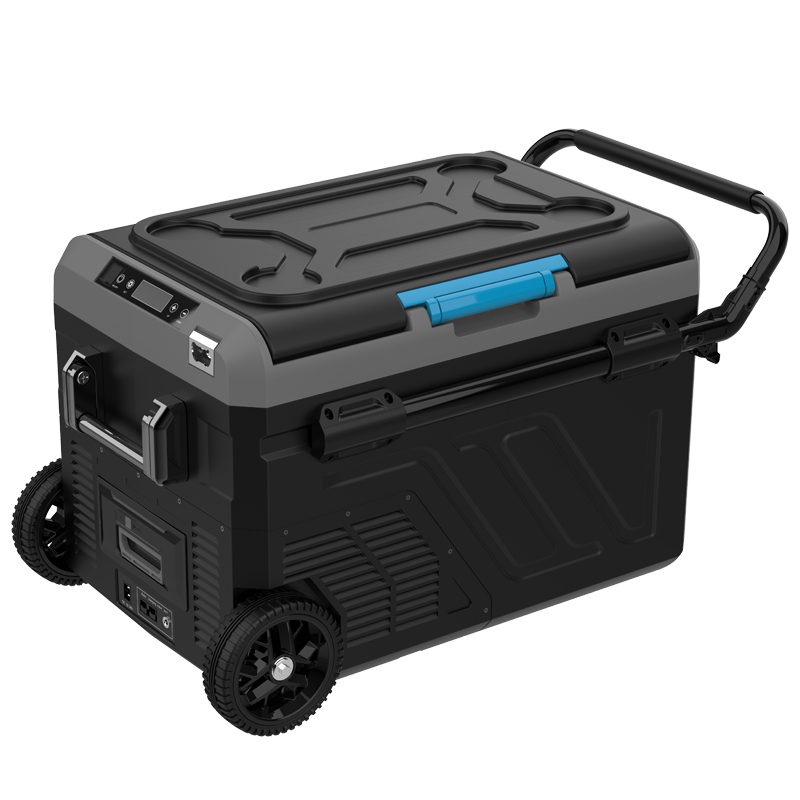
A single-zone compressor car fridge has one temperature-controlled compartment set to one temperature at a time across the full -22C to +24C range. The single-zone C052-035 (37L, 22.6kg, 52W, R134a/26g refrigerant) and C052-055 (55L, 25.6kg, 60W, R134a/38g) at Ningbo Iceberg are typical single-zone SKUs. The retailer sells one SKU at one price point, and the customer sets the temperature they want for that one compartment.
A dual-zone compressor car fridge has two temperature-controlled compartments that can be set to different temperatures simultaneously, typically one for freezer (-20C) and one for fridge (+4C). The Ningbo Iceberg wholesale compressor refrigerator freezer dual temperature C053-040 series spans 15L-80L total capacity with separate freezer and fridge zones. The retailer sells one SKU at a higher price point (typically 30-50% premium to single-zone comparable capacity), and the customer uses both compartments independently.
The single-zone / dual-zone distinction maps directly to the customer segment. Single-zone buyers are typically price-conscious first-time buyers or weekend campers who want one compartment for drinks or food. Dual-zone buyers are typically serious overlanders, road-trip families, or marine/RV owners who want to run a frozen compartment and a refrigerated compartment at the same time. A retailer who only stocks single-zone SKUs misses the higher-margin dual-zone segment; a retailer who over-stocks dual-zone SKUs burns shelf meters on slow-moving inventory.
Capacity Split Configurations: 4 Typical Combinations
The 4 capacity split configurations below cover the most common outdoor retailer compressor car fridge walls in 2024-2026. Each configuration lists the C052 / C053 reference SKUs from Ningbo Iceberg, the typical retail price band (USD), and the typical footprint per unit.
| Configuration | Reference SKU | Total Capacity | Retail Price Band (USD) | Footprint per Unit | Typical Customer |
|---|---|---|---|---|---|
| Single-zone 25L compact | C052-025 family | 25L | 180-260 | 0.4 m² (compact) | First-time buyers, weekend campers |
| Single-zone 35L standard | C052-035 / C052-055 family | 35L / 37L / 55L | 260-460 | 0.55 m² | Weekend campers, family SUV |
| Dual-zone 25L+15L | C053-040 25L+15L variant | 40L total (split) | 350-480 | 0.7 m² | Road-trip couples, overlanding beginners |
| Dual-zone 35L+25L | C053-040 35L+25L variant / C053-060 | 60L total (split) | 480-680 | 0.85 m² | RV / marine / serious overlanders |
The four configurations cover roughly 85% of the retail SKU mix demand for outdoor retailers in the 2026 outdoor season. The remaining 15% includes special-purpose SKUs (e.g., thermoelectric coolers, ice maker units, slush machines) which are outside the compressor car fridge category. For a retailer just starting the compressor car fridge wall, the 4-configuration table is the right reference for the initial assortment.
Retail Margin per Shelf Meter: The Math Behind the Decision
The retail margin per shelf meter formula is the unit economics metric for the SKU mix decision. The formula is:
Margin per meter = (Retail price – Landed cost) × Units per shelf meter
Where:
- Retail price = the price the customer pays at the register (or online checkout), typically 2.5-3.5x the FOB Ningbo cost
- Landed cost = FOB cost + freight + duty + last-mile delivery to shelf, typically FOB × 1.4-1.6 for an EU importer
- Units per shelf meter = number of SKU units that fit per linear meter of shelf (depends on the SKU footprint)
For a hypothetical 4-meter wall with a 50:50 split between single-zone (C052-035 37L, 0.55m footprint) and dual-zone (C053-040 25L+15L, 0.7m footprint), the margin per meter math works out as follows. Single-zone: retail price 320 USD, landed cost 130 USD, units per meter 1.8, margin per meter = (320-130) × 1.8 = 342 USD per meter. Dual-zone: retail price 480 USD, landed cost 200 USD, units per meter 1.4, margin per meter = (480-200) × 1.4 = 392 USD per meter. The dual-zone SKU delivers ~15% higher margin per meter despite the lower units per meter, because the per-unit margin advantage (280 vs 190 USD) outweighs the density disadvantage (1.4 vs 1.8 units per meter).
The math above is illustrative; real numbers vary by retailer, market, and freight corridor. The key takeaway is that per-unit margin alone is misleading: a SKU with 50% higher per-unit margin but 25% lower units per meter delivers only 12.5% higher margin per meter, not 50%. The Outdoor Industry Association 2025 retail margin benchmark (referenced in the references) tracks this distinction for outdoor retailer category management.
7 Dimensions Capacity Split Decision Matrix
The 7-dimension capacity split decision matrix below compares single-zone and dual-zone compressor car fridge SKUs across the 7 dimensions that determine the optimal mix for an outdoor retailer wall. Each dimension is scored on a 1-5 scale (1 = strong single-zone advantage, 5 = strong dual-zone advantage) with the dimension weight noted.
| Dimension | Weight | Single-Zone Score | Dual-Zone Score | Decision Implication |
|---|---|---|---|---|
| SKU turnover velocity | High | 4 (faster, lower price) | 3 (slower, premium segment) | Single-zone wins on velocity |
| Inventory carrying cost | High | 4 (lower absolute inventory) | 3 (higher absolute inventory) | Single-zone wins on working capital |
| Average ticket size | Medium | 3 (lower) | 5 (higher) | Dual-zone wins on ticket size |
| Return / exchange rate | Medium | 4 (simpler spec) | 3 (more complex, dual zone spec) | Single-zone wins on return rate |
| Shelf utilization efficiency | High | 5 (smaller footprint per unit) | 2 (larger footprint) | Single-zone wins on density |
| Brand positioning (premium) | Low | 2 (commodity perception) | 5 (premium technology) | Dual-zone wins on positioning |
| After-sales service complexity | Medium | 4 (single compressor, single thermostat) | 3 (dual compressor or dual evaporator) | Single-zone wins on service simplicity |
The weighted score (weight × score) for the single-zone side is approximately 4×0.3 + 4×0.3 + 3×0.15 + 4×0.15 + 5×0.3 + 2×0.1 + 4×0.15 = 1.2 + 1.2 + 0.45 + 0.6 + 1.5 + 0.2 + 0.6 = 5.75. For the dual-zone side: 3×0.3 + 3×0.3 + 5×0.15 + 3×0.15 + 2×0.3 + 5×0.1 + 3×0.15 = 0.9 + 0.9 + 0.75 + 0.45 + 0.6 + 0.5 + 0.45 = 4.55. The single-zone side leads 5.75 to 4.55, but this is the weighted score across all 7 dimensions — the retail margin per shelf meter math above (which captures only per-unit margin and units per meter) showed dual-zone winning. The discrepancy illustrates that the 7 dimensions are not equally weighted for every retailer: a retailer optimizing for brand positioning should weight dimension 6 higher and get a different conclusion.
The matrix should be re-evaluated quarterly based on the actual sell-through data from the retailer. The Outdoor Industry Association publishes a quarterly retail benchmark that can be used to calibrate the dimension weights. For retailers in markets with stronger overlanding / RV / marine customer segments (US West Coast, Australia, Nordics, Germany), the dual-zone weighting should be increased. For retailers in markets with stronger weekend camping segments (Southern Europe, urban Asia), the single-zone weighting should be increased.
Case Data: Outdoor Retailer A (Dual-Zone Heavy) vs Retailer B (Single-Zone Heavy)
Two outdoor retailer case data sets from 2025 illustrate the capacity mix decision. The numbers below are 12-month rolling totals compiled from retailer reports and from the Ningbo Iceberg dealer channel feedback.
Retailer A (Dual-Zone Heavy Mix, 4-meter wall in a German specialty outdoor store): SKU mix = 1 single-zone (C052-035 37L) + 3 dual-zone (C053-040 25L+15L, 35L+25L, 55L+25L). 12-month GMV: USD 142,000. Total wall area: 4 linear meters. Margin per meter per year: USD 8,400. Sell-through rate: 78%. Average days on shelf: 47 days. The dual-zone heavy mix delivers high absolute margin per meter but slow SKU velocity.
Retailer B (Single-Zone Heavy Mix, 4-meter wall in an Australian camping chain): SKU mix = 3 single-zone (C052-025 25L, C052-035 37L, C052-055 55L) + 1 dual-zone (C053-040 35L+25L). 12-month GMV: USD 118,000. Total wall area: 4 linear meters. Margin per meter per year: USD 7,650. Sell-through rate: 91%. Average days on shelf: 28 days. The single-zone heavy mix delivers lower absolute margin per meter but faster SKU velocity and higher working capital efficiency.
The two retailers optimize for different objectives: Retailer A maximizes absolute margin per meter; Retailer B maximizes turnover and working capital efficiency. Both are defensible strategies, but they require different wall compositions. The Ningbo Iceberg car fridge cooler manufacturer channel supports both composition strategies with the same OEM/ODM production line.
The 12-month rolling data should not be extrapolated beyond the 2025-2026 retail cycle. The compressor car fridge category is evolving rapidly as dual-zone technology matures and prices converge with single-zone. A retailer running the same capacity mix for 24+ months risks being out of step with customer preferences. Quarterly review of the capacity mix is recommended.
7-Step Capacity Mix Sizing for New SKU Walls
The 7-step capacity mix sizing methodology below applies to outdoor retailers planning a new compressor car fridge wall or re-planning an existing wall. Each step has a measurable output that feeds into the next step.
- Determine total SKU count for the wall. Total SKU count for the wall based on retail floor space (typical: 3-5 SKUs per 4 linear meters). The total SKU count drives shelf utilization and SKU portfolio complexity.
- Set single-zone vs. dual-zone ratio. Set single-zone vs. dual-zone ratio (typical 60:40 or 50:50 based on customer segment). The ratio drives the dual-zone exposure and the working capital efficiency.
- Pick capacity segments within each zone type. Pick capacity segments within each zone type (e.g., 25L and 35L single; 25L+15L and 35L+25L dual). The capacity segments drive the customer reach (weekend vs. serious overland).
- Plan shelf layout and units per shelf meter per SKU. Plan shelf layout and units per shelf meter per SKU. The shelf layout drives the absolute units per meter and the margin per meter calculation.
- Run 60-day test sell-through with limited stock. Run 60-day test sell-through with limited stock (typical 8-12 units per SKU). The test data calibrates the sell-through rate and the average days on shelf.
- Optimize mix based on sell-through data. Optimize the mix based on sell-through data (typically 1-2 SKU swaps after the first 60-day test). The optimization step captures the customer preference signal that the initial sizing could not.
- Scale to production order with OEM supplier. Scale to production order with OEM supplier (Ningbo Iceberg supports OEM/ODM with Pantone color matching, custom logo, and private mold development, with typical lead time 30-45 days for 500-2000 units). The OEM scale step converts the optimized mix into the production order.
The 7 steps apply to both new wall launches and existing wall re-plans. For existing walls, step 1 starts with the current SKU count and step 6 optimizes within the existing footprint. For new walls, step 1 starts from a blank slate. The methodology is robust across both scenarios.
Common Pitfalls When Planning Single-Zone vs. Dual-Zone Capacity Mix
Three pitfalls show up repeatedly in outdoor retailer capacity mix planning. Each is easy to avoid in the planning stage and expensive to correct after bulk ordering.
Pitfall 1: Optimizing per-unit margin instead of margin per shelf meter
A capacity mix that picks SKUs based on per-unit margin alone (e.g., “dual-zone has 50% higher per-unit margin, so add more dual-zone SKUs”) ignores the shelf footprint effect. The fix is to compute the margin per shelf meter for every SKU before selection. A SKU with 50% higher per-unit margin but 25% lower units per meter delivers only 12.5% higher margin per meter, not 50%. Ningbo Iceberg publishes the footprint and the margin per meter reference for each C052 / C053 SKU so retailers can run the math.
Pitfall 2: Skipping the 60-day sell-through test
A capacity mix that goes directly from step 4 (shelf layout) to step 7 (production order) without the 60-day sell-through test (steps 5-6) risks committing to a suboptimal mix. The fix is to limit the test order to 8-12 units per SKU and to run the full 60 days before scaling. A retailer that skips the test typically over-commits to the dual-zone segment in markets where single-zone turnover is faster (or vice versa).
Pitfall 3: Not aligning the compressor brand tier with the customer segment
A capacity mix that picks dual-zone SKUs with the basic Anuodan compressor when the customer segment expects LG or SECOP premium compressors risks higher return rates. The fix is to align the compressor brand tier (Anuodan, BAIXUE, LG, SECOP) with the customer segment and the SKU price point. For Ningbo Iceberg OEM orders, the compressor brand is a standard configurable option on the C052 / C053 series.
Frequently Asked Questions
1. What is the difference between single-zone and dual-zone compressor car fridges?
A single-zone compressor car fridge has one temperature-controlled compartment set to one temperature at a time (typical range -22C to +24C, as on the C052-035 37L and C052-055 55L). A dual-zone compressor car fridge has two temperature-controlled compartments that can be set to different temperatures simultaneously (freezer + fridge), as on the C053-040 dual temperature series (15L-80L).
2. Which is better for retail margin per shelf meter: single-zone or dual-zone?
It depends on the retailer’s positioning. Dual-zone SKUs (C053-040) typically retail at 30-50% higher prices but take 1.5-2x the shelf footprint per unit. Single-zone SKUs (C052-035, C052-055) have lower per-unit margins but enable higher units per shelf meter. The decision should be made with the retail margin per shelf meter formula, not per-unit margin alone.
3. How many SKUs should an outdoor retailer carry in each capacity segment?
For an outdoor retailer with one wall of 4 linear meters dedicated to compressor car fridges, a typical split is 1 single-zone SKU (35L), 1 single-zone SKU (55L), 1 dual-zone SKU (25L+15L), and 1 dual-zone SKU (35L+25L). This 4-SKU split maximizes the variety cover while keeping shelf utilization above 85%.
4. Does dual-zone compressor car fridge consume more power?
Yes, dual-zone compressor car fridges typically consume 20-40% more power than single-zone units of comparable total capacity because the compressor runs longer to maintain two independent temperature zones. For a C053-040 dual temperature unit the rated power is 60-80W versus 52W for the C052-035 single-zone 37L.
5. What is the typical lead time for OEM compressor car fridge orders?
For OEM orders of 500-2000 units of the C052-035, C052-055, or C053-040 series, the typical lead time is 30-45 days from PO confirmation to ex-factory delivery. For orders above 5000 units, lead time extends to 60-75 days. Ningbo Iceberg supports OEM/ODM with Pantone color matching, custom logo, and private mold development.
Planning the Compressor Car Fridge Wall for Your Outdoor Retail Stores?
Ningbo Iceberg supplies the C052 series (single-zone, 25L/35L/55L) and C053-040 series (dual temperature, 15L-80L) with OEM/ODM support including Pantone color matching, custom logo, and compressor brand selection (Anuodan / BAIXUE / LG / SECOP). The compressor fridge manufacturer hub indexes the full series with reference specs, retail margin math, and capacity mix templates.
About the Author
Miya — Business Manager at Ningbo Iceberg Electronic Appliance Co., Ltd.
Miya brings 10+ years of experience in mini refrigerators, beauty refrigerators, outdoor car refrigerators, cooler boxes, and ice makers product export. She specializes in OEM/ODM mini refrigerators and car refrigerators, custom mold development, global sourcing, and international trade compliance. She works directly with European and North American outdoor retailer procurement teams to plan compressor car fridge category assortments.
Post time: Aug-06-2026