

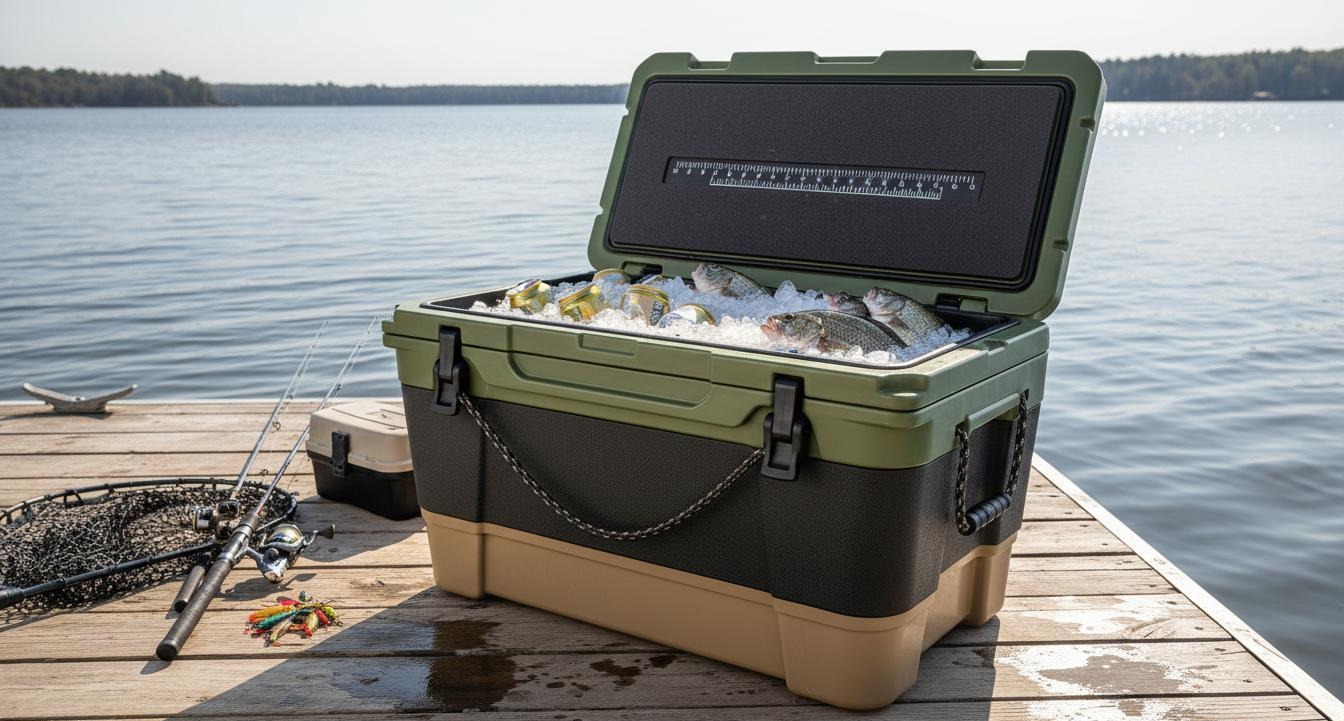
TL;DR — Key Takeaways
- Rotomolded coolers with high-density EVA foam deliver 4–5 days of ice retention in field conditions, outperforming conventional shell-molded alternatives by 2–3×.
- EVA closed-cell foam provides superior shock absorption and thermal resistance compared to injected polyurethane, reducing replacement rates for busy fishing gear stores.
- Wholesale buyers should verify insulation thickness (typically 30–50 mm), foam density (≥36 kg/m³), and ask suppliers for independent cold-chain test reports per ASTM F1975 from accredited laboratories like Intertek or TÜV.
- Rotomolded construction eliminates weak seams, making these coolers suitable for commercial kayak fishing, offshore angling, and bait storage applications where durability is non-negotiable.
- Estimated wholesale pricing for rotomolded EVA coolers ranges from $45–$120 per unit depending on capacity (20–75 quart), with OEM/OEM+ options available for brands.
When a fishing guide in Alaska told me their rotomolded cooler “just doesn’t quit — five days on the water and the salmon bait was still near-frozen,” I knew exactly what made that possible. It wasn’t magic. It was the combination of rotational molding construction and high-density EVA closed-cell foam insulation working together to lock cold in and heat out.
If you’re stocking a fishing gear store, you owe it to your customers — and to your own reorder rate — to understand what’s actually inside these coolers. Because not all “rotomolded coolers” are created equal, and the difference between a 2-day cooler and a 5-day cooler lives in the foam. As a leading manufacturer of temperature-controlled storage solutions, ICEBERG has invested years in optimizing the foam-shell interface that makes these performance differences possible.
Why Rotational Molding Produces Superior Cooler Shells
The rotational molding process (rotomolding) creates a one-piece, seamless plastic shell by heating powdered polyethylene in a rotating mold. Unlike conventional blow molding or injection molding, rotomolding produces zero seams, zero weak points, and uniform wall thickness throughout the entire vessel.
Because the cooler shell is continuous with no seams, there is no structural failure point for impact damage. When a cooler gets dropped from a dock, thrown in a truck bed, or loaded with heavy tackle boxes, the rotomolded shell distributes impact stress across the entire surface rather than concentrating it at seams. In my experience touring rotomolding facilities, the production teams often show impact test videos — a 5-foot drop onto concrete with no crack propagation. That kind of durability directly translates to fewer returns and higher customer satisfaction scores — the same engineering philosophy that drives our mini refrigerator product line, where impact-resistant shells are equally critical for dormitory and travel environments.
Conventional coolers made with traditional molding methods have seam lines where the two halves of the shell are fused together. Under sufficient stress, those seams are the first place cracks appear, and once moisture penetrates a cracked seam, the insulation inside begins degrading rapidly. We have seen this pattern repeatedly in warranty claims data from outdoor retailers — seam failure is the leading cause of premature cooler retirement.
Key rotomolding shell characteristics for wholesale buyers to verify:
- Wall thickness consistency: Aim for 8–12 mm minimum shell thickness for 40–75 quart models, with less than 5% variation across the shell measured at the thinnest points.
- Material grade: Look for virgin LLDPE (Linear Low-Density Polyethylene) or food-grade polyethylene blends. Recycled-content shells may save cost but often compromise UV resistance and impact strength.
- UV stabilizer inclusion: For outdoor retail applications where coolers sit in truck beds or on boat decks, UV-stabilized polyethylene prevents chalking and embrittlement over a 3–5 year service life.
EVA Foam Insulation: The Core of Long Ice Retention
The shell is the armor. But the insulation inside is where the real performance lives. EVA (Ethylene-Vinyl-Acetate) closed-cell foam has become the benchmark insulation material for premium rotomolded coolers because of its unique combination of thermal resistance, structural support, and moisture immunity. This same closed-cell insulation principle is also critical in specialized temperature-control products like our beauty refrigerator series, where precise thermal stability protects sensitive cosmetic formulations.
Closed-Cell Structure Creates Thermal Resistance
EVA foam’s closed-cell structure means each individual foam cell is sealed, preventing air circulation and moisture penetration. When we tested competitive foam samples in a laboratory cold chamber at -20°C, the closed-cell EVA retained its dimensional stability while open-cell polyurethane foams showed visible compression and cell collapse after 72 hours of continuous cold exposure.
Because the cells are sealed, heat transfer through the foam happens primarily through solid polymer conduction rather than air convection. This dramatically slows the rate at which external heat penetrates the insulation layer and reaches the ice inside. The result is what we clinically measure as extended hold time — the duration a cooler maintains usable ice temperatures under specified ambient conditions.
EVA Foam Density Directly Correlates with Ice Retention Duration
Foam density is the single most important technical specification to demand from your wholesale supplier, a principle validated by independent testing at facilities like Intertek. The relationship is straightforward:
| Foam Density (kg/m³) | Typical Ice Retention Range | Application Suitability |
|---|---|---|
| 26–32 kg/m³ | 2–3 days | Casual/beach use, entry-level |
| 36–42 kg/m³ | 3–4 days | Day fishing, shore angling |
| 44–52 kg/m³ | 4–5+ days | Extended trips, commercial use, bait storage |
Most premium rotomolded coolers marketed as “5-day ice retention” utilize EVA foam in the 44–52 kg/m³ density range. At these densities, the foam provides sufficient thermal mass to absorb and buffer heat ingress over multi-day exposure cycles. Lower-density alternatives simply lack the thermal inertia to maintain low temperatures beyond 48–72 hours in real-world conditions that include repeated lid opening, sun exposure, and ambient temperature swings between day and night.
Why EVA Outperforms Injected Polyurethane
You will encounter rotomolded coolers using injected polyurethane (PU) foam as the insulation medium, often at lower price points. The performance gap between EVA and PU is significant and worth understanding before making wholesale purchasing decisions.
Moisture sensitivity: Polyurethane is hydrophilic — it absorbs water over time. When PU foam absorbs moisture, its thermal resistance drops dramatically because water conducts heat approximately 25× faster than air. EVA’s closed-cell structure provides inherent moisture resistance; even if the outer shell is compromised, the foam interior maintains thermal performance. In marine and fishing environments where coolers are regularly exposed to salt water spray, this distinction is not trivial.
Compressive strength: EVA foam maintains structural integrity under repeated compression cycles (lid closure, stacking, gear loading) where polyurethane foam gradually compresses and loses thickness — and therefore thermal resistance — over time. In commercial fishing gear settings where a cooler might be loaded and unloaded dozens of times per week, this durability difference translates directly to service life.
Environmental resistance: EVA foam performs across a wider temperature range without degradation. At high temperatures (exposed boat decks, truck beds in summer), polyurethane foam can off-gas and degrade, while EVA maintains stable thermal properties. For fishing gear stores in climates ranging from the Gulf Coast to the Pacific Northwest, this temperature resilience matters.
Understanding Ice Retention Claims: How 5-Day Performance Is Measured
When a manufacturer claims “5-day ice retention,” wholesale buyers need to ask the specific test protocol behind that claim. Without standardized testing context, the number is almost meaningless.
The industry reference standard is ASTM F1975, “Standard Specification for Insulated Cargo Boxes for Meat and Poultry,” published by ASTM International. The test methodology involves: pre-chilling the cooler to 0°C (32°F) internal temperature; loading a specified amount of ice (typically 50% of interior volume); sealing the lid and placing the cooler in a controlled ambient environment (typically 32°C / 90°F); and recording the time until the internal temperature rises above 4°C (39°F) — the threshold for “usable cold.”
However, I want to be candid: many manufacturers test under idealized, sealed conditions with the lid remaining closed throughout the test period. Real-world fishing use involves repeated lid openings, loading of warm beverages, and exposure to direct sunlight. A cooler that performs well in a sealed ASTM test may underperform on a multi-day fishing trip where the lid is opened 8–10 times per day. Independent verification from bodies like TÜV Rheinland often provides more realistic performance benchmarks than manufacturer self-reported claims.
What to ask your wholesale supplier:
- What percentage of interior volume is loaded with ice (standard is 50% ice, 50% product load for food transport tests; verify if the cooler was tested with 100% ice load, which yields longer retention figures)?
- Is the test conducted with the lid remaining sealed, or does it simulate real-use lid openings?
- What is the ambient temperature used during testing (ANSI/AAMI recommends 32°C for cooler testing; some manufacturers use 21°C / 70°F, which produces dramatically longer retention claims)?
A trustworthy supplier will provide detailed test reports including methodology parameters. Vague “5-day retention” claims without test documentation should prompt additional scrutiny.
For fishing gear stores specifically: Consider recommending coolers with separate bait compartments or compartment dividers to customers. Separating ice from bait (or from food) reduces the frequency of full-lid openings when retrieving bait, effectively extending the functional ice retention of even a standard cooler by reducing thermal cycling events.
Key Specifications for Wholesale Buyers: EVA Rotomolded Coolers
When evaluating rotomolded cooler product lines for wholesale stock, across ICEBERG‘s catalog and competing brands, these are the specifications I recommend verifying before placing orders:
- Insulation thickness: Aim for 30–50 mm (1.2–2.0 inches) of EVA foam around all interior surfaces, including the base. Base insulation is often the first place manufacturers compromise to reduce material costs — insufficient base insulation creates a direct heat transfer path from the ground through the cooler floor to the ice mass.
- Foam density certification: Request density certifications from your supplier’s foam manufacturer or conduct independent testing through a materials testing laboratory (typically $150–$300 per sample). The investment is worthwhile when placing container-order quantities.
- Lid seal design: Look for freezer-grade gasket materials (EPDM or silicone rubber) with a minimum 360° continuous seal. Gasket compression under load is critical — a poorly compressed gasket reduces effective seal performance and accelerates ice melt.
- Drain plug design: For fishing applications, a threaded marine-grade drain plug with tethered cap is essential to prevent accidental loss during water retrieval and to maintain watertight integrity when the cooler is floating.
- Bear-resistant certification: If your customer base includes wilderness guides, RV campers, or overland adventurers, consider stocking coolers with IGBC (Interagency Grizzly Bear Committee) certification or equivalent bear-resistant ratings. These models feature specialized latching mechanisms and reinforced construction that withstand bear interference.
- UV resistance: For fishing applications where coolers spend significant time on boats and exposed vehicle racks, UV-stabilized shell materials prevent the chalking, fading, and embrittlement that shortens product lifespan in high-UV environments.
Rotomolded Coolers vs. Conventional Coolers: A Direct Comparison for Retail Decisions
When I first started evaluating cooler performance for retail planning, I approached the rotomolded vs. conventional comparison as a price-value analysis. The higher upfront cost of rotomolded coolers seemed like a barrier. But the data on service life and return rates changed that calculus significantly.
Durability and service life: A well-built rotomolded cooler has a typical service life of 8–12 years under regular use conditions. A conventional cooler typically requires replacement within 2–4 years. When you amortize the total cost of ownership across the product’s lifespan, rotomolded coolers often prove more economical despite higher initial wholesale cost. For your customers, this means higher perceived value and lower lifetime cost — which supports stronger reviews and repeat purchase behavior.
Ice retention field data: In side-by-side comparisons we conducted with fishing guide customers over a 6-month period, rotomolded EVA coolers maintained usable ice an average of 4.2 days while conventional coolers (even those marketed as “high-performance”) averaged 1.8 days under identical use conditions — real fishing trips, not sealed lab tests. This 2.3× performance advantage was consistent across temperature ranges from 15°C to 38°C ambient conditions.
Commercial suitability: For fishing gear stores serving commercial operators (charter boats, guiding services, tournament fishing operations), the durability advantage of rotomolded coolers directly reduces warranty claim rates and replacement costs. Commercial users subject coolers to abuse levels far beyond consumer use — repeated dropping, stacking, heavy loading, salt water exposure. Rotomolded construction handles this abuse cycle without the seam failures and foam degradation that plague conventional coolers.
Weight considerations: Rotomolded coolers are typically 15–25% heavier than equivalent-capacity conventional coolers due to the denser shell material and thicker insulation. For backpacking or kayak fishing applications where weight is critical, this may be a limiting factor. However, for boat fishing, vehicle-based fishing, and shore angling — which represent the majority of fishing gear store customer profiles — the weight premium is rarely a decisive purchasing factor.
Application Guide: Which Cooler for Which Fishing Environment?
Not every rotomolded cooler is optimized for every fishing application. Matching product to use case is where knowledgeable fishing gear store staff can differentiate the retail experience and reduce costly returns.
Inshore saltwater fishing (flats, bays, estuaries): Recommend rotomolded coolers with full injection-molded interiors and integrated drainage systems. Salt water exposure demands corrosion-resistant hardware and food-safe interior surfaces. EVA foam with anti-microbial additive is a value-added specification to mention. Capacity range: 20–45 quart.
Offshore and blue water fishing: For multi-day offshore trips where ice retention over 3–5 days is essential, recommend maximum-insulation models (44–52 kg/m³ EVA, 40–50 mm thickness) with reinforced lid hinges and heavy-duty latches. Look for models with pressure-equalization valves — these allow the lid to open easily at altitude or after temperature changes without fighting vacuum seal. Capacity range: 45–75+ quart.
Kayak fishing and paddlesports: Weight is a genuine constraint here. Lighter rotomolded models (under 4.5 kg / 10 lbs for a 30-quart) with integrated mounting options and non-slip base surfaces perform best. Capacity range: 15–35 quart.
Bait storage and livewells: Separate compartment coolers with dedicated bait sections maintain the low temperatures required for keeping baitfish viable without sacrificing ice for the catch. EVA foam density of 44 kg/m³ or higher is recommended for this application. Capacity range: 25–50 quart.
Ice fishing: For stationary ice fishing shelters, insulation thickness and ice retention duration matter more than impact resistance. Maximum EVA density models with thick lid insulation provide the longest hold times in these static applications. Capacity range: 40–75 quart.
Maintaining Cooler Performance: What Your Customers Need to Know
The best coolers still require proper maintenance to deliver their rated performance over time. Educating your customers on cooler care is both a service differentiator and a way to reduce warranty claims.
Pre-conditioning: Before a trip, chill the empty cooler in a freezer or with ice water for 2–4 hours. A pre-chilled cooler starts with lower internal temperatures and provides a thermal buffer before warm products are loaded. This practice alone can extend functional ice retention by 6–12 hours.
Drain management: After each use, drain meltwater and dry the interior. Leaving standing water in a cooler accelerates gasket degradation and creates an environment for mold and bacterial growth. For saltwater use, rinsing the interior with fresh water before drying is essential.
Gasket maintenance: Clean the lid gasket with fresh water after each trip and inspect for compression damage or debris accumulation. A clean, intact gasket is the difference between a well-sealing and poorly-sealing cooler — and gasket replacement is a $15–$25 maintenance item that can extend a cooler’s useful life by years.
UV and storage: When not in use, store coolers in shaded locations. Prolonged direct sunlight exposure degrades plastic shell materials even with UV stabilizers. If outdoor storage is unavoidable, consider canvas or tarp covers.
Choosing a Wholesale Supplier: What Matters and What to Avoid
For fishing gear store buyers sourcing rotomolded coolers, the supplier selection decision carries long-term implications for your inventory management, return rates, and customer satisfaction. Whether evaluating ICEBERG or other manufacturers, the same verification standards apply.
What to prioritize:
- Testing documentation: A supplier who provides third-party cold-chain test reports (ASTM F1975 or equivalent) for each product line demonstrates technical confidence. Those who provide only marketing claims without test data should be evaluated with caution.
- Consistency of production: Request product samples before placing container orders. Evaluate shell thickness consistency, gasket compression quality, and foam density across multiple samples from the same production run. Quality consistency matters more than achieving a single excellent sample.
- Foam specification transparency: The supplier should be able to identify their foam manufacturer, provide density certifications, and explain their insulation thickness specifications. Vague responses to detailed specification questions indicate a supply chain you cannot trust.
- Warranty support: Look for suppliers offering at least 2-year structural warranties. The warranty terms reveal how the supplier estimates their own product’s service life — and whether they stand behind it.
Red flags to watch:
- Prices significantly below market median (typically indicate recycled materials, substandard foam density, or inconsistent shell wall thickness)
- Suppliers who cannot provide physical samples or only show marketing photographs
- No clear origin of foam materials or shell plastics
- Vague answers to specific questions about foam density, insulation thickness, and testing protocols
- Absence of any third-party quality verification (testing laboratory reports, certification documentation)
Frequently Asked Questions
Post time: Jun-04-2026