

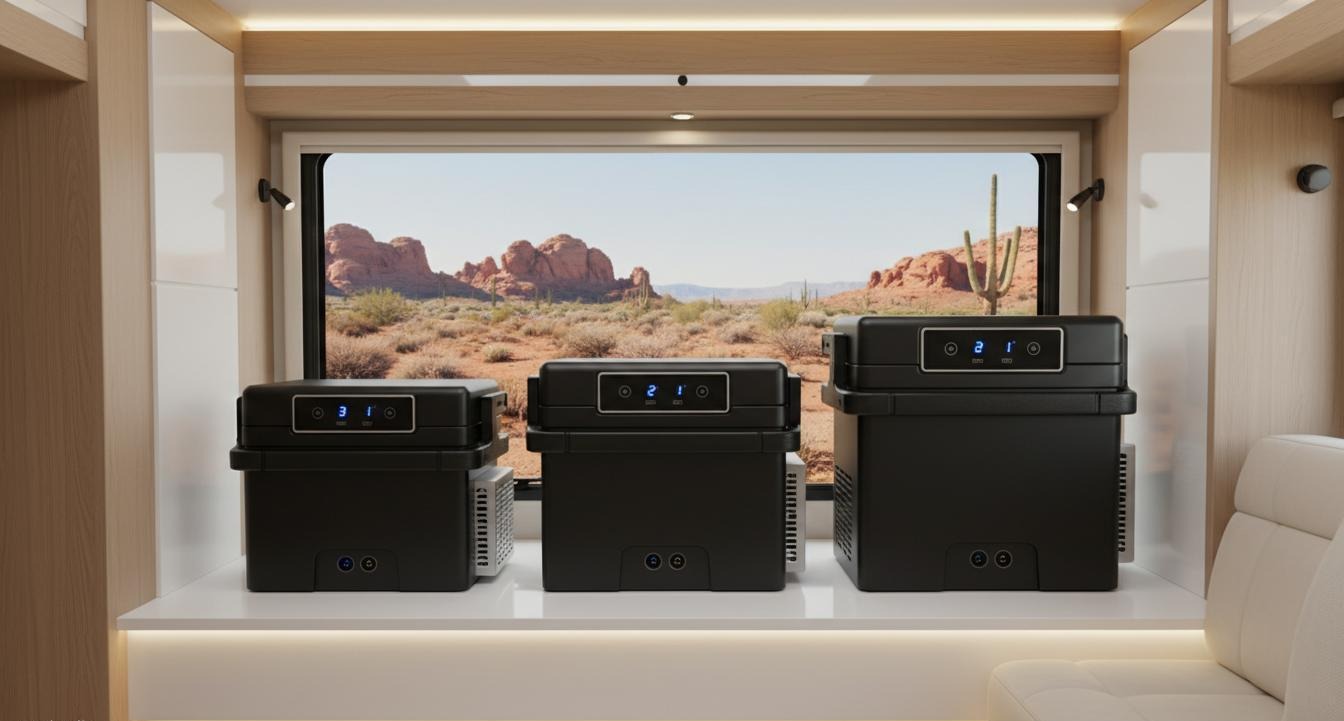
For RV dealership buyers and fleet procurers, stocking portable refrigeration that actually performs in real-world conditions separates profitable seasons from costly returns. At Ningbo Iceberg Electronic Appliance, we’ve spent a decade tuning compressor-driven and thermoelectric cooler solutions for the demanding mobile retail channel—and in this guide, I’ll walk you through exactly how to build your wholesale inventory around the capacity tiers that move.
Why “Portable Refrigerator Wholesale” Is the Search Your Dealers Are Making Right Now
Let’s be direct about what I see happening in the wholesale market for portable refrigeration. Dealers searching for portable refrigerator wholesale aren’t browsing casually—they’re buying for lot prep, service vehicles, and customer upfit packages. They’ve already figured out they need compressor cooling for true freezing performance, and they’re evaluating suppliers on MOQ flexibility, lead time, and cold-chain credibility. This search intent is high-conversion: retail-ready buyers who understand the difference between a $25 thermoelectric unit and a real compressor freezer. If you’re not showing up in those search results with a credible spec sheet and a factory-direct story, your competitor is.
I run the product development and wholesale channel at Ningbo Iceberg, and I’ve watched the portable refrigeration market mature significantly over the past five years. The buyers who used to call us asking “what’s the cheapest 12V cooler” are now asking about compressor displacement, refrigerant type, and cycle life. That’s a fundamentally different customer—one who makes purchasing decisions based on total cost of ownership rather than upfront unit price. Understanding that shift is the first step to building a wholesale inventory that actually generates margin instead of returns.
Our catalog spans two distinct cooling technologies, each with distinct margin profiles and target customer bases:
- Compressor refrigeration — genuine freezing to -18°C, R134a/R134YF refrigerant, 12V/24V DC input, built for cargo vans, RVs, and overland rigs. Models from 35L to 55L payload. Target customer: overland adventurer, long-haul driver, medical transport operator, serious off-grid weekend warrior.
- Thermoelectric (Peltier) cooler boxes — 16–20°C below ambient cooling, dual-function hot/cold, PP housing, OEM-customizable colors and logos. Capacities from 12L to 40L for daytime camping, beach trips, and last-mile delivery. Target customer: casual camper, family on a road trip, tailgater, food delivery service operator.
The decision about which tier to prioritize in your inventory depends entirely on your dealer network’s customer mix. I’ll walk through both in detail so you can make the right call.
Compressor Tier: What Dealers Need to Know About Real Freezing Performance
If your dealership serves overland, marine, or long-haul trucking customers, compressor refrigeration is the only category that earns repeat business. Here’s the spec sheet reality you need to internalize before you build your compressor inventory:
| Model | Volume | Dimensions (mm) | Power | Voltage | Temp Range | Climate Class | MOQ |
|---|---|---|---|---|---|---|---|
| CFP-35L | 35L | 350 × 620 × 390 | 48W | 12V / 24V DC | -18°C to +20°C | T / N / SN | 200 units |
| CFP-45L | 45L | 350 × 620 × 490 | 48W | 12V / 24V DC | -18°C to +20°C | T / N / SN | 200 units |
What this means for your inventory planning: the CFP-35L fits under most RV dinette benches and cargo van partition systems. If you’re stocking for sprinter van conversion companies, this is your core SKU. The CFP-45L is the stock-moving unit for Class B and C motorhome conversions where customers want multi-day ice retention without buying a built-in refrigerator. Both models ship with a R134a compressor—our standard specification uses Anuodan, but we also work with BAIXUE, LG, and SECOP compressors depending on customer preference and market availability. Lead time runs 35–45 days after deposit, so plan your inventory cycles accordingly.
Cooling Speed That Translates to Customer Satisfaction
In summer conditions—ambient temperature 30°C or higher—our compressor fridges reach -18°C in approximately 40 minutes from a cold start. In winter startup conditions, when the engine is cold and ambient temperature is around 0°C, that drops to approximately 20 minutes. Here’s why this matters for your warranty return rate: the compressor works harder against cold ambient conditions but the solid polyurethane foam insulation maintains stability once the target temperature is reached. That combination—fast pull-down plus stable insulation—keeps the compressor from cycling excessively, which extends compressor life and reduces field failures.
The insulation spec is worth dwelling on. We use high-quality solid polyurethane foam (PU foam) throughout the compressor product line. The thermal resistance of quality PU foam means the compressor doesn’t have to run continuously to maintain temperature; it runs intermittently, which is how compressor refrigeration is supposed to work. Cheap cooler boxes use thin-wall construction with low-density foam, and the compressor runs constantly trying to compensate for thermal conductance that’s far above spec. That constant running is what kills compressors in the field and generates warranty claims that eat your margin.
For your procurement team: when you’re evaluating compressor refrigerator suppliers, ask specifically about foam density and wall thickness, not just “high-quality insulation” in the marketing description. A unit that costs $20 less upfront but generates 15% more warranty returns by year two is not a savings.
Thermoelectric Tier: The 25L–40L Day-Trip Segment Where Volume Moves
For dealers stocking the weekend adventure market—beach-bound families, fishing trip regulars, tailgate crowds—the thermoelectric cooler box category delivers volume at accessible price points. I want to be precise about what this technology can and cannot do, because I see dealers lose customers by mischaracterizing thermoelectric performance.
These are not true freezers. They’re the segment your customers buy for day-long beverage chilling and shoreline picnic storage. If you tell a customer a thermoelectric cooler will keep their ice cream frozen on a 90°F beach day, you’re setting up a return. If you tell them it will keep their drinks cold and their lunch safe through a 6-hour beach day, you’re building a relationship that generates referrals.
| Series | Capacity | Net Weight | Dimensions (mm) | Cooling Delta | Voltage | MOQ |
|---|---|---|---|---|---|---|
| CBP-25L-B | 25L | 4.9–5.8 kg | 446 × 306 × 447 | 16–20°C below ambient | DC12V / AC220V | 500 units |
| CBP-30L-B | 30L | 5.9–6.6 kg | 446 × 306 × 507 | 16–20°C below ambient | DC12V / AC220V | 500 units |
| CBP-40L-A | 40L | 7.7–8.3 kg | 529 × 337 × 518 | 16–20°C below ambient | DC12V / AC220V | 500 units |
All three models operate on a semiconductor (Peltier) system—no compressor, no refrigerant, no moving gas. The tradeoff is simple: you get reliable passive cooling with zero mechanical failure points, but you cannot reach sub-zero temperatures. At 25°C ambient, the best you’ll achieve inside is around 5–9°C. That covers cold drinks, fresh food, and sunscreen. It does not cover ice cream or frozen proteins. Period.
For your inventory planning, this is the segmentation I recommend: the 25L fits a solo road tripper or couple, works perfectly as a personal cooler for day hikes and short camping trips. The 30L is your best all-around seller for the family market—enough capacity for a family’s worth of food and drinks for a full day at the beach or campground. The 40L moves for family camping groups and fishing guides who need volume over temperature precision; it also works for small commercial applications like last-mile food delivery where the dual-function hot/cold capability matters.
All three support OEM color and logo customization at 500-unit MOQ, which means you’re ordering branded units for your retail floor, not generic boxes your competitor is also stocking. This is a meaningful margin differentiator that many dealers overlook. A thermoelectric cooler box at $25–$38 per unit sits at a price point where customers make impulse purchases at the register. When that cooler has your dealer’s logo on it and your brand colors, you’re building brand recall that translates to service department traffic and financing product attachment.
What Makes a Wholesale Compressor Fridge Actually Marketable in 2025–2026
I want to address something I see buyers get wrong in the procurement process. They judge these units on price-to-volume ratio and miss the certification envelope entirely. Here’s why the certification package matters more than the per-unit cost in your landed cost calculation.
Your end customers—overland adventurers, marine operators, long-haul drivers—are increasingly carrying sensitive cargo: insulin, breast milk, temperature-stable biologics, pharmaceutical supplies. They need to know the cooler they buy has been independently verified by an accredited testing body. When a customer asks about CE certification or ETL listing, and your dealer can’t produce the documentation, you’re losing the sale to a competitor who can.
Ningbo Iceberg holds BSCI, ISO9001, ISO14001, IATF16949, CE, CB, ETL, ROHS, PSE, KC, SAA, and LFGB certifications across the full compressor and thermoelectric lineup. Let me be specific about why each matters for your wholesale channel:
- CE marking — required for legal sale in EU member states. If your dealers are selling into European markets, CE is non-negotiable. It’s not optional decoration on the spec sheet; it’s the regulatory requirement that keeps products off customs hold and retailers out of regulatory trouble.
- CB Scheme — the CB Scheme covers mutual recognition of electrical equipment safety test reports across 50+ participating countries. A CB report means your product has been evaluated against IEC standards, and member countries accept it as the basis for their own national certification. For a portable refrigerator manufacturer selling into global markets, CB is the foundational certification that unlocks national marks in individual countries.
- ETL Listed — the ETL mark is recognized in the United States and Canada as evidence of product compliance with relevant safety standards. For North American retail channel compliance, ETL is often preferred over some other marks because it’s recognized by the Occupational Safety and Health Administration (OSHA) as an NRTL (Nationally Recognized Testing Laboratory).
- RoHS — Restriction of Hazardous Substances compliance is increasingly required by EU and Asia-Pacific retail buyers who face their own supply chain compliance obligations. If your customers have to certify their own products as RoHS-compliant, they need their component suppliers to provide RoHS documentation. We provide it.
The CE and CB marks aren’t decorative—they’re what your dealers need to list products legally in EU, North American, and Asia-Pacific retail channels. When you’re quoting container quantities, make sure you’re factoring certification coverage into your landed cost comparison. The supplier who quotes you $3 per unit less but doesn’t have CE or ETL documentation is costing you more in the long run than the certified supplier who quoted higher upfront.
Building Your Wholesale Order: What I’d Tell My Own Procurement Team
Here’s the honest procurement logic I share with our key accounts when they’re building their 2025–2026 inventory plans. I’ve watched enough procurement cycles go wrong to know where the failure points are, and most of them aren’t in the product—they’re in the planning.
Step 1: Segment by use case, not by price. Compressor fridges (CFP series) are for customers who need actual freezing—fishers who need to keep bait or catch frozen, overlanders on multi-week expeditions, medical transport operators moving temperature-sensitive biologics, long-haul truckers who need to keep food fresh for a week. Thermoelectric cooler boxes (CBP series) are for daytime and weekend use where temperature maintenance matters more than deep freezing. Don’t try to upsell a $600 compressor unit to someone who just wants to keep their drinks cold at the beach. The return rate on mismatched product recommendations will eat your margin faster than any competitor’s price advantage.
Step 2: Plan around the 200-unit compressor floor and 500-unit thermoelectric floor. Our compressor models carry a 200-unit MOQ; thermoelectric cooler boxes require 500 units. That sounds like a significant commitment, but at container quantities, you’re looking at a single 20-foot container for either line. At landed cost per unit in a 20-foot container from Ningbo to your distribution warehouse, you’re in a strong competitive position against distributors who are still buying small-batch via freight forwarder and absorbing the per-unit freight premium. Run your landed cost calculation with and without container commitment; the math usually favors container.
Step 3: Push for the dual-voltage configuration on every SKU. Both compressor and thermoelectric lines support 12V/24V DC plus 100–240V AC with an adapter. This single SKU covers car, marine, and home use—your dealers can stock one model and satisfy three retail use cases without managing separate SKUs for each voltage configuration. For your dealers managing inventory in a 5-6 figure SKU count, the consolidation of dual-voltage support alone is worth the conversation with their procurement team.
Step 4: Factor the warranty margin into your total cost of ownership model. We offer a 2-year warranty with free parts replacement. Compare that to the typical 6-month distributor warranty that barely covers the shipping cost of a compressor replacement. For your fleet customers running 50+ units—the marina operators, the fishing charter companies, the overland expedition providers—the warranty structure alone is a material line-item difference in your total cost of ownership calculation. A 2-year warranty with free parts means you’re not budgeting for compressor replacement labor and shipping in year two, which for a fleet of 50 units can easily represent $3,000-$5,000 in avoided costs that never show up in the per-unit price comparison but absolutely belong in the TCO model.
The Customization Angle That Moves Retail Floor Units
Every thermoelectric cooler box in our catalog ships customizable in color, logo, and packaging. This isn’t a nice-to-have—it’s one of the highest-margin opportunities in your wholesale inventory mix. Here’s the play I recommend to every dealer who works with us on inventory planning.
Order at least a pilot run of logo-branded units in your highest-volume thermoelectric SKU. I’m talking about 100-200 units for the pilot, not a full container. Put your dealer’s logo on the lid, match the color to your brand identity, and stock them on the retail floor. Here’s what happens: a customer comes in looking for a portable cooler, sees a generic unit at $28 and a branded unit at $32, and picks the branded unit because the price difference is trivial against the total purchase and they remember where they bought it six months later. That’s brand recall translating to foot traffic.
For the marine and RV dealer segment specifically, this is even more powerful because the customers in those channels are brand-loyal in ways that general retail customers aren’t. An overland enthusiast who buys a branded compressor fridge from your lot becomes a regular buyer, a referral source, and a service department customer. The $4 per unit premium on the branded unit is the cheapest customer acquisition cost in the store.
Dealers tell me the portable car cooler box with handle is their fastest-moving retail unit precisely because it sits at the $25–$38 price point where customers make impulse purchases at the register. Stock the floor model in your brand color, and you turn a commodity cooler into a retail margin opportunity. At 500-unit MOQ with typical customization costs, the per-unit premium over generic stock is minimal, and the margin improvement on a full container shipment is meaningful.
Lead Time, Payment Terms, and What to Expect on the Factory Floor
Our standard production lead time is 35–45 days after deposit receipt for compressor models, and comparable timelines for the thermoelectric line. Payment terms are 30% T/T deposit, 70% balance against copy of Bill of Lading, or L/C at sight. Sample lead time runs 3–5 days after sample fee receipt—use this to validate your custom color run before committing to a full container order. I can’t stress this enough: the sample step is not optional for custom branding runs. Color matching on PP plastic is more art than science, and the only way to know if the color you spec in a PDF matches what comes off the production line is to get a physical sample in your hands before the container ships.
We’re a 40,000-square-meter factory with 16 production lines, 500+ employees, and an annual output exceeding 2.6 million units. That’s not a trading company with a warehouse—it’s a production facility with in-house R&D, injection molding, and assembly capacity. When you place a container order, you’re buying directly from the factory that builds these, not from a middleman who drops ships from our loading dock. Ask for a video walkthrough of the production floor before you place your first order. Any legitimate manufacturer will provide it. A trading company will deflect.
Final Procurement Checklist: Run Through This Before You Send Your RFQ
Before you finalize your wholesale RFQ, confirm these details with your supplier. I’m giving you the checklist I give our key account managers when they’re working through a new account’s first container order, because I’ve seen every one of these items create a problem when they weren’t confirmed upfront:
- Compressor brand and refrigerant type — Anuodan R134a is our standard; specify R134YF if your market has specific environmental compliance requirements that R134a doesn’t satisfy. Don’t assume they’re interchangeable; they’re not for every market.
- Dual-voltage confirmation — verify that 12V/24V DC plus 100–240V AC adapter compatibility ships as standard, not as a cost-add option. Some suppliers advertise dual-voltage capability but price the AC adapter as an add-on, which changes the per-unit economics for dealers who assumed it was bundled.
- Climate class rating — T/N/SN covers tropical through subtropical; if your dealers are stocking for Scandinavian markets, confirm the rating satisfies local regulatory requirements. Climate class matters for compressor longevity in extreme ambient conditions, and a unit rated T/N/SN that runs year-round in a tropical climate may see accelerated compressor wear that exceeds the warranty coverage.
- Custom logo MOQ timing — at 500-unit MOQ for thermoelectric and 200-unit for compressor, a 45-day lead time is realistic for a custom color and logo run from a factory with in-house printing capability. Anything promising sub-30-day turnaround on custom branding should raise a flag about whether the supplier is actually doing the printing in-house or outsourcing to a third party, which introduces quality control risk and potential timeline slippage.
- Warranty parts and replacement process — confirm that free parts replacement includes outbound shipping to the end customer, not just the parts themselves. That’s the difference between a 2-year warranty and a 2-year parts-only credit with freight charges that make the warranty effectively worthless for your fleet customers who need turnkey reliability, not parts-in-hand DIY repair.
Stock the right tier for your customer base, verify the certification coverage for your target markets, and lock in your container order before Q4 demand tightens lead times across the industry. The dealers who plan their Q4 inventory in Q2 consistently outperform those who wait until August to start their procurement cycle. Lead times extend during peak season, and a 45-day lead time in May becomes a 60-day lead time in August. Plan accordingly.
Post time: May-29-2026