

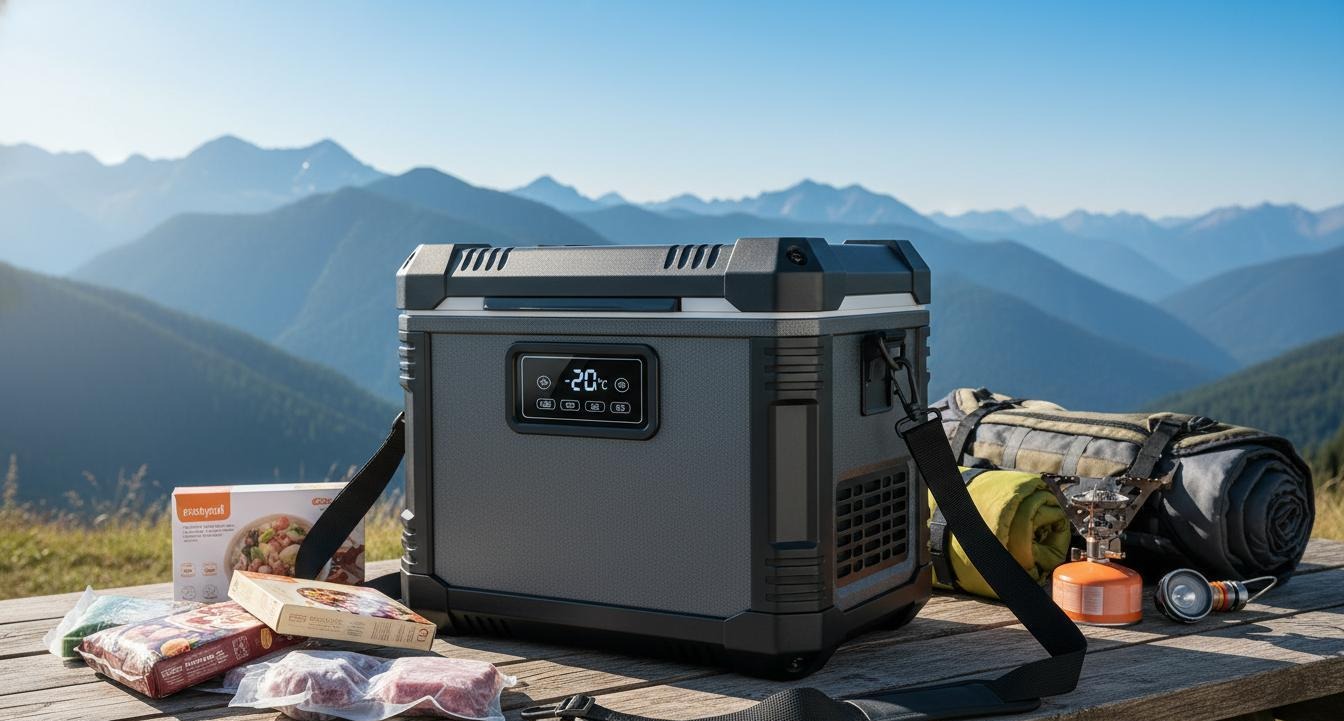
The outdoor recreation market has experienced a sustained growth trajectory over the past decade, with camping and overland adventure tourism emerging as two of the fastest-growing segments in the global outdoor industry. Central to the camping experience is food and beverage storage—and as campers increasingly demand restaurant-quality meals in remote environments, the market for high-performance portable freezer units has evolved from a niche category into a mainstream retail staple. For wholesale buyers serving camping retailers, understanding the technical specifications, market positioning, and supply chain dynamics of outdoor portable freezer wholesale is essential to building a product assortment that captures this growing demand.
Unlike standard coolers that rely on ice packs to maintain cool temperatures for hours, portable freezer units use compressor-based or thermoelectric cooling to achieve true freezer temperatures—sometimes as low as -20°C—even in ambient temperatures exceeding 35°C. This genuine freezing capability fundamentally changes the camping food storage equation: fresh meat, dairy, and frozen meals can be transported and stored safely over multi-day camping trips, enabling a level of culinary ambition that was previously impossible in outdoor settings.
Understanding Portable Freezer Technology: Compressor vs. Thermoelectric Systems
The performance capability of a portable freezer is primarily determined by its cooling technology. Buyers sourcing for camping retail should understand the fundamental trade-offs between compressor-based and thermoelectric systems, as these differences directly affect product performance, price point, and appropriate use case.
Compressor-Based Portable Freezers
Compressor-based portable freezers work on the same principle as household refrigerators: a refrigerant fluid is compressed, allowed to expand through a metering device, and evaporates to absorb heat from the cabinet interior. The resulting cooling effect can achieve temperatures as low as -20°C to -25°C—genuine deep freezing that preserves fresh meat, fish, and dairy for extended periods without ice. This technology is identical to the refrigeration systems used in automotive and marine applications, which means compressor portable freezers can operate reliably in vehicles, boats, and off-grid settings where 12V DC power is available.
The ICEBERG portable car cooler box range uses high-efficiency compressor systems that are designed for automotive 12V/24V DC input with AC adapter compatibility for home mains operation. These units are specifically engineered for the high vibration, variable temperature, and power fluctuation conditions that characterise automotive and outdoor use.
Compressor portable freezers offer several critical advantages for serious outdoor use: genuine deep-freeze capability down to -20°C or lower; performance that is unaffected by ambient temperature (within design limits); compressor systems are more energy-efficient at achieving and maintaining very low temperatures compared to thermoelectric alternatives; and faster pull-down time—compressor units can cool a warm cabinet to -18°C significantly faster than thermoelectric units. ICEBERG’s 50-litre camping cooler box with wheels exemplifies the large-format compressor portable freezer category, designed for extended camping trips where genuine freezer storage for multiple days of provisions is required.
Thermoelectric Portable Coolers
Thermoelectric portable coolers use the Peltier effect (as described in the makeup fridge article) to create a temperature differential between the cabinet interior and the ambient environment. Unlike compressor systems, thermoelectric units cannot achieve temperatures below approximately 40°F (4°C) in ambient temperatures above 77°F (25°C) because the thermoelectric element’s maximum temperature differential is limited. For this reason, thermoelectric units are better classified as “coolers” rather than “freezers”—they maintain food and beverages below ambient temperature, but they do not achieve true freezing.
For outdoor use, thermoelectric units are best suited for: day trips where ice pack cooling is sufficient; budget-conscious consumers who prioritise price over genuine freezer capability; and scenarios where power availability is limited and the lower power consumption of thermoelectric units (typically 40–60W vs. 80–120W for compressor units at equivalent volume) is a significant advantage. Outdoor recreation market research consistently identifies genuine freezer capability as the most sought-after feature in portable refrigeration among serious campers, which has driven market growth for compressor-based solutions.
Capacity Selection: Matching Storage Volume to Trip Duration and Group Size
Selecting the appropriate capacity for a portable freezer offering requires matching the storage volume to the specific use case profile of the target consumer segment. Wholesale buyers should understand the typical capacity ranges and their recommended applications to construct an appropriate product assortment.
20–30 Litre: Solo and Couple Camping
Units in the 20–30 litre range represent the entry point for genuine compressor portable freezers. This capacity is sufficient to store 2–3 days of fresh provisions for 1–2 people: approximately 3–4 kg of fresh meat and dairy, a selection of frozen meals, and beverages. These units typically weigh 8–15 kg (depending on the refrigeration system and cabinet construction) and can be transported in a standard vehicle boot or back seat without difficulty.
The 20–30 litre segment is the highest volume retail category for portable freezers in most markets. ICEBERG’s compact portable fridge range in this capacity category features models with handles and shoulder straps for convenient carrying, making them suitable for day hikes, beach trips, and car camping where the freezer needs to be carried short distances from the vehicle to the camp.
40–50 Litre: Family Camping and Group Adventure
Units in the 40–50 litre range are designed for multi-day family camping trips, overland expeditions, and group outdoor activities where several days of full-size provisions must be stored. The ICEBERG 50-litre camping cooler box with wheels is specifically designed for this segment, with heavy-duty wheels and a retractable handle that enable the unit to be rolled over rough terrain—addressing the primary pain point of moving a large, heavy cooler box from the vehicle to the campsite.
At this capacity, the power consumption of compressor refrigeration (80–120W at 12V DC) becomes a meaningful consideration for campers running off battery power. Users must ensure their vehicle’s auxiliary battery system or portable power station has sufficient capacity to run the unit overnight without depleting the vehicle starting battery. Many models include a low-voltage battery protection function that automatically shuts off the unit when battery voltage drops below a safe threshold.
60–80 Litre: Expedition and Commercial Use
The largest portable freezer units (60–80 litres) are designed for extended expeditions, remote work camps, commercial catering, and professional outdoor guide operations where large quantities of provisions must be maintained at safe temperatures for groups of 8–15 people over extended periods (5–10 days without resupply). These units require robust power management and are typically powered by dedicated auxiliary battery systems or portable generators.
Temperature Performance: The Critical Specification for Freezer Evaluation
For genuine portable freezer applications, the specified minimum temperature is the single most important performance specification. Wholesale buyers should verify that the temperatures stated by manufacturers are verified performance data—not marketing language that overstates real-world performance.
Real-world vs. rated performance: Manufacturers typically rate minimum temperature under controlled laboratory conditions (ambient temperature of 25°C, no load, stabilised operation). In real-world camping conditions, ambient temperatures frequently exceed 30°C, the cabinet is opened regularly to access provisions, and the unit may be operated on a vehicle battery with slightly lower voltage than ideal. Under these conditions, actual achievable minimum temperature may be 5–10°C higher than the rated specification. This is particularly important for consumers who need to maintain frozen food safety—rising above -12°C begins to compromise the safety of frozen meats and dairy products over multi-day storage.
Consumer testing publications recommend that buyers verify that a portable freezer can maintain at least -18°C (the standard for domestic freezer cabinets) in ambient temperatures of up to 32°C before considering it suitable for genuine freezer applications. Units that can only achieve -10°C to -12°C in real-world conditions are better classified as “high-performance coolers” rather than true portable freezers.
Power Consumption and Battery Management for Outdoor Use
Portable freezers are unique among consumer appliances in that they are often powered by vehicle batteries, portable power stations, or solar generator systems—not the stable, unlimited mains power supply that household appliances assume. Understanding power consumption and battery management is therefore essential for both wholesale buyers assessing product quality and end consumers making purchasing decisions.
Running Power and Starting Current
Compressor portable freezers consume varying amounts of power depending on their operating state: running power (when the compressor is actively cooling, typically 50–120W for 12V DC units), and starting current (the brief spike of current required to start the compressor motor, which can be 3–5 times the running current for 1–2 seconds). This starting current is important for users with small portable power stations or limited vehicle auxiliary battery capacity, as the initial power draw may trigger the power station’s overload protection.
Low Voltage Disconnect (LVD) Protection
Almost all quality compressor portable freezers include a Low Voltage Disconnect (LVD) function that automatically shuts off the unit when the source battery voltage drops below a preset threshold—typically 10.5–11.0V for 12V systems. This protection prevents the user from completely draining their vehicle starting battery, which would leave them stranded in a remote location. ICEBERG’s portable cooler range includes LVD protection as standard across its product line, a feature that is essential for safe use in automotive and off-grid power environments.
Solar Compatibility
For overland adventurers and remote camping enthusiasts running on solar power, the energy efficiency of a portable freezer is critical to maintaining battery charge over extended periods without drive time. Solar energy market data shows that portable solar panel and battery storage systems are among the fastest-growing segments in the outdoor power equipment market, creating a natural synergy with energy-efficient portable refrigeration. Buyers sourcing for this market segment should look for units with variable-speed compressor technology (also called DC inverter or digital compressor), which adjusts the compressor speed to match cooling demand, significantly reducing average power consumption compared to fixed-speed compressor units.
Certifications and Compliance for International Outdoor Appliance Distribution
Portable freezers, like all electrical products, require appropriate certifications for each target market. For outdoor and automotive electrical appliances, the most critical certifications are:
- CE marking: Required for the EU market. For portable refrigeration used in vehicles and outdoor environments, the applicable directives include the Low Voltage Directive (LVD 2014/35/EU) for electrical safety, and the EMC Directive (2014/30/EU) for electromagnetic compatibility.
- RoHS compliance: Required in the EU and increasingly globally. Confirms that the product does not contain restricted hazardous substances in its electrical and electronic components.
- IP rating: For portable outdoor appliances, Ingress Protection (IP) ratings for dust and water resistance are relevant. Units intended for outdoor use should have at least an IPX4 rating (protected against water splashing from any direction).
- Automotive EMC: For units powered from vehicle electrical systems, compliance with automotive EMC standards (e.g., CISPR 12 for vehicle electromagnetic emissions) ensures that the unit does not interfere with vehicle electronics.
ICEBERG’s product portfolio is manufactured under ISO 9001 quality management system certification, with comprehensive electrical safety and EMC testing documentation available for international distribution and retail procurement qualification. Products are exported to over 80 countries, with compliance documentation covering CE, ETL, CCC, and RoHS requirements as standard for major destination markets.
Supply Chain and MOQ Strategy for Camping Retail Wholesale Buyers
For camping retailers and outdoor equipment distributors building a portable freezer product category, understanding the supply chain dynamics and MOQ structures that govern this product category is essential to structuring competitive procurement arrangements.
Understanding China’s Portable Refrigeration Manufacturing Landscape
China is the dominant global manufacturing base for portable refrigeration appliances, with major production clusters in Zhejiang (including Ningbo, where ICEBERG is located), Jiangsu, and Guangdong provinces. The manufacturing landscape ranges from large-scale OEM factories with comprehensive certification coverage and international brand customers, to small-scale workshops producing lower-specification units for budget market segments.
Working with established manufacturers like ICEBERG—with a 40,000 square metre facility and 10-year track record—provides wholesale buyers with production capacity, quality system maturity, and certification documentation that smaller manufacturers often cannot match. The tradeoff is typically a higher per-unit price and higher MOQ requirements, but these are offset by better quality consistency, more reliable supply, and lower risk of certification or compliance issues that could require product recalls.
MOQ Structure and Custom Configuration
Standard product MOQ for quality portable freezers from established manufacturers typically starts at 50–100 units per model, with price breaks at 200, 500, and 1,000 units. Custom configurations (logo printing, custom colours, specific voltage configurations for target markets) typically require higher MOQ (200–500 units) and longer lead times (8–12 weeks including sample development and approval).
For camping retailers entering the portable freezer category for the first time, a common entry strategy is to start with a private label arrangement on existing product designs with a modest initial order (50–100 units), then expand to custom configurations in subsequent orders once sales velocity has been established. This approach minimises initial inventory risk while building the brand equity and customer data that justifies the higher investment of custom product development.
For retailers constructing a comprehensive portable freezer assortment, offering a range of capacity options from 20L through 50L ensures that the product line covers the full spectrum of consumer use cases—from lightweight solo adventures requiring a compact 20-litre unit that fits in a daypack, through to extended family camping trips where a 50-litre unit with wheels provides genuine deep-freeze capability for a week’s provisions. This breadth of range also supports higher average transaction values by enabling customers to trade up from entry-level to premium models as their outdoor capabilities and ambitions grow.
Conclusion: Building a Portable Freezer Product Assortment Strategy
The outdoor portable freezer market presents a compelling growth opportunity for camping retailers and outdoor equipment distributors, driven by the sustained growth of camping culture, overland adventure tourism, and the demand for premium outdoor culinary experiences. Successful procurement in this category requires understanding the technology trade-offs between compressor and thermoelectric systems, matching capacity to the target consumer segment’s trip duration and group size requirements, verifying real-world temperature performance against rated specifications, and sourcing from manufacturers with the certifications, quality systems, and production capacity to support long-term product programs.
The key procurement success factors are: specifying genuine -18°C to -20°C deep-freeze capability for products positioned as “freezers” (not just coolers); selecting a capacity ladder that covers the solo camper through the expedition group segments; ensuring LVD battery protection is standard to support safe automotive and off-grid use; verifying all required market certifications are documented and current; and structuring OEM/ODM arrangements that balance product customisation with manageable MOQ and lead times.
For wholesale buyers seeking a manufacturer with proven capability in portable refrigeration, ICEBERG Electronic Appliance Co., Ltd. offers comprehensive compressor-based and thermoelectric portable cooling solutions backed by 10 years of manufacturing experience, a 40,000 square metre production facility, and an established export track record serving over 80 countries with OEM/ODM capabilities for both standard and custom configurations.
ICEBERG Electronic Appliance Co., Ltd. is a professional factory producing electronic mini fridge, cosmetic fridge, camping cooler box and compressor car fridge. With a history of ten years, the factory covers an area of 40,000 square metres, equipped with high-performance injection moulding machines, PU foam machines, constant temperature testing machines, vacuum extraction machines, auto packing machines, and other advanced equipment to ensure strict quality control. Products have been exported to over 80 countries and regions worldwide. The company supports OEM and ODM service for models and packaging.
Post time: Jun-03-2026