

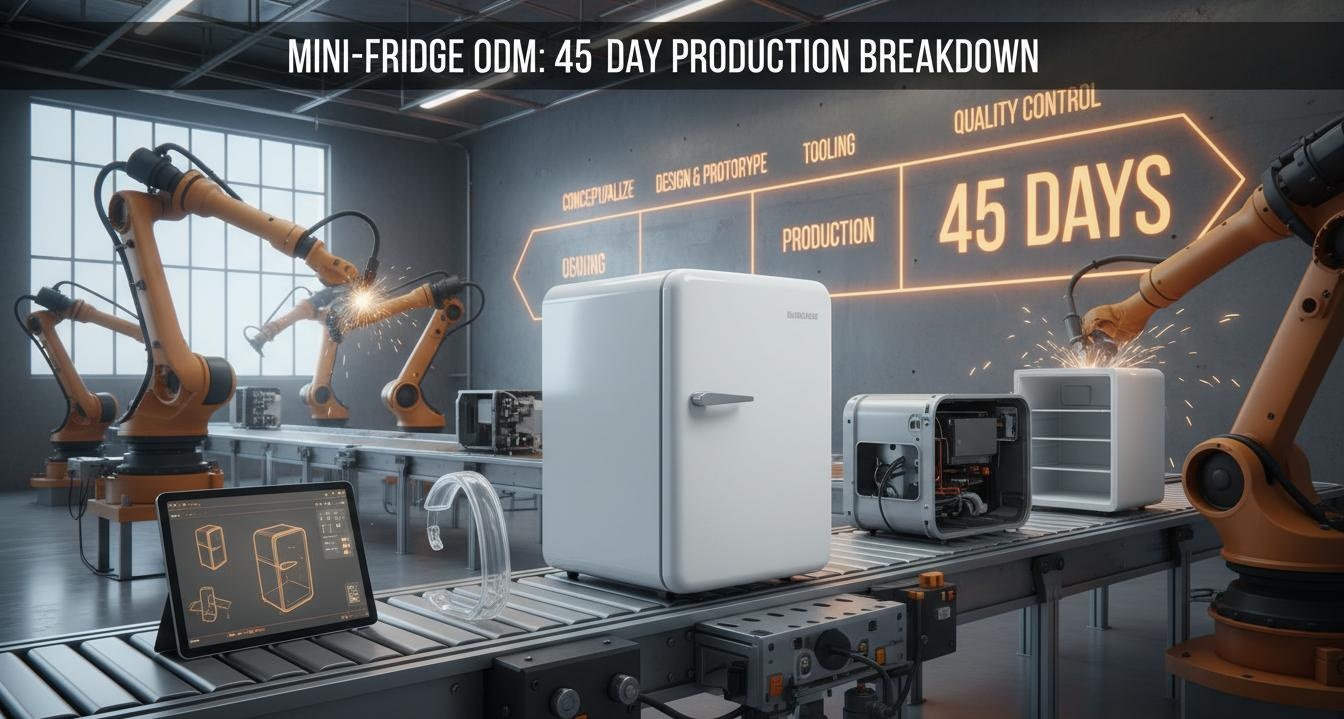
- 45-day ODM timeline is achievable with pre-qualified suppliers, existing tooling, and dedicated project management — but requires Day 1 alignment on specs
- Design freeze happens by Day 5 — final specifications locked before prototype starts
- Prototype approval by Day 15 — functional validation completes before pilot production
- Pilot run at Day 30 — small-batch verification before mass production
- Container loading by Day 45 — final QC passed and goods ready for export
Bringing a mini refrigerator from concept sketch to a shipping container in just 45 days sounds ambitious — and until recently, it was nearly impossible for most brands. The traditional ODM timeline for small appliance development stretches anywhere from 90 to 120 days, with design iterations, supplier qualification, and production ramping consuming months of lead time.
But the dynamics have shifted. Today’s supply chain infrastructure, combined with modular design approaches and pre-qualified component ecosystems, makes a 45-day turnaround not only possible — it’s becoming the new standard for brands that need to move fast. This isn’t about rushing quality; it’s about eliminating waste in the traditional development cycle through better planning, clearer specifications, and stronger supplier partnerships.
This guide breaks down exactly what happens in each phase, identifies the critical decision points that can derail the timeline, and provides milestone checklists so you know whether your project is on track. Whether you’re a startup launching your first product or an established brand entering the mini refrigerator category, understanding this process gives you realistic expectations and actionable checkpoints.
For teams turning this roadmap into a sourcing brief, Aisberg’s mini refrigerator ODM services and custom refrigerator manufacturing pages are useful reference points for matching timeline assumptions with actual factory capabilities.
Why 45 Days Is Now Possible — and What It Would Have Taken 5 Years Ago
Five years ago, a 45-day ODM timeline for mini refrigerators would have been considered reckless. The average development cycle stood at 90-120 days, and brands typically planned for 6-8 months from concept to container. So what’s changed?
The biggest shift is component standardization and supply chain prefactoring. In the past, every new mini refrigerator project required custom tooling for the compressor, custom molds for the cabinet, and custom development for the control electronics. Each of these steps took 3-6 weeks on its own. Today, most ODM factories maintain pre-qualified component libraries — standardized compressor units, proven door assemblies, and validated refrigeration cycles — that can be combined for different product configurations without starting from scratch.
Because tooling lead times have been compressed from weeks to days, the overall timeline shrinks accordingly. A compressor module that previously required 4 weeks of tooling adaptation now ships from inventory in 48 hours. This isn’t cutting corners; it’s the result of accumulated learning across thousands of similar projects.
Additionally, digital prototyping services have dramatically accelerated the design validation phase. Where physical prototypes were once required to verify thermal performance and door swing mechanics, now CFD (computational fluid dynamics) modeling and finite element analysis can predict behavior with 90%+ accuracy before any tooling is touched. This means design errors get caught in the CAD phase, not during expensive tooling modifications.
The final piece is supplier relationship maturity. Brands that work with the same ODM partners over multiple generations of products build predictable development cycles. There’s no time spent on supplier qualification, payment term negotiations, or quality system alignment — all of which consumed 2-4 weeks on first-time collaborations.
What would have taken 5 years ago wasn’t just longer in absolute time — it was longer because of redundant decision cycles, unvalidated assumptions, and relationship-building overhead. Today’s 45-day timeline exists because the industry has learned where the time actually goes, and structured processes to eliminate non-value-adding delays.
Phase 1 (Days 1-5): Concept Freeze and Technical Specification Lock
The first 5 days determine everything. You cannot compress this phase without sacrificing quality later — but you can eliminate the extended iterations that stretch traditional projects. By Day 5, every critical specification must be locked and documented. This includes electrical requirements, thermal performance targets, dimensional constraints, material selections, and certification roadmap.
Day 1-2 focuses on requirement alignment. The brand provides target market requirements — voltage (110V/120V for North America, 220-240V for Europe), plug type, energy efficiency targets (DOE compliance for US, ERP for Europe), and intended use case. Is this a hotel mini bar, a desktop office cooler, or a medical-grade refrigeration unit? Each use case carries different specifications.
Because the use case drives every downstream decision, clarity here prevents costly pivots later. A unit intended for hotel use requires door lock provisions and energy monitoring; a medical unit needs precise temperature control (±1°C vs. ±5°C for standard); a dorm room unit needs compact form factor and lightweight construction.
Day 3-4 involves CAD-based concept development. The ODM provides initial 3D renderings based on agreed specifications. This is where practical manufacturing considerations get incorporated — draft angles for plastic injection molding, hinge placement for serviceability, and compressor accessibility for maintenance.
Therefore, the concept review meeting on Day 4 or 5 must be attended by both design engineers and production engineers. Design aesthetics matter, but if the production team cannot manufacture the design at target cost, you face delays that no amount of fast-tracking can recover.
Day 5 marks the design freeze milestone. All specifications are documented in a Technical Specification Sheet (TDS) that both parties sign off on. At this point, changes to the specification trigger formal change requests with timeline impact assessments. The goal isn’t to prevent all changes — it’s to ensure changes are conscious decisions, not accumulated drift.
Phase 1 Checklist
- Target market and voltage requirements confirmed
- Thermal performance targets specified (temperature range, pull-down time, energy consumption)
- Dimensional constraints documented (width, depth, height including packaging)
- Material specifications finalized (cabinet material, door panel, interior lining)
- Certification roadmap agreed (UL, ETL, CE, CCC as applicable)
- 3D CAD concept reviewed and approved by both design and production
- Technical Specification Sheet signed by both parties
- Single point of contact identified on both brand and ODM sides
Phase 2 (Days 6-15): Prototype Development and Functionality Validation
With locked specifications, the prototype phase begins immediately. The goal of Days 6-15 isn’t to produce a perfect production sample — it’s to produce a sample that validates functionality and identifies design risks before tooling commit.
Day 6-7 involves detailed engineering release. The ODM converts approved 3D concepts into manufacturing-ready documentation — detailed part drawings, assembly instructions, and Bill of Materials (BOM). Component sourcing begins for any items not in standard inventory.
Day 8-12 is the prototype build window. Depending on component availability, this phase typically produces 3-5 prototype units. Some get subjected to functional testing; others serve as design review samples.
Functional testing includes temperature pull-down testing — measuring how quickly the unit reaches set temperature from ambient. A standard mini refrigerator should pull down to 4°C (39°F) within 2 hours in a 32°C (90°F) ambient environment. Testing at extreme conditions (worst-case scenarios) identifies design margins.
Door hinge cycle testing gets performed per IEC 62552 requirements — 10,000 open/close cycles minimum for household refrigeration, with the unit operating under each cycle. Door gaskets and hinge mechanisms must maintain seal integrity after thousands of cycles.
Technical teams should verify this test plan against IEC 62552 refrigerator testing standards and market-specific efficiency references such as DOE energy efficiency guidance before approving the prototype gate.
Day 13-15 is the prototype review and approval window. The brand reviews test results, examines sample quality, and provides sign-off for pilot production. Any required design modifications get documented with clear remediation plans.
Because prototype issues identified early cost 10x less to fix than issues discovered during pilot production, thorough validation here pays dividends. Common prototype findings include insufficient insulation thickness (leading to condensation), inadequate door seal design (leading to energy waste), and noisy compressor vibration (leading to customer complaints).
Phase 2 Checklist
- Prototype units built (minimum 3 units)
- Temperature pull-down test completed and results documented (target: 4°C within 2 hours at 32°C ambient)
- Energy consumption measured at various ambient conditions
- Door hinge cycle test completed (10,000+ cycles per IEC 62552)
- Door seal integrity verified — smoke test or equivalent
- Noise level measured at operating condition (target: <40 dB for bedroom use)
- Dimensional verification against specifications
- All findings documented with remediation plans
- Prototype approval signed off by brand
Phase 3 (Days 16-30): Pilot Run and Pre-Shipment Quality Verification
Prototype approval triggers production preparation. The pilot run — typically 50-100 units — serves as the final quality system validation before mass production commitment. This is where manufacturing process issues surface, not during mass production when they’re exponentially more expensive.
Day 16-20 focuses on tooling finalization and production setup. All custom tooling (injection molds, assembly fixtures, test equipment) gets finalized. The production line configures for the specific product. Operator training completes.
Day 21-25 is the pilot production window. Units roll off the production line at reduced speed while process parameters get optimized. Every unit undergoes First Article Inspection to verify assembly consistency.
First Article Inspection verifies that the first unit off the production line meets all specifications — dimensionally, functionally, and aesthetically. Any deviation requires process adjustment before continuing.
Day 26-28 involves pre-shipment testing. The pilot batch units undergo the same functional tests as prototypes, plus additional tests that weren’t practical at prototype scale:
- Drop testing — per ISTA 1A, units should survive a 150mm drop without functional damage
- Vibration testing — simulating transport conditions for 30 minutes minimum
- Cosmetic inspection — all surfaces examined for scratches, dents, and finish defects
Day 29-30 is the pilot approval and mass production release. The brand reviews pilot batch results, approves pilot samples, and formally releases mass production. Any remaining open items get documented with owner and target resolution date.
Because pilot run findings directly predict mass production yield, expect a 5-10% rework rate in the pilot batch as normal. Anything above 15% indicates insufficient process preparation and should trigger a hold until root causes are identified.
Phase 3 Checklist
- Tooling finalization completed and verification data documented
- Production line setup and calibrated
- Operator training completed with competency verification
- First Article Inspection passed
- Pilot batch produced (50-100 units)
- Functional testing completed on pilot batch samples
- Drop testing completed per ISTA 1A
- Vibration testing completed (30 minutes minimum)
- Cosmetic inspection passed with defect map
- Rework rate below 15%
- Mass production release approved by brand
- Quality Documentation Package compiled
Phase 4 (Days 31-45): Mass Production, QC and Container Loading
With mass production approved, the final phase executes at full production speed. Days 31-45 are about maintaining the quality standards validated in the pilot run while achieving target production volumes.
Day 31-35 focuses on production ramp-up. The first mass production units roll off the line. In-line inspection stations verify critical-to-quality parameters at each assembly stage. Any drift from pilot run parameters triggers immediate investigation.
In-line quality verification includes:
- Compressor amp draw check — every unit verified vs. specification
- Temperature uniformity check — multiple points measured
- Door seal vacuum test — no air leakage below threshold
- Dimensional spot check — samples measured per Statistical Process Control (SPC)
Day 36-40 covers aging and final testing. After assembly, units undergo a minimum 4-hour running test to verify no early failures. Some brands require 24-hour burn-in for critical applications.
Day 41-43 is packaging and palletization. Final visual inspection precedes packaging. Units get packed per agreed specifications — typically foam inserts, poly bag, and corrugated outer. Pallet configuration gets verified for container optimization.
By Day 44-45, units move to container loading. Final outbound QC sampling occurs immediately before loading. Loading sequence gets documented for unloading efficiency at destination. Container seal gets applied, and shipping documents get exchanged.
Therefore, container loading completes with signed proof of loading — the formal handoff from manufacturer to logistics provider. This document verifies quantity, packaging condition, and seal integrity at time of departure.
Phase 4 Checklist
- Production ramp-up completed at target throughput
- In-line QC verification per control plan
- Running test completed (minimum 4-hour burn-in)
- Final visual inspection completed
- Packaging verified per specification
- AQL 2.5 inspection passed on random sample
- Shipping documents prepared (commercial invoice, packing list, bill of lading)
- Container loaded and verified
- Proof of loading signed
- Container sealed and dispatched
Critical Path Items: The 3 Decisions That Can Derail the 45-Day Timeline
Every 45-day ODM timeline has decision points that, if not managed properly, will extend the project by weeks. These aren’t random delays — they’re predictable moments where brand-side decisions are required. Managing these three decision points proactively is the single biggest factor in on-time delivery.
Decision 1: Specification Changes After Design Freeze
The first and most common derailment is specification changes after the design freeze date. Once prototype or production tooling begins, any specification change requires re-qualification of affected processes. Changing door material from PCM to glass after tooling is complete can add 10 days to the timeline — not because the change is complex, but because re-qualification takes time.
Because every change request requires: engineering review, cost impact assessment, supplier confirmation, quality plan update, and re-testing. What seems like a simple swap triggers a cascade of validation requirements.
The fix: Finalize specifications before Day 5. If changes are absolutely necessary after Day 5, explicitly acknowledge the timeline impact before issuing the change request.
Decision 2: Certification Timing and Scope
Certification requirements often get addressed late in the project, causing timeline compression that makes on-time delivery impossible. UL listing for the US market requires 8-12 weeks under normal scheduling; CE marking requires 4-8 weeks via notified body. Attempting to compress these into a 45-day timeline guarantees failure.
Therefore, certification scope must be defined by Day 5, with submission target dates established. Most certifications can run in parallel with production preparation (testing can start once prototypes are available), but the timeline only works if the certification roadmap is clear from day one.
For export-focused programs, certification planning should include UL listing requirements, applicable CE or ETL pathways, and packaging verification using ISTA packaging testing standards; commercial teams can then use the ODM inquiry channel to confirm which documents are already available.
The fix: If certification timing is critical, consider certification to standards that already exist in the certificate library, or consider pre-certification of common configurations.
Decision 3: Payment and Logistics Alignment
Production cannot start without payment terms aligned. Mass production cannot ship without logistics documentation ready. These business decisions are often deprioritized in favor of technical discussions, but they have longer lead times than most technical items.
Because payment term negotiations can add 2-3 weeks if not addressed during the specification phase, and because customs documentation errors cause port delays that ripple into production schedule changes, business process alignment deserves equal airtime with engineering discussions.
The fix: Reconcile payment terms and logistics requirements by Day 10, with documentation deadlines established that create buffer before production completion.
The “45-Day Promise” Reality Check: When ODM Can and Cannot Meet This Deadline
45 days is achievable — but not for every project, and not with every supplier. Understanding the boundary conditions that enable fast-track timelines prevents disappointment and protects brand-supplier relationships.
45-day timeline is realistic when:
1. Pre-existing tooling or compatible tooling is available. New tooling for custom compressor housings, unique door configurations, or non-standard dimensions adds lead time. If the product requires significant new tooling investment, expect 60-75 days minimum.
2. Components are in supplier inventory. Standard compressor modules, commonly available thermostats, and existing door assemblies can ship immediately. Specialty components (e.g., medical-grade temperature sensors) require advance sourcing — add 2-4 weeks.
3. Certification already exists or is pre-qualified. If the destination market requires certification, and if standard certifications are already held for similar product families, certification can run in parallel. New certification applications add 8-16 weeks.
4. Brand decision-makers are available. The bottleneck is rarely factory capacity — it’s brand-side review and approval cycles. If decisions require committee approval or if reviewers are unavailable for 5+ days, the timeline extends accordingly.
5. Payment terms are standard or pre-agreed. New payment relationships require credit review, which adds time. For brands without established payment history, expect advance payment requirements that create cash flow considerations.
45-day timeline is NOT realistic when:
1. New certification is required from scratch. New market entry (especially for medical or commercial refrigeration) requires certification timelines that cannot be compressed below standard processing times.
2. Extreme customization is required. Products that deviate significantly from standard configurations (special dimensions, non-standard voltages, unique features) require additional development time.
3. Peak season timing coincides. During peak production periods (April-June for summer products, August-October for holiday products), capacity constraints extend lead times regardless of commitment.
4. First-time brand-to-ODM collaboration. Relationship establishment overhead (quality system alignment, documentation standards, communication protocols) adds 2-4 weeks on first projects. Subsequent collaborations benefit from established processes.
Frequently Asked Questions
Q1: How long does it take to bring a mini fridge from concept to mass production using ODM?
The standard ODM timeline for mini refrigerator development ranges from 60 to 90 days for projects using existing tooling and pre-certified components. A compressed 45-day timeline is achievable when specifications are locked by Day 5, prototype approval completes by Day 15, and both parties maintain dedicated project management. However, this timeline requires pre-existing supplier relationships, standard component availability, and streamlined decision-making processes. New brands or highly customized products should plan for 75-120 days as baseline.
Q2: What is the minimum timeline for ODM mini fridge production?
The theoretical minimum timeline is 35-40 days for an exact replica of an existing product using in-stock tooling and components with already-obtained certifications. However, in practice, 45 days represents the realistic minimum for new orders with customized branding. This baseline assumes zero delays in brand decision-making, certification already in place, standard payment terms established, and production capacity available. Any deviation from these conditions extends the timeline proportionally.
Q3: What are the key milestones in a mini fridge ODM project?
The four critical milestones in a mini fridge ODM project are: Design Freeze (Day 5) when all technical specifications are locked; Prototype Approval (Day 15) when functional validation completes and design risks are identified; Pilot Run Approval (Day 30) when small-batch production validates manufacturing processes; and Mass Production Release and Shipment (Day 45) when goods are QC passed and loaded for export. Each milestone requires formal sign-off from the brand and represents a gate that must pass to proceed. Missing any milestone deadline extends the overall timeline.
Q4: What can cause delays in ODM mini fridge production timelines?
The primary causes of delay in ODM mini refrigerator timelines are: specification changes issued after design freeze (adding 7-21 days per change); certification delays when new certifications are required (adding 8-16 weeks); component supply disruptions especially for semiconductor-intensive control boards; brand-side decision delays where review cycles exceed 72 hours; tooling issues discovered during prototype or pilot phases; and payment term disputes that block production release. Most delays are preventable through upfront specification clarity and proactive milestone management, but supply chain disruptions can be outside either party’s direct control.
Q5: Can I customize an ODM mini fridge model and still meet a 45-day timeline?
Yes, within limits. Moderate customization — logo printing, color changes, minor dimension adjustments, or packaging variations — fits within the 45-day timeline if components are standard and tooling is compatible. However, major customization requiring new injection molds, custom compressor selection, or non-standard electrical configurations extends the timeline to 60-90 days depending on complexity. The key factor is whether the customization requires new tooling or reuses existing tooling with modification. Cosmetic customization typically adds zero to 5 days; structural customization typically adds 15-30 days.
Post time: May-20-2026