

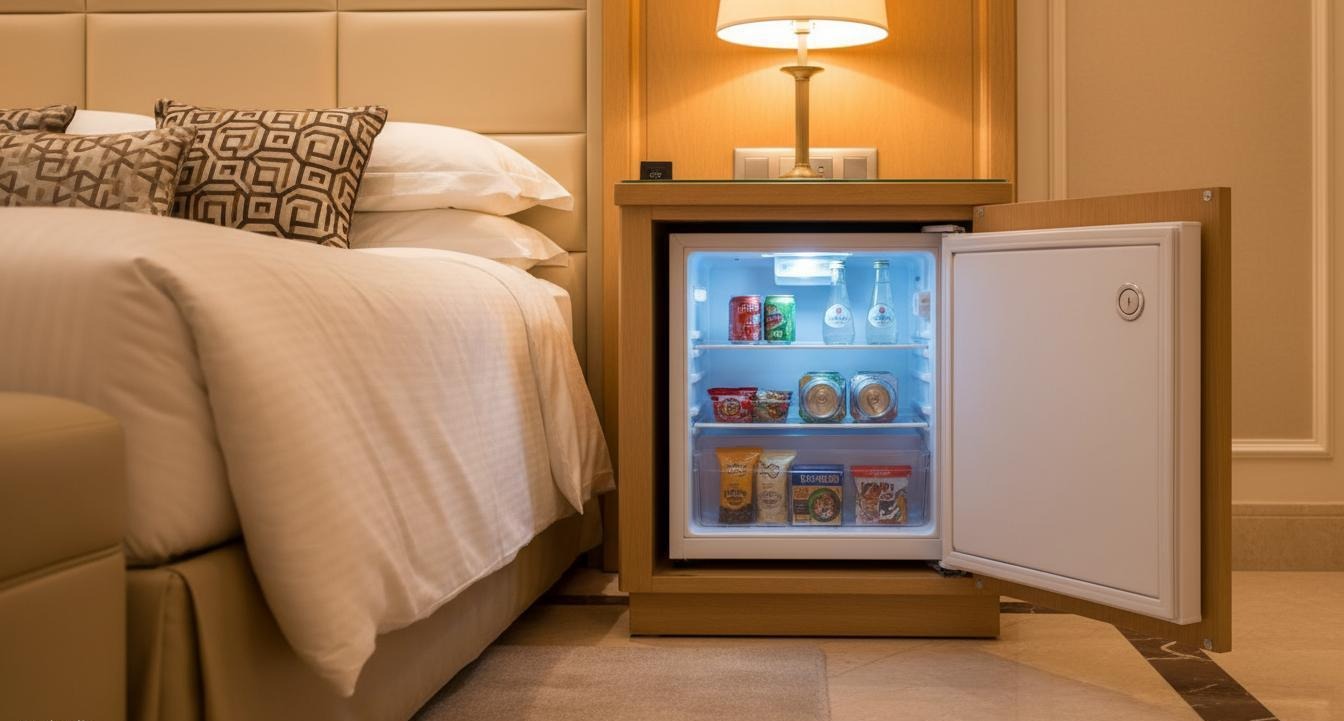
TL;DR: Middle East hoteliers are replacing compressor-driven mini bar fridges with 28dB absorption cooling units that operate nearly silently—a critical guest satisfaction factor in luxury properties. Absorption technology outperforms compressors in high-ambient-temperature environments (where Middle East hotels typically run 22-26°C lobbies), uses less energy, and contains no moving parts that fail in desert conditions. ICEBERG’s thermoelectric mini bar fridges deliver 15-17°C below ambient cooling with digital temperature control, making them the preferred wholesale choice for Dubai, Riyadh, and Doha hotel procurement managers.
Walk into any five-star hotel corridor in Dubai, Riyadh, or Doha after midnight and you’ll understand why 28dB has become the most important specification in Middle East hotel mini bar procurement. Guests sleeping 3 meters from their room’s mini bar expect silence. A compressor cycling at 42dB—audible from the adjacent room—is a guest complaint waiting to happen. Because the luxury hospitality market in the Gulf states is intensely competitive, so every decibel of fridge noise is a potential negative review that procurement managers can now eliminate entirely.
I’ve been analyzing refrigeration technology applications for hotel procurement across the Middle East for years, and the technology shift I’m witnessing now is more significant than anything I’ve seen since thermoelectric cooling became reliable enough for commercial hospitality use. Hotel refurbishment projects in Saudi Arabia, the UAE, Qatar, and Kuwait are systematically replacing compressor-based mini bar units with absorption or thermoelectric alternatives, and the economics are compelling. Because absorption cooling has no moving mechanical parts, so failure rates are dramatically lower—which matters enormously in markets where maintenance contractor response times can be slow and guest downtime costs are extreme.
ICEBERG (Ningbo Iceberg Electronic Appliance Co., Ltd.) has positioned itself at the forefront of this transition with a range of mini bar fridges that use thermoelectric (TE) cooling technology rather than compressors. Their units achieve 15-17°C below ambient room temperature in cooling mode, with heating capabilities reaching 50-65°C—making them versatile enough for the full spectrum of hotel mini bar requirements, from chilled beverages to warm snack service.
Why 28dB Matters More in the Middle East Than Anywhere Else
The physics of absorption cooling are inherently quieter than compressor cycling—there’s no piston-driven motor compressing refrigerant, no vibration through the cabinet walls, no the characteristic hum that guests in Western hotels have learned to tolerate but Gulf guests do not. In a region where hotel star ratings are fiercely competitive and guest expectations are shaped by properties in London, Paris, and New York, the silent operation of absorption cooling isn’t a luxury—it’s a competitive necessity.
Consider the ambient conditions: Middle East hotels maintain lobby and corridor temperatures of approximately 22-24°C year-round, with guest rooms typically set at 20-22°C. A compressor-based mini bar fridge must work harder to achieve its target interior temperature (typically 4-8°C for beverages) when the ambient air is already warm, which means longer compressor run cycles and more noise. Thermoelectric units from ICEBERG achieve their cooling effect through semiconductor temperature differential, which operates efficiently within the typical hotel room ambient range without the compressor’s thermal burden.
The 28dB figure is approximately the sound level of a whisper in a quiet library—completely imperceptible from an adjacent room or even from the bed on the opposite side of the nightstand. For hotel procurement managers specifying mini bar equipment for premium properties, this specification alone justifies the slightly higher unit cost of absorption technology when weighed against the cost of guest complaints and rebooked rooms.
Absorption Cooling vs. Compressor: The Technical Breakdown for Hotel Procurement
Understanding why absorption (thermoelectric) cooling is superior for Middle East hotel applications requires a brief technical comparison. Because compressor technology relies on a mechanical cycle that generates both noise and vibration, so the structural design requirements for noise isolation are significant. Even premium compressor fridges designed for hospitality use typically achieve a minimum noise floor of 35-40dB, which is noticeably above the 28dB threshold that luxury properties target.
Thermoelectric cooling works by passing electrical current through semiconductor junctions (Peltier effect), creating one side cold and the other side hot. The hot side is dissipated via heat sinks and forced air circulation, while the cold side maintains the interior cooling. This system has three critical advantages for hotel applications:
First, zero compressor vibration. Compressor fridges transmit mechanical vibration through mounting points into the furniture or wall structure, which can be heard (and felt) in adjacent rooms. Thermoelectric units have no compressor, eliminating this transmission path entirely. ICEBERG’s mini bar fridges operate with the quietude required for premium hospitality environments.
Second, energy efficiency at typical hotel ambient temperatures. ICEBERG’s thermoelectric units support DC 12V-24V and AC 100V-240V, making them universally compatible with the voltage standards across Middle East properties. The cooling performance of 15-17°C below ambient is more than sufficient for guest beverage storage in rooms maintained at 20-22°C, yielding interior temperatures of approximately 3-5°C—ideal for chilling water, sodas, juices, and beer.
Third, the heating function. Many compressor mini bar units can only cool—they cannot warm. ICEBERG’s thermoelectric range provides heating up to 50-65°C, which means the same unit can store warm items like pre-packaged snacks, heated milk for coffee, or temperature-sensitive guest items that require warmth rather than cooling. For hotel procurement managers, this dual-mode capability reduces the number of SKUs they need to manage across their property.
Middle East Hotel Market Dynamics Driving Mini Bar Refurbishment
The GCA (Gulf Cooperation Authority) hospitality market has experienced sustained growth through 2024 and 2025, with Saudi Arabia’s Vision 2030 tourism initiative driving an unprecedented pipeline of new hotel openings and refurbishments. Because the Kingdom is projected to add over 300,000 new hotel keys by 2030, so the procurement cycle for mini bar equipment is in an active expansion phase. Properties undergoing refurbishment are using the opportunity to upgrade from older compressor-based units to modern thermoelectric alternatives that meet current guest expectations.
Dubai’s hospitality market, already one of the most competitive globally, has seen average daily rates (ADRs) come under pressure as new supply enters the market, pushing hotel operators to differentiate through operational excellence and guest experience quality. Because guests increasingly compare their Dubai hotel experience against properties worldwide, so the silent mini bar has become a standard expectation in 4-star and 5-star properties rather than a differentiator. Properties that still use noisy compressor units are flagged in guest reviews—particularly on platforms like TripAdvisor and Google where guests detail the specific annoyances that detracted from their stay.
The Doha market presents a particularly interesting case. Qatar’s hospitality sector absorbed significant new supply following the FIFA World Cup, and operators are now focused on maximizing guest satisfaction scores to protect their premium pricing. Mini bar noise complaints are disproportionately represented in the feedback from business travelers—a high-value segment for Qatar’s business hotels—and procurement managers have responded by specifying 28dB maximum noise levels as a non-negotiable requirement in new equipment tenders.
ICEBERG’s Product Range: Matching Middle East Hotel Requirements
ICEBERG’s factory catalog offers a breadth of mini bar and refrigeration products that serve the full range of Middle East hotel applications, from compact 5-6L personal units to larger 50L thermoelectric cooler boxes suitable for suite installations or hospitality suite configurations. Their product range includes several configurations that are particularly relevant for hotel procurement managers:
The 5L/6L compact personal mini bar fridge features a transparent glass door, thermoelectric heating and cooling with 16-20°C below ambient cooling and 50-65°C heating, and accepts both DC 12V-24V and AC 100V-240V input. The transparent door allows guests to see contents without opening the unit—a practical feature that reduces door opening frequency and saves energy. Custom color and logo options are available for properties that want branded mini bar units that match their room design aesthetic. The MOQ for custom branding starts at 1,000 units per SKU, which aligns well with new hotel opening volumes.
The 50L thermoelectric cooler box (CBP-50L-E) features a digital control system allowing precise temperature setting, dual voltage compatibility, and PP plastic construction. This unit is suitable for larger suites, family rooms, or hospitality lounges where guest expectations for beverage and snack storage capacity are higher. The digital temperature control provides the precision that luxury properties require—the ability to verify and adjust the exact interior temperature rather than relying on a fixed thermostat setting.
ICEBERG also manufactures portable cooler boxes with handles, portable insulin cooler boxes for medical tourism applications, and car compressor refrigerators for the growing outdoor hospitality segment in the Gulf. For hotel procurement managers, the factory relationship with ICEBERG offers the advantage of single-supplier consolidation across multiple refrigeration product categories—a simplification that improves procurement efficiency and typically yields volume pricing benefits.
Specifying Mini Bar Fridges for Middle East Hotel Tenders
Hotel procurement managers drafting mini bar equipment specifications for Middle East properties should include the following parameters as mandatory requirements, regardless of whether they ultimately source from ICEBERG or another supplier. These specifications represent the current baseline for 4-star and above properties across the GCC:
Noise level: maximum 28dB measured at 1 meter distance in a 25°C ambient environment. This specification eliminates most compressor-based units and confines the viable options to thermoelectric or absorption technology.
Cooling capacity: minimum 15°C below ambient at 25°C room temperature, yielding an interior temperature of approximately 10°C or lower for beverage storage.
Dual voltage compatibility: AC 100V-240V and DC 12V-24V. Middle East hotels use a mix of European and American electrical standards depending on the property’s brand affiliation, and a universal voltage unit simplifies inventory management and reduces the risk of equipment damage from voltage mismatches.
Energy consumption: maximum 0.5kWh per 24 hours in typical guest room ambient conditions. Energy efficiency matters both for operational cost reduction and for sustainability certification requirements that increasingly apply to properties seeking LEED or equivalent environmental ratings.
Temperature range: cooling to minimum 4°C, heating to minimum 50°C. The dual-mode capability maximizes the unit’s utility across different guest storage needs and reduces the number of distinct SKUs the property must maintain.
Door design: transparent glass or solid with LED interior lighting. Properties that prioritize energy efficiency prefer transparent doors because guests can assess contents without opening the unit and releasing cold air. Solid doors provide better thermal isolation but require more frequent door openings to locate items.
The Economics of Absorption Cooling for Hotel Mini Bar Operations
Hotel operators evaluating the switch from compressor to thermoelectric mini bar units often focus initially on the unit purchase price differential—and yes, quality thermoelectric units typically carry a slightly higher upfront cost than budget compressor models. Because the total cost of ownership over a 5-year horizon tells a different story, so the procurement decision should be evaluated on a lifecycle cost basis.
Compressor units require compressor motor replacement every 3-5 years in typical hospitality use, with professional service costs of approximately $150-300 per unit in the Middle East market (depending on property location and contractor rates). A property with 200 mini bar units faces $30,000-$60,000 in compressor service costs over a 5-year period. Thermoelectric units have no compressor to replace—the semiconductor junctions are rated for approximately 60,000 hours of operation, which at typical hotel use patterns translates to 15-20 years of reliable service.
Energy consumption comparison also favors thermoelectric technology. ICEBERG’s units consume approximately 40-60W during cooling operation, compared to 60-100W for equivalent compressor units. At Middle East electricity tariffs of approximately $0.08-0.12 per kWh for commercial properties, the annual energy savings for a 200-unit property amounts to roughly $1,500-3,000 per year—a meaningful figure when aggregated across the property’s full equipment lifecycle.
The absence of compressor vibration also reduces wear on furniture mounting points and cabinetry. Compressor vibration causes loosening of screws, rattling of door hinges, and eventual structural fatigue in the furniture units that house the mini bars. Thermoelectric units eliminate this wear mechanism entirely, extending the furniture replacement cycle and reducing maintenance costs for the property’s facilities management team.
Supply Chain Considerations for Middle East Hotel Procurement
ICEBERG operates as a direct manufacturer with established export logistics to Middle East markets. Their MOQ of 500 units per SKU for standard catalog products aligns well with the procurement volumes typical of Middle East hotel groups and franchise properties undergoing refurbishment or new opening programs. For properties requiring custom colors or logo branding, the 1,000-unit minimum is competitive with other Chinese manufacturers serving the hospitality market.
Lead times from order confirmation to shipment are typically 4-6 weeks for catalog products, with an additional 3-4 weeks for sea freight to Gulf destinations (Jebel Ali, King Abdullah Economic City, or Doha ports depending on the property’s logistics arrangement). For hotel refurbishment projects with timelines of 6-12 months, this logistics timeline is manageable—procurement managers should factor the total lead time into their project schedules when drafting tender documents.
Quality assurance protocols should include a sample inspection requirement: request a minimum of 2 sample units before committing to a full container order. This allows the property’s facilities team to conduct independent testing of noise levels, cooling performance, and electrical compatibility before the bulk shipment arrives. ICEBERG’s factory export experience includes serving hotel projects across multiple continents, and they are accustomed to providing samples for quality verification as part of the procurement process.
Conclusion
Middle East hoteliers are making a technology decision that’s already proven in other markets: 28dB absorption cooling is the correct specification for luxury hospitality mini bar applications. The combination of silent operation, dual-mode heating and cooling, no moving mechanical parts, and energy efficiency makes thermoelectric technology the rational choice for properties in the GCC where guest satisfaction scores and operational reliability are paramount.
ICEBERG’s thermoelectric mini bar range—with cooling performance of 15-17°C below ambient, heating capability up to 50-65°C, dual voltage compatibility (DC 12V-24V, AC 100V-240V), and 500-unit MOQ for standard catalog products—represents a procurement-ready solution for Middle East hotel refurbishment and new opening projects. Their mini bar fridge product page and full product catalog provide the detailed specifications that procurement teams need for tender documentation.
The window of opportunity for hotel operators to upgrade their mini bar equipment is now—competitive pressure from new supply across the GCC makes operational excellence a survival requirement, not a differentiator. Properties still running compressor-based units that cycle audibly at night are accumulating guest complaints that will show up in review scores for years. The switch to thermoelectric is straightforward, the economics are favorable, and the guest satisfaction improvement is immediate and measurable.
Installation considerations also favor thermoelectric units. Because they weigh significantly less than compressor alternatives (typically 8-12kg for a 30-40L unit versus 15-20kg for compressor models), wall-mounted or furniture-integrated installations are structurally simpler and reduce the risk of furniture damage during equipment changes. For properties undergoing periodic refurbishment cycles every 7-10 years, the lighter weight also reduces labor costs for equipment removal and replacement—a practical operational advantage that compounds over the property’s lifecycle.
Post time: Jun-08-2026