

- Cooling temperature range 5 to 18 degrees Celsius with default 8 to 15 degrees. The range covers the temperature window where most skincare serums retain stability without freezing.
- LED mirror built into the door eliminates the need for a separate bathroom mirror and provides consistent illumination independent of the hotel bathroom lighting.
- WiFi app control allows the user to set temperature from the phone, monitor door status, and pre-cool the fridge. For hotels, it also allows the engineering team to monitor the appliance status across all rooms from a central dashboard.
- Certification has to match the destination market: CE for Europe, UL or ETL for North America, CCC for China, SAA for Australia, PSE for Japan. The LED mirror and WiFi module need their own wireless certifications.
- Sound level no more than 28 to 32 decibels at one meter. A fridge above 35 decibels is noticeable in a quiet hotel room at night and is usually rejected by the property.
The cosmetic fridge in a 2026 hotel room is no longer just a cooling appliance; it is an amenity that integrates lighting, mobile app, and refrigeration into a single in-room experience, and the procurement specification has to cover all three subsystems, not just the cooling performance. Buyers who specify the cosmetic fridge on the cooling capacity alone end up with an amenity that disappoints on the lighting, the app integration, and the certification, and the property has to absorb the cost of the disappointing amenity through the next refit cycle.
This article is the hotel specification guide I share with amenity procurement teams and hospitality group buyers who contact our Ningbo factory about cosmetic fridge orders for 2026 room refits. The cooling subsystem falls under the IEC 60335 household refrigeration appliance safety standards family, which is the international baseline the major certification marks trace back to. It is built around the verification of our 6L/9L/15L/20L mini skincare fridge with glass door product line, with the broader cosmetic fridge and beauty fridge catalog as the product context. For buyers specifying across multiple properties, our engineering team can issue a property-by-property BOM that locks the size, color, certification, and app integration per property. If you are specifying a cosmetic fridge amenity for a 2026 room refit, the eight sections below walk through the five specs in detail.
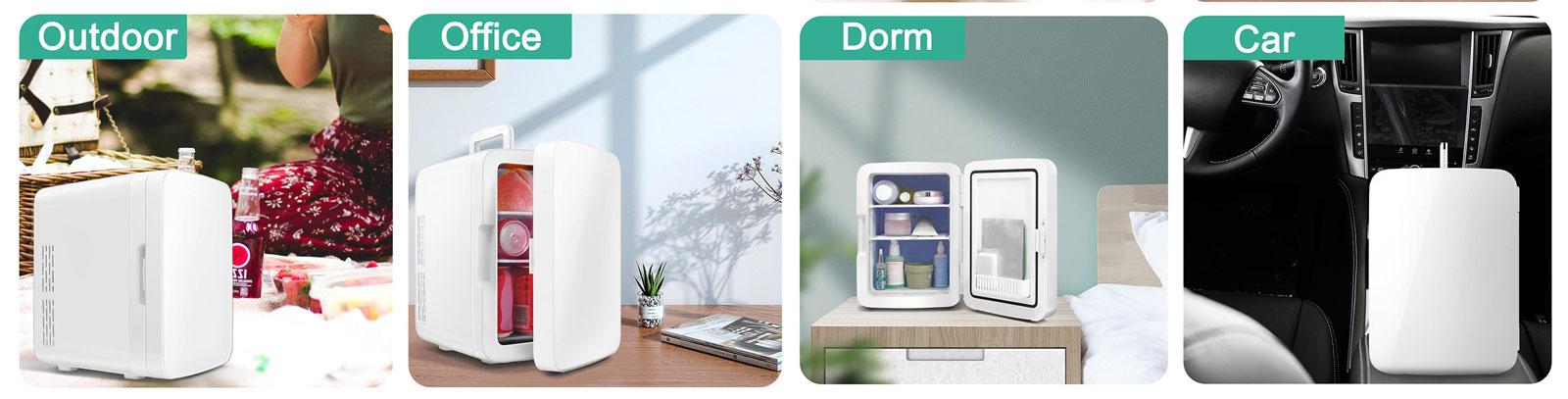
6L/9L/15L/20L mini skincare fridge with glass door and digital display. View product specifications →
Why the 2026 Hotel Room Refit Has to Specify the Cosmetic Fridge as a System, Not an Appliance
The reason the 2026 hotel room refit specification has to treat the cosmetic fridge as a system rather than an appliance is that the guest experience depends on the integration of three subsystems — cooling, mirror illumination, and mobile app — not on any single subsystem in isolation. A fridge that cools perfectly but has a dim mirror, or a fridge with a bright mirror but no app, disappoints on the system-level experience even though each subsystem works as specified.
The system-level thinking is also what allows the property to capture the maintenance benefit of the WiFi app. A property that installs cosmetic fridges across 200 rooms and connects each fridge to the central dashboard can detect failures before the guest complains, can monitor door-open events that suggest guest misuse, and can collect usage data that informs the next refit cycle. None of that is possible if the fridge is specified as a cooling appliance only.
The system-level thinking also drives the certification specification. The cooling subsystem needs the electrical safety certification for the destination market. The LED mirror subsystem needs the wireless certification if it includes any smart features. The WiFi app subsystem needs the wireless certification for the destination market band (2.4 GHz WiFi is global, but the certification mark varies). The procurement team has to specify all three certifications together, not as separate appliances.
Spec 1 — Cooling Temperature Range and the Skincare Storage Window
The cooling temperature range is the first specification because it determines which skincare products can be stored in the fridge without freezing or without losing potency. The wrong temperature range either damages the product or fails to preserve it.
A hotel-grade cosmetic fridge should maintain a temperature range of approximately 8 to 15 degrees Celsius at the default setting, with an adjustable range of approximately 5 to 18 degrees Celsius across the user-accessible temperature dial or app. The default range covers the temperature window where most skincare serums, eye creams, and moisturizers retain stability without freezing. The adjustable range allows the property to set a cooler temperature for serum storage or a warmer temperature for cream storage.
The cooling technology is typically thermoelectric (Peltier) for the 6L to 15L sizes and compressor for the 20L and larger sizes. Thermoelectric cooling is quieter and lighter, which suits the hotel in-room placement, but the cooling capacity is lower than compressor. Compressor cooling is more powerful but louder and heavier. The procurement team has to match the cooling technology to the size and the in-room placement. For US-flagged hotel properties that participate in sustainability programs, the energy-efficiency claims can be cross-referenced against the ENERGY STAR qualified refrigeration product criteria.
Spec 2 — LED Mirror Illumination and the In-Room Skincare Application Workflow
The LED mirror built into the cosmetic fridge door is the second specification because it changes the in-room skincare application workflow, and the workflow change is what justifies the LED mirror upgrade over a standard opaque-door fridge.
The LED mirror eliminates the need for a separate bathroom mirror when applying skincare products. The user opens the cosmetic fridge, takes out the serum, applies the serum at the fridge itself, and returns the serum to the fridge, all without walking back to the vanity. This workflow is particularly valuable for skincare routines that involve multiple products applied in sequence, because the products stay cold between applications.
The LED illumination should be consistent across the mirror surface, with no hot spots or dead zones. The LED color temperature matters for color rendering on the skin — a cool white LED above 6000K can make skin look washed out, while a warm white LED below 3000K can make skin look yellow. A neutral white LED between 4000K and 5000K is the standard for skincare application because it renders skin tones accurately. Photobiological safety of the LED ring is documented under the IEC 62471 lamp and lamp system photobiological safety standard family.
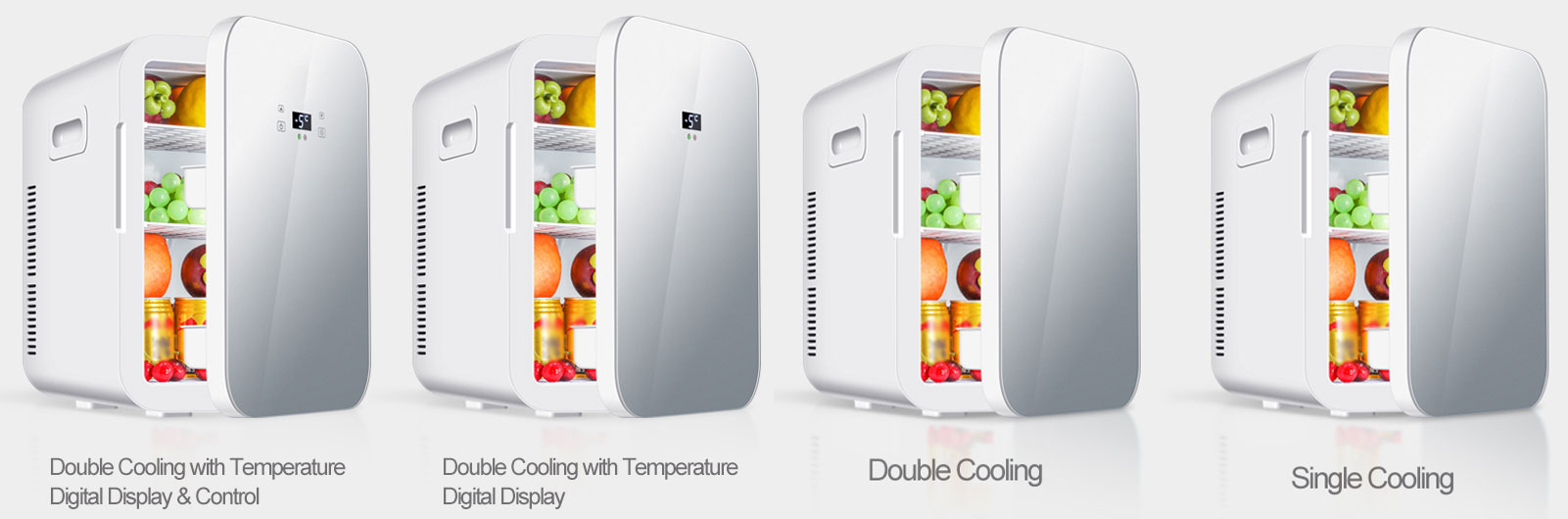
Skincare fridge glass door detail showing the LED mirror illumination and digital temperature display.
Spec 3 — WiFi App Integration and the Hotel Operations Benefit
The WiFi app integration is the third specification because it provides both the guest-side benefit (temperature control from the phone) and the property-side benefit (central monitoring across all rooms), and the property-side benefit is often the deciding factor for the procurement team.
For the guest, the WiFi app allows the user to set the temperature from the phone, monitor the door open / close history, receive alerts when the door is left open, and pre-cool the fridge before arrival. Pre-cooling is a feature that the property can advertise as a guest amenity (“your fridge is pre-cooled before you arrive”), and it is also a feature that reduces the compressor load when the guest first opens the door.
For the property, the WiFi app allows the engineering team to monitor the appliance status across all rooms from a central dashboard. The dashboard shows which fridges are running, which have been opened in the last 24 hours, which have triggered a door-open alert, and which have lost WiFi connection. The maintenance team can detect failures before the guest complains, can plan cleaning routes based on actual usage, and can collect usage data that informs the next refit cycle.
The WiFi app integration typically uses 2.4 GHz WiFi (which is global) and connects to the property WiFi network. The app configuration per property is part of the OEM order, and the OEM should provide the app documentation and the property-specific configuration file. For US-shipped units, the radio module falls under the equipment authorization regime administered by the US Federal Communications Commission (FCC), and for European shipments under the Radio Equipment Directive documented through the EU CE marking and RED framework.
Spec 4 — Certification Across the Three Subsystems
The certification specification is the fourth dimension because the cosmetic fridge has to clear three different certification tracks, one for each subsystem, and a missing certification in any one track is a customs hold or a property rejection.
| Subsystem | Certification Track | Common Marks |
|---|---|---|
| Cooling subsystem | Electrical safety + energy efficiency | CE / UL / ETL / CCC / SAA / PSE |
| LED mirror subsystem | Photobiological safety + LED driver | IEC 62471 / UL 8750 |
| WiFi app subsystem | Wireless + EMC | FCC / RED / SRRC / MIC |
The certification documentation must be available before the shipment leaves the factory. A shipment that arrives at the destination port without the certification documentation is held in customs until the documentation is provided, which adds days to weeks to the delivery timeline and may push the room refit past the property’s opening date.
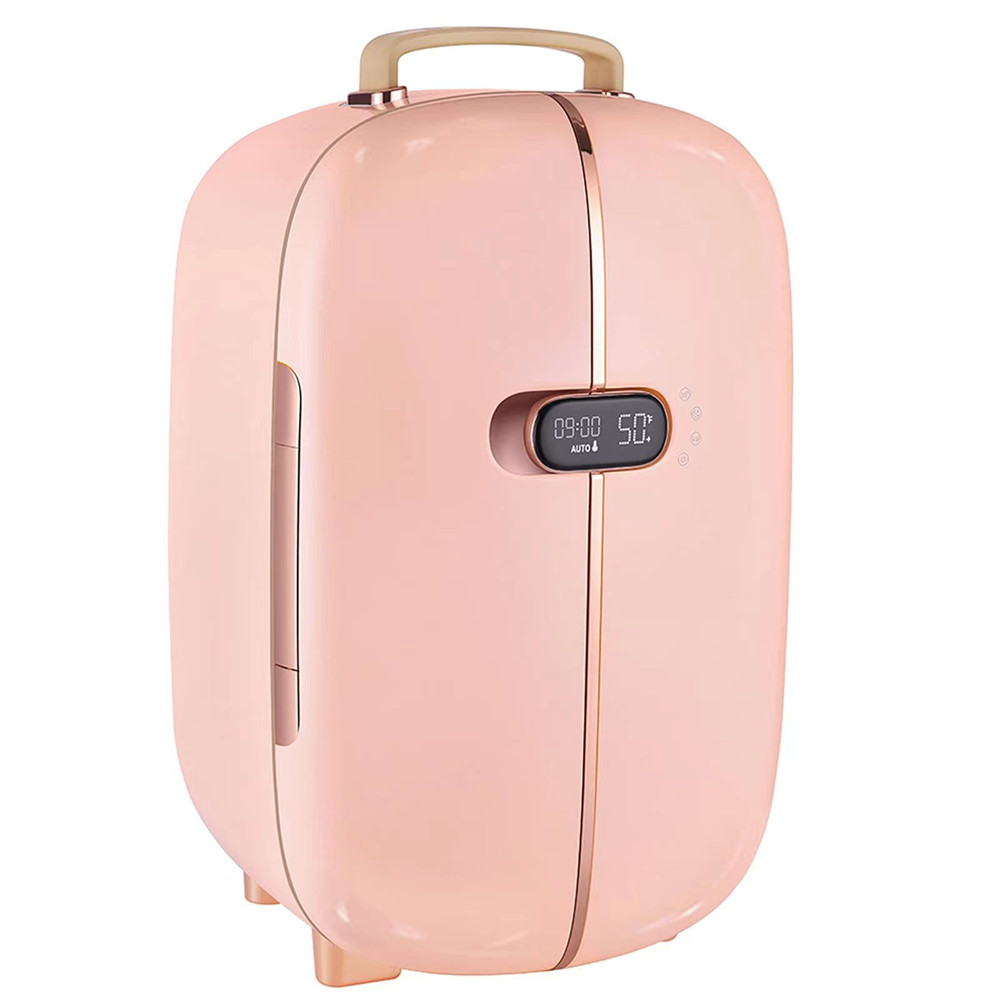
MFA-12L smart cosmetic fridge with WiFi app control and LED mirror — the 12L upgrade option for premium hotel suites.
Spec 5 — Sound Level and the In-Room Noise Tolerance
The sound level specification is the fifth dimension because the cosmetic fridge sits in the hotel room, not in a back-of-house area, and a fridge that is audible in a quiet hotel room at night is rejected by the property and by the guest.
A hotel-grade cosmetic fridge should operate at no more than 28 to 32 decibels at one meter, which is the standard quiet-operation range for thermoelectric units designed for in-room placement. Compressor units typically run louder (35 to 40 decibels) and are usually specified for larger sizes where the cooling capacity is needed.
The sound level is measured at one meter from the unit under standard operating conditions. The property’s engineering team typically spot-checks the sound level at installation by placing a sound meter at one meter from the fridge and recording the reading. A fridge that exceeds the specification is rejected and replaced under warranty.
How to Order the Cosmetic Fridge for a Multi-Property Hotel Group
A multi-property hotel group that is specifying the cosmetic fridge across multiple properties has to manage the order at the property level, not at the room level, because the certification, the app configuration, and the maintenance workflow are property-specific. A consolidated group order can simplify the procurement but has to be split per property at the configuration stage.
The right approach is to issue one master purchase order to the OEM, with a property-by-property schedule that specifies the quantity, the capacity, the color, the certification mark, and the app configuration per property. The OEM processes the order as one production run and ships per property with the property-specific documentation and app configuration pre-loaded.
The lead time for a custom-branded cosmetic fridge order with LED mirror and WiFi app control typically runs 35 to 50 days from PO confirmation for a standard color, and 50 to 70 days for a custom color or custom app integration. The lead time includes tooling for the brand plate, app configuration, and certification documentation for the destination market.
Multi-Property Hotel Group Order Checklist
- Master PO with property-by-property schedule: quantity, capacity, color, certification mark, app configuration per property.
- Consolidated production run, per-property shipment: one production run at the OEM, multiple shipments per property with property-specific documentation.
- App configuration pre-loaded per property: the OEM pre-loads the WiFi app configuration per property before shipment.
- Spare units per 20 rooms: the property should keep one spare unit per 20 rooms for emergency replacement.
- Standard lead time 35 to 50 days: standard color, custom app integration may extend to 50 to 70 days.
Frequently Asked Questions
What temperature range should a hotel-grade cosmetic fridge maintain?
A hotel-grade cosmetic fridge should maintain a temperature range of approximately 8 to 15 degrees Celsius at the default setting, with an adjustable range of approximately 5 to 18 degrees Celsius across the user-accessible temperature dial or app. The range covers the temperature window where most skincare serums and moisturizers retain stability without freezing.
Why does a cosmetic fridge have an LED mirror built into the door?
The LED mirror built into the cosmetic fridge door eliminates the need for a separate bathroom mirror when applying skincare products. The LED ring or panel provides consistent illumination that does not depend on the hotel bathroom lighting, and the user can apply serums, eye creams, and moisturizers at the fridge itself rather than walking back to the vanity with temperature-sensitive products in hand.
What does WiFi app control add to a hotel cosmetic fridge?
WiFi app control allows the user to set the temperature from the phone, monitor the door open / close history, receive alerts when the door is left open, and pre-cool the fridge before arrival. For hotel amenities, the WiFi app control also allows the property to monitor the appliance status remotely and detect failures before the guest complains.
How does a hotel property manage cosmetic fridge maintenance across the room refit cycle?
A hotel property that installs cosmetic fridges across the room refit typically uses a multi-unit procurement order, a single spare unit per 20 rooms for emergency replacement, and a documented cleaning schedule between guest stays. The WiFi app control supports the maintenance workflow by allowing the engineering team to verify the fridge status across all rooms from a central dashboard.
Does a cosmetic fridge need a specific certification for hotel installation?
A cosmetic fridge for hotel installation needs the standard electrical safety certification for the destination market (CE for Europe, UL or ETL for North America, CCC for China, SAA for Australia, PSE for Japan). For refrigeration, the fridge needs to comply with the energy efficiency standard for the destination market where one exists. For the LED mirror and the WiFi module, the fridge needs the wireless certification for the destination market (FCC for North America, RED for Europe, SRRC for China, MIC for Japan).
How does the size of a cosmetic fridge relate to the room refit standard?
The 6L size is the most common for hotel amenity applications because it fits on the standard bathroom vanity without occupying the counter space. The 9L size is the upgrade option for properties that want to offer a larger amenity footprint or for suites where the counter space is larger. The 15L and 20L sizes are typically residential rather than hotel amenity applications.
How is the sound level of a cosmetic fridge specified for hotel use?
A hotel-grade cosmetic fridge should operate at no more than 28 to 32 decibels at one meter, which is the standard quiet-operation range for thermoelectric or compressor units designed for in-room placement. A fridge above 35 decibels is noticeable in a quiet hotel room at night and is usually rejected by the property.
What is the typical lead time for a custom-branded cosmetic fridge order from a Chinese factory?
A custom-branded cosmetic fridge order with LED mirror and WiFi app control typically takes 35 to 50 days from PO confirmation for a standard color and 50 to 70 days for a custom color or custom app integration. The lead time includes tooling for the brand plate, app configuration, and certification documentation for the destination market.
Miya — Business Manager, Ningbo Iceberg Electric Appliance Co., Ltd.
Miya is the Business Manager at Ningbo Iceberg, with over 10 years of experience in mini refrigerators, beauty refrigerators, outdoor car refrigerators, cooler boxes, and ice makers product export. The company specializes in OEM/ODM mini refrigerators and car refrigerators, custom mold development, global sourcing, and international trade compliance. Miya works directly with hotel amenity buyers and hospitality procurement teams to specify cosmetic fridges for 2026 room refit cycles.
This article is for informational purposes for international B2B buyers of cosmetic fridges for hotel amenity and residential applications. Cooling specifications, LED mirror specifications, and WiFi app specifications are drawn from publicly available refrigeration and wireless standards and from Iceberg factory engineering records. The reference framework for factory-side quality management across the cosmetic fridge and mini refrigeration industry is published through the ISO quality management and refrigeration standards catalog. Always confirm specifications against the latest factory data sheet and against the specific destination market certification requirements before placing a purchase order.
Post time: Aug-24-2026