

TL;DR
- A cosmetic fridge does not have one compliance route. Three variant decisions — cooling technology, power input and connectivity — decide which directives apply before you look at a single certificate.
- CE marking needs an EU Declaration of Conformity for the exact model. EMC always applies; the Low Voltage Directive only applies if mains voltage is built in; radio equipment rules apply only to connected versions.
- RoHS is a declaration inside the technical file, not a mark on the product, and it has to name the restricted-substances list your production lot was actually built against.
- WEEE and ElektroG require registration with the German designated body, the EAR Foundation, before you distribute, and the registration number must appear on the product or packaging.
- VerpackG is the one that stops containers. LUCID registration, dual system participation and volume reporting are three separate obligations, and the 30 tonne threshold is measured in packaging material, not units.
- GPSR has changed your job specifically: a responsible person established in the EU, German-language safety information, and product traceability.
Importing cosmetic fridges into Germany means running four regimes and two German registries, and the mistake most importers make is treating them as one compliance exercise attached to one product. It is not. The compliance route for a cosmetic fridge is decided by three variant choices — thermoelectric or compressor cooling, DC or AC power input, and offline or connected — and every one of those choices changes which directives apply. Get those three right at purchase order stage and the rest is a documentation checklist. Get them wrong and you will discover the gap at the port.
The examples below come from the product range on our cosmetic fridge page, because that range deliberately spans the variants that matter here: 4 L to 26 L thermoelectric units, AC and DC powered versions, a WiFi and Bluetooth app-control version, and separate 20 L and 30 L compressor lines.
This is a practical checklist, not legal advice. Requirements, thresholds and designated bodies change, so confirm the current position with your compliance adviser or the competent authority before you commit to a shipment.
The Three Variant Decisions That Set Your Compliance Path
Before any certificate is discussed, we ask three questions, and they determine everything that follows. In our order of importance, they are cooling technology, power input and connectivity.
Cooling technology. The thermoelectric cosmetic fridges in our range use a semiconductor cooling module and contain no refrigerant at all — one of our 6 L beauty fridges is specified as 100% freon-free, which is a genuine selling point and a genuine compliance simplification. The compressor refrigerator lines in the same catalogue are a different matter for us: they contain refrigerant, so they fall within the EU fluorinated greenhouse gas rules, currently the Fluorinated Greenhouse Gases Regulation (EU) 2024/573.
Power input. This is the one that catches people out, and it caught us out too on our first design review. The Low Voltage Directive applies to equipment rated for 50 V to 1000 V AC and 75 V to 1500 V DC. A cosmetic fridge designed for DC 12 V to 24 V car use therefore sits outside its scope, which surprises most people we brief. Because the appliance falls below the voltage threshold, the external mains adapter becomes a separate product in scope, with its own declaration, and that adapter is what actually reaches the German mains socket. If your unit has AC 100 V to 240 V input built in, the Low Voltage Directive applies to the fridge itself, and that is the version we quote with an in-line adapter.
Connectivity. Our 9 L app-control version connects over WiFi or Bluetooth, and that single feature pulls the Radio Equipment Directive (EU) 2014/53/EU into scope, along with spectrum, electromagnetic compatibility and safety requirements for radio equipment. It also raises a question an insurer will ask us, and it is a good one: what happens to the product if the app service is withdrawn?
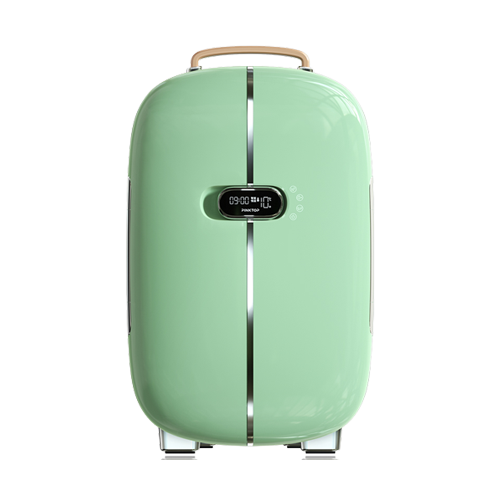 A 12 L thermoelectric cosmetic fridge in the standard configuration: DC and AC power input, digital display, no radio module. This is the variant with the simplest compliance path. Adding WiFi to this same product changes the directive set, which is why the variant has to be fixed before the declaration is issued.
CE Marking: Which Directives Actually Apply
We always start from the same point: CE marking is not a quality mark, and it is not something you affix yourself. It is a manufacturer’s declaration that the product meets the essential requirements of every applicable EU directive, supported by a technical file you keep and can produce on demand.
For a thermoelectric cosmetic fridge the baseline set is narrower than importers usually expect, and narrower than we expected at the start. Electromagnetic compatibility under Directive 2014/30/EU applies to essentially all of them, because there is electronics on the board. The Low Voltage Directive applies only where mains input is built in. Radio equipment rules apply only to the connected version. And the General Product Safety Regulation sits alongside all of them, not instead of them.
What we require in the technical file is specific: product description, design and manufacture information, the declarations themselves, test reports, the RoHS restricted-substances declaration, instructions and warnings, and a description of the production process. Because the file is model-specific, a declaration issued for a 6 L DC unit does not legally cover a 12 L AC unit from the same family, even when the electronics are nearly identical.
RoHS: A Declaration Inside the File, Not a Mark on the Product
RoHS is the piece importers most often misunderstand. It is not a certification logo and nothing is stamped on the product. It is a declaration that the equipment complies with the restrictions on hazardous substances, and it belongs in the technical file alongside the other evidence.
The instrument is Directive 2011/65/EU as amended, including the delegated directives that extended the substance list beyond the original electrical and electronic categories. What we need from the factory is a declaration that names the actual production lot or series, not a generic letter saying the materials used are compliant.
Two practical points come out of our own material reviews. First, we ask whether the declaration covers the plastics, the printed circuit board, the wiring harness and the external adapter, because they come from different suppliers and the combination is what you are placing on the market. Second, we ask how the declaration is re-issued when a supplier changes, because a RoHS declaration that quietly refers to a component you no longer buy is worse than no declaration at all.
WEEE and ElektroG: Register Before You Ship, Not After
German electrical waste law puts a registration duty on anyone who distributes electrical and electronic equipment into the German market, and we have seen importers discover this very late, and since July 2022 that duty explicitly extends to distributors and importers rather than only to producers established in Germany.
The registration itself is handled by the designated body for German electrical waste, the EAR Foundation. Registration and the take-back contract that goes with it are separate steps, and the registration number has to be visible on the equipment or on its packaging so that end users can identify it.
The ordering matters because of what we control. As importer we own the artwork and the market placement, so we own the numbering step, and it sits upstream of the print run rather than downstream of it. Retailers and marketplaces will ask for this number before they will list the product, which makes it a commercial dependency as well as a legal one.
VerpackG: the Law That Stops Containers
The German Packaging Act, which replaced the 1998 packaging law in July 2022, is the obligation that most often halts one of our shipments, and it is the one least connected to the product itself.
We see three duties here, and they are frequently confused with one another. Registration happens in the LUCID packaging register run by the central packaging register office, which is where we file ours, and applies to producers and fillers placing more than 30 tonnes of packaging material on the German market per calendar year. System participation means contracting with one of the approved dual systems, because packaging in Germany is financed through a system of shared responsibility rather than through the municipality. Volume reporting is a separate obligation: once you are registered, you report the tonnage of each material category you place on the market, and the categories are defined by material, not by whether the box is yours or the factory’s.
Three details catch importers out, and they caught us out as well. The 30 tonne threshold is measured in packaging material, so a heavy-duty retail carton per unit counts even when the product inside is small. The LUCID registration number has to be communicated onward to your retail customers as part of your own downstream obligations. And registration is not a one-off: the reporting obligation recurs.
None of this is a Chinese-market obligation, and that is the part which surprises our overseas suppliers. It attaches to whoever places the packaged goods on the German market, which in most structures is the importer or the German distributor, not the factory that filled the carton.
GPSR: The Regulation That Changed the Importer’s Job
The General Product Safety Regulation, Regulation (EU) 2023/988, has been applicable since 13 December 2024 and is the change most importers have not yet absorbed into their documents.
It adds three things that land directly on us as importer. Products from outside the EU need a responsible person established in the EU who can be contacted by both authorities and consumers. Products need traceability, meaning the economic operator, product identifier and batch information have to be recoverable. And safety information has to be supplied in the language of the member state where the product is sold, which for Germany means German.
For a cosmetic fridge we find the traceability requirement is easy to over-engineer and easy to under-engineer. You need enough to answer, six months later, which lot a returned unit came from, and you need it without reconstructing it from an email chain. A batch marking scheme agreed with the factory at tooling stage costs almost nothing then and a great deal later.
One specific watch item we now raise with every customer. Product pages frequently describe cosmetic fridges with food-contact or food-grade language, because the same cabinet is sold for storing drinks or medicines. Food contact rules apply when a product is intended for food contact, and an unsubstantiated claim of that kind on a cosmetic appliance is a claim-substantiation issue under the General Product Safety Regulation. Decide what the product is before you decide what you may say about it.
The Pre-Shipment Checklist
Consolidated into one page, this is what we work through with an importer before the first container is booked. The full version, with the step-by-step detail, is in the checklist below.
| Obligation | Applies to | Held by | Must exist |
|---|---|---|---|
| EU Declaration of Conformity and technical file | Each model or variant sold | Manufacturer, held by importer | Before placing on market |
| RoHS restricted-substances declaration | Each production series | Manufacturer, in the file | Before placing on market |
| WEEE registration and take-back contract | Importer or German distributor | Importer, via EAR Foundation | Before first distribution |
| WEEE number on product or packaging | Every unit shipped | Importer, via artwork | Before printing cartons |
| LUCID packaging registration | Above 30 t/yr packaging material | Producer or filler | Before packaging is produced |
| Dual system participation | Above the threshold | Producer or filler | Before first placing on market |
| Packaging volume reporting | Registered producers, recurring | Producer or filler | Ongoing after registration |
| EU responsible person and batch traceability | Importer placing goods on EU market | Importer, or contracted party | Before placing on market |
| German-language safety and use information | Every unit shipped | Importer, via manual and packaging | Before shipment |
The pattern in that table is worth noticing: only two rows belong to the factory, and the rest is ours. Everything else is the importer’s work, and most of it has to be finished before the container is booked rather than after it arrives.
Frequently Asked Questions
Does a thermoelectric cosmetic fridge need CE marking in Germany?
Yes, if it falls within the scope of one or more EU harmonisation directives, and in practice it does, because it contains electronics. The typical baseline is electromagnetic compatibility. Low Voltage Directive requirements apply only where mains voltage is built in rather than supplied through an external adapter, and radio equipment requirements apply only to connected versions.
Is the Low Voltage Directive needed for a 12 V cosmetic fridge?
Not for the fridge itself. That directive applies to equipment rated for 50 V to 1000 V AC and 75 V to 1500 V DC, so a DC 12 V to 24 V product falls below its scope. The external mains adapter that powers it is a separate product in scope and needs its own declaration, and it is usually that adapter rather than the fridge that a market surveillance authority will ask about first.
Does a WiFi-enabled cosmetic fridge need extra certification?
It brings the product into the scope of the Radio Equipment Directive, which covers spectrum, electromagnetic compatibility and safety for radio equipment in addition to the directives that already applied. It also raises a software lifecycle question, because a connected product depends on an app that may be discontinued, and that belongs in your answers to due diligence questionnaires.
When does VerpackG apply to my import, and what does LUCID involve?
It applies to whoever places packaged goods on the German market. LUCID is the packaging register run by the central packaging register office, and registration is required above 30 tonnes of packaging material per calendar year. Registration is only one of three duties: you must also contract with a dual system and report your packaging volumes by material category on a recurring basis.
Do I need WEEE registration even though I am not the manufacturer?
Yes. German electrical waste law places a registration duty on distributors who place equipment on the German market, and that has covered distributors and importers since July 2022. Registration is with the EAR Foundation, the designated body, and the registration number must be visible on the equipment or its packaging for end users.
Do compressor-based cosmetic fridges need refrigerant compliance?
Yes. Thermoelectric cosmetic fridges contain no refrigerant, but compressor units do, and they fall under the EU fluorinated greenhouse gas rules, currently Regulation (EU) 2024/573. This is one of the reasons importers who already handle thermoelectric units cleanly get caught out when they add a compressor line, because the same carton, the same declaration template and the same testing history no longer cover the product.
What does GPSR require from an importer of cosmetic fridges?
Three practical duties. A responsible person established in the EU who can be contacted by authorities and consumers, traceability so that a returned unit can be traced to its production lot, and safety and use information supplied in German. Under the General Product Safety Regulation, Regulation (EU) 2023/988, these apply alongside the sector-specific rules rather than in place of them.
Can one Declaration of Conformity cover a whole cosmetic fridge range?
Only where the models genuinely share compliance-relevant characteristics. In practice a range that mixes DC and AC powered units, or offline and connected versions, needs separate declarations, because each of those switches a directive on or off. We issue declarations per configuration rather than per product family for exactly this reason.
About the author
Miya — Business Manager, Ningbo Iceberg
Miya has more than 10 years of experience in mini refrigerators, beauty refrigerators, outdoor car refrigerators, cooler boxes and ice makers for export. Her expertise covers OEM and ODM mini refrigerators and car refrigerators, custom mould development, global sourcing and international trade compliance, which is the combination that shapes how this checklist is put together.
Post time: Oct-22-2026