

The global mini fridge market has undergone a remarkable transformation in the past decade. From a niche appliance for college dormitories, mini refrigerators have evolved into specialized cooling solutions for skincare preservation, car travel, medical transport, and outdoor recreation. According to Grand View Research, the global mini fridge market is projected to exceed USD 3.5 billion by 2028, with the cosmetic fridge segment growing at over 12% CAGR.
For beauty brands, automotive accessory distributors, outdoor gear retailers, and hospitality buyers, finding the right manufacturer is the critical first step. This guide provides a comprehensive framework for evaluating mini fridge factories — from production certifications and vertical integration to OEM/ODM processes and export logistics.
Why Does Choosing the Right Mini Fridge Factory Impact Your Brand?
Unlike standard home appliances, mini fridges face unique performance requirements depending on the application. A cosmetic fridge must maintain a precise 10°C interior temperature for skincare preservation. A car fridge must withstand vibration, temperature extremes, and dual-voltage power systems (12V DC / 240V AC). A camping cooler box needs energy-efficient thermoelectric cooling for off-grid use.
According to the U.S. Consumer Product Safety Commission (CPSC), mini refrigerators were involved in over 1,200 reported safety incidents between 2020 and 2024, including electrical failures and inadequate temperature regulation. For B2B buyers, a single product failure can trigger costly warranty claims and brand damage across an entire product line.
A 2025 industry survey by the Association of Home Appliance Manufacturers (AHAM) confirmed that 82% of retailers terminated supplier relationships within 12 months of a major quality failure, regardless of price competitiveness. The message is clear: manufacturer quality is non-negotiable.
What Certifications Should a Qualified Fridge Factory Hold?
Mini fridge certifications vary by target market. Here is a market-by-market breakdown of the essential requirements:
| Target Market | Required Certifications | Scope |
|---|---|---|
| USA & Canada | ETL, FCC, DOE, CA-65 | Electrical safety, energy efficiency, materials compliance |
| European Union | CE (LVD + EMC), GS, RoHS, REACH, ERP, LFGB | Low voltage, electromagnetic compatibility, food contact safety |
| United Kingdom | UKCA | Post-Brexit UK market access |
| Japan | PSE | Electrical appliance and material safety |
| South Korea | KC | Korea Certification for electrical products |
| Australia | SAA | Standards Australia certification |
| Global / Factory Level | ISO 9001, ISO 14001, ISO 45001, BSCI, IATF 16949 | Quality, environmental, occupational health, social compliance |
A full-line mini fridge factory like Ningbo Iceberg holds all of these certifications — from CB/CCC/CE/ETL/FCC for electrical safety to LFGB/FDA/REACH for food contact materials, plus BSCI and ISO management systems. This eliminates the costly process of re-certifying products for different markets.
How Do You Evaluate a Mini Refrigerator Factory’s Production Capability?
Production capability is about more than square footage. Here are the benchmarks professional procurement teams use when evaluating mini fridge manufacturers:
- Production scale: Look for factories with 30,000–40,000 m² of dedicated manufacturing space and multiple automated production lines. Iceberg operates 8 production lines with advanced injection molding, PU foam, and auto-packing machines.
- Annual output & growth trajectory: Sales growth from $7.5M (2017) to $85.8M (2022) — a compound annual growth rate of over 60% — indicates strong operational scaling and market demand validation.
- R&D investment: In-house mold development capability shortens OEM/ODM timelines. Look for factories that offer 2D/3D mold design, prototype testing, and design standardization services.
- Export experience: Consistent exports to 80+ countries demonstrate adaptability to different voltage standards (110V/220V), plug types, and regulatory frameworks.
What Types of Mini Fridges Can a Full-Range Manufacturer Produce?
A complete product portfolio signals manufacturing depth. Here are the major categories a professional cooling appliance manufacturer should be able to supply:
1 Cosmetic & Skincare Refrigerators
The fastest-growing segment. A cosmetic fridge manufacturer must deliver precise temperature control at 10°C with air cooling systems that inhibit bacterial growth. These units need to be ultra-quiet (under 25 dB), energy-efficient, and aesthetically designed for bedroom or vanity placement. The global cosmetic fridge market has grown from a niche novelty to a must-have beauty accessory, driven by consumer awareness that skincare ingredients degrade 40% faster at room temperature.
2 Car Refrigerators (Compressor & Thermoelectric)
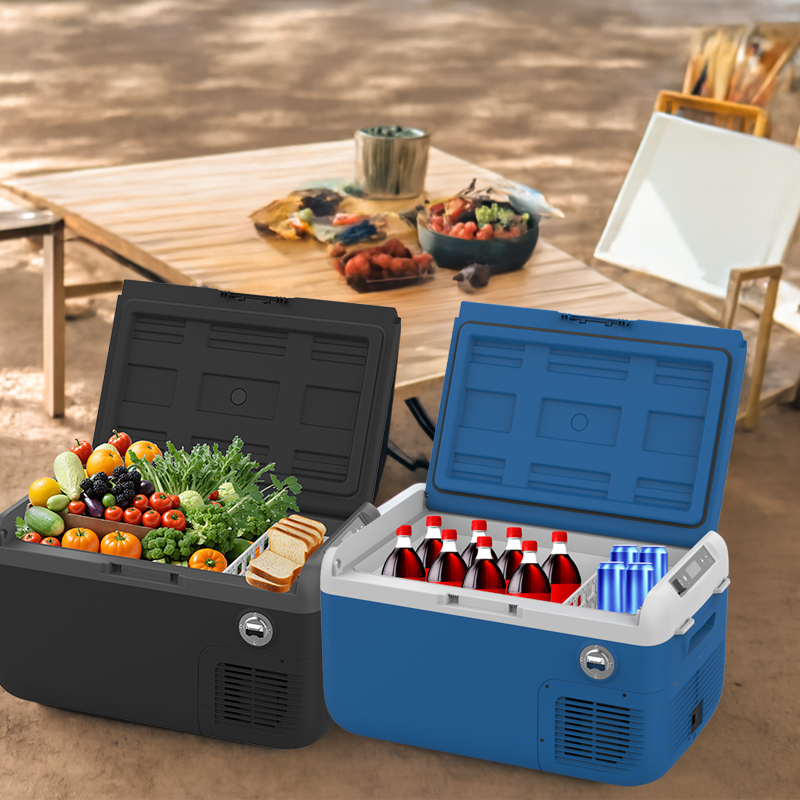
The car fridge OEM market has exploded with the growth of van life, overlanding, and long-haul trucking. Compressor car fridges (capable of reaching -18°C) serve the premium segment, while thermoelectric cooler boxes (cooling 15–20°C below ambient) serve the value market. Dual-voltage capability (12V DC / 100–240V AC) is now a baseline requirement.
3 Mini Fridges for Home, Office & Dorm
The classic mini fridge category remains the highest-volume segment. Standard configurations include 4L–28L capacity, heating and cooling dual-function (50–65°C warming), transparent doors, and compact footprints. LED lighting, USB charging ports, and customizable exterior panels are popular differentiators.
4 Camping Cooler Boxes
Portable cooler box suppliers serve the outdoor recreation market with durable PP plastic construction, carry handles, and efficient insulation. Sizes range from 10L to 35L, with AC/DC power options for campsite and vehicle use.
5 Specialty Products: Ice Makers, Slush Machines & Medical Coolers
Forward-thinking factories also produce ice makers, slush machines, and medical-grade insulin cooler boxes with stable temperature regulation for diabetes management. The medical cooler segment represents a high-value niche with strong growth in home healthcare markets.
What Is the OEM/ODM Process for Mini Fridge Manufacturing?
Understanding the full development cycle helps B2B buyers plan product launches with realistic timelines:
| Phase | Duration | Key Activities |
|---|---|---|
| 1. Project Initiation | 1–2 weeks | Market analysis, product concept development, specification review |
| 2. Design & Validation | 2–4 weeks | Detailed CAD design, cooling system engineering, internal assessment |
| 3. Mold Development | 4–6 weeks | 2D/3D mold creation, injection mold fabrication, tooling trials |
| 4. Prototype Testing | 2–3 weeks | Temperature stability test, vibration test, voltage tolerance test, safety check |
| 5. Design Standardization | 1–2 weeks | Technical specification finalization, production documentation |
| 6. Pilot Run & Mass Production | 4–8 weeks | Trial batch production, feedback integration, full-scale manufacturing |
Total timeline: 14–24 weeks for a new ODM product; 6–10 weeks for OEM (branding-only) on existing models with pre-existing molds.
How Do You Ensure Quality Control in Mini Fridge Production?
Mini fridge quality control involves unique considerations compared to other appliances, due to the combination of electrical systems, refrigerant management, and thermal insulation. Professional manufacturers implement multi-layer QC:
- Incoming QC: Compressor performance validation, thermoelectric module testing, insulation material density check
- In-Process QC: PU foam injection quality, injection molding consistency, wiring harness integrity, cooling system pressure test
- Final QC: 24-hour temperature hold test, dielectric strength test (1,500V), noise level measurement (under 25 dB for cosmetic fridges), energy consumption verification
- Pre-Shipment QC: AQL 2.5 random sampling, cosmetic finish inspection, packaging drop test, labeling and documentation verification
“We launched our first private-label cosmetic fridge with a factory that had impressive samples but weak QC documentation. The first batch had a 7% failure rate — thermostats drifting 3–4°C above spec. We switched to a manufacturer with in-house mold capability and full certification coverage. Our return rate dropped to under 1.2%, and our beauty retail partners renewed their contracts immediately.”
— Product Development Director, European beauty and lifestyle brand (name withheld for confidentiality)
What Logistics and Export Factors Matter for Fridge Sourcing?
Exporting mini fridges involves specific logistics considerations due to their size, weight, and the inclusion of sealed cooling systems:
- Port proximity: Ningbo port is one of the world’s busiest, providing direct container shipping to North America, Europe, Australia, and other major markets.
- Container loading: A standard 20″GP container holds approximately 500–800 mini fridges (depending on size), while a 40″HQ container holds 1,000–1,600 units.
- MOQ flexibility: Standard MOQ for mini fridges is 500–1,000 units. Many factories offer lower MOQ for first-time partnerships, color/logo customization samples, and pilot runs.
- Customs compliance: HS Code 8418.29 (refrigerating or freezing equipment) requires proper refrigerant declarations, energy efficiency documentation, and country-specific safety test reports.
How to Build a Long-Term Partnership with a Mini Fridge Factory
Based on interviews with sourcing directors from five international home and beauty product distributors (anonymized), these traits distinguish reliable manufacturing partners:
✓ Full Certification Coverage
Factories holding certifications for all target markets — US (ETL/FCC), EU (CE/GS/REACH), UK (UKCA), Japan (PSE), Korea (KC), and Australia (SAA) — eliminate months of re-certification delays for new product launches.
✓ Proven OEM/ODM Track Record
Look for manufacturers with a structured 7-step process from project initiation to mass production, including design validation, internal assessments, and multi-stage prototype testing.
✓ Application-Specific Expertise
The best factories understand that a cosmetic fridge has different engineering requirements than a car fridge or a camping cooler. Specialized R&D teams for each application category indicate deep domain knowledge.
✓ Transparent Costing and Lead Times
Detailed quotations breaking down material costs, mold development fees, certification expenses, and logistics charges are the hallmark of a professional manufacturing partner.
Frequently Asked Questions About Mini Fridge OEM Manufacturing (FAQ)
David Lin
Senior Cooling Appliance Industry Specialist & B2B Sourcing Analyst
David Lin has 10+ years of experience in the cooling appliance and small home appliance manufacturing sector, specializing in mini fridge OEM/ODM sourcing, thermoelectric and compressor cooling technologies, and export compliance. His analysis has been referenced by AHAM and multiple industry trade publications. He advises North American and European importers on manufacturer selection and quality assurance in the cooling appliance category.
Post time: May-17-2026