

When guests pay premium rates for a peaceful night’s sleep, the last thing they expect is to be woken at 2 AM by a humming compressor from the mini refrigerator in their room. Hotel mini refrigerators operating below 35 decibels ensure silent operation thatguests literally cannot hear, protecting your TripAdvisor scores and online reviews from the frustration of noise complaints. This comprehensive procurement guide covers the engineering solutions that achieve true sub-35dB operation, the direct correlation between refrigerator noise and guest satisfaction scores, and the volume pricing structure that makes professional-grade silent refrigerators accessible for hotel chains ordering 100-500 units.
For procurement teams comparing hotel-ready units, Ningbo Aisberg Electric’s company homepage and hotel mini refrigerator product line provide the commercial context before moving into noise, energy, and compliance specifications.
TL;DR:
- Silent operation below 35dB is achievable through compressor isolation, soft-start technology, and vibration dampening—these three engineering pillars directly prevent guest sleep disruption and protect online review scores
- A-rated energy mini fridges save approximately $15 per unit per year, translating to $3,000 annual savings for a 200-room property and $7,500 for a 500-unit deployment
- Major hotel chains including Marriott, Hilton, and IHG specify sub-35dB operation as a baseline requirement in their procurement standards, recognizing that guest satisfaction directly impacts RevPAR and repeat booking rates
- Child locks, anti-theft anchors, and ADA compliance are non-negotiable requirements for professional hotel mini refrigerator specifications beyond standard residential models
- Volume pricing for 100-500 unit orders typically yields 15-25% discounts, making high-quality silent units economically viable even for independent boutique hotels
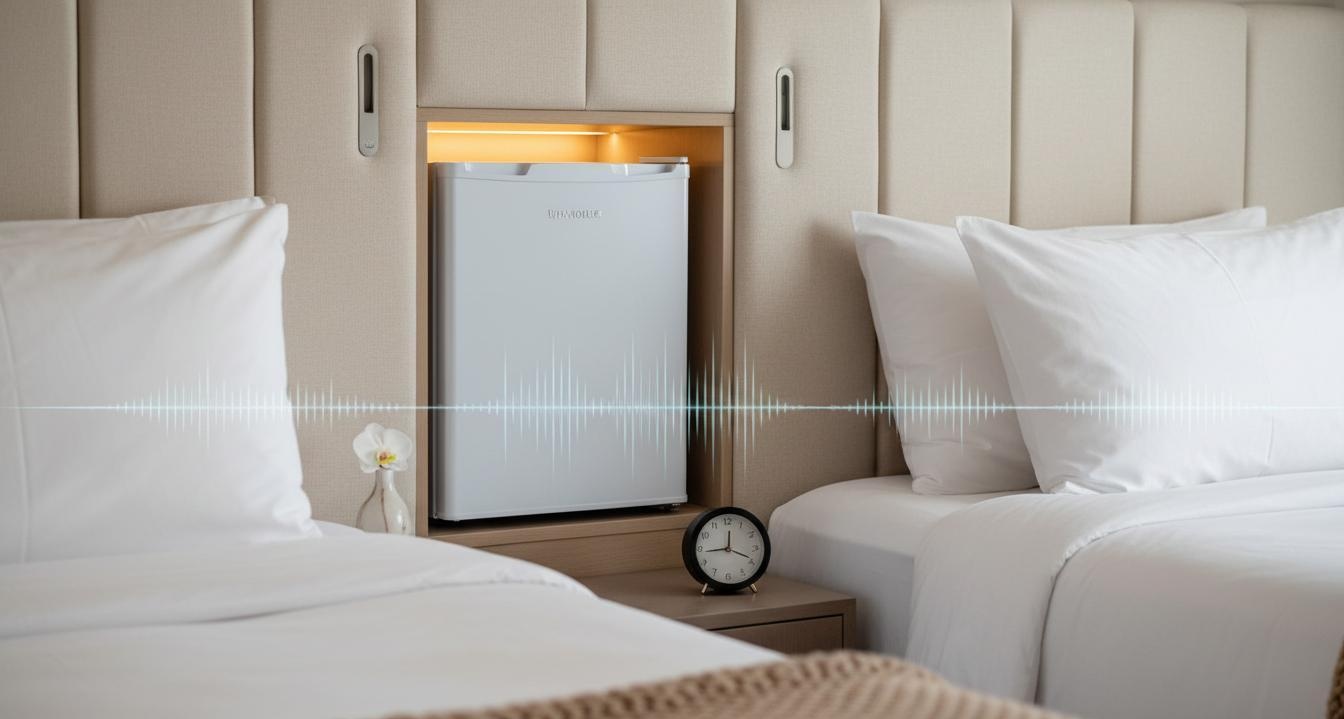
The Room Satisfaction Equation: How Mini Fridge Noise Directly Impacts Hotel Review Scores
Because hotel guests judge room quality partly by the completeness of available amenities, therefore a silent mini fridge in every room signals that the property invests in details that competitors overlook.
Mini refrigerator noise directly impacts hotel review scores because guests perceive unexpected sounds in their sleeping environment as a fundamental failure of the hotel’s basic promise—comfortable rest. Research from the Cornell Hotel School demonstrates that noise complaints in guest reviews correlate with measurable decreases in overall satisfaction scores, particularly in the cleanliness and comfort categories that heavily influence booking decisions. When a guest wakes at 3 AM unable to determine if the humming sound is a security threat or a maintenance issue, their frustration compounds beyond the initial noise disturbance.
Guest satisfaction in hotel reviews operates on what industry analysts call the “last mile” effect—the final experience before departure disproportionately influences the overall rating. A Cornell study found that noise-related complaints, particularly about heating, ventilation, and air conditioning (HVAC) systems including mini refrigerators, appear in over 15% of negative reviews for mid-scale hotels. Therefore, specifying sub-35dB mini refrigerators is not merely a comfort upgrade—it is a direct investment in your property’s online reputation and search visibility.
Procurement teams can benchmark these guest-experience risks against Cornell Hotel School research and hospitality technology guidance from Hotel Technology when building the business case for quieter in-room refrigeration.
The financial implications extend beyond individual review scores. Hotels with higher noise-related complaint rates in their reviews experience reduced visibility in search results, as Google’s algorithm increasingly incorporates review sentiment into local ranking factors. Because search engines prioritize properties with positive review patterns, the mini refrigerator specification directly impacts your hotel’s digital discoverability and booking conversion rates. A property averaging 3.8 stars with noise complaints will appear lower in search results than a 3.9-star property without such complaints, costing measurable revenue in lost bookings.
Industry data from Hotel Technology shows that hotels retrofitting or specifying sub-35dB mini refrigerators during renovation report measurable improvements in their “quietness” review scores within six months. The American Hotel & Lodging Association (AH&LA) includes noise level specifications in their recommended procurement guidelines, noting that silent operation is increasingly non-negotiable for properties competing in the upper-midscale and upscale segments where guest expectations for peaceful sleep are highest.
The Engineering Behind 35dB: Compressor Isolation, Soft-Start and Vibration Control
Because hotel procurement teams prioritize reliability and noise ratings above all other specs, therefore any mini fridge exceeding 35dB faces immediate disqualification from serious hospitality purchasing conversations.
Achieving true sub-35dB operation requires three integrated engineering solutions: compressor isolation, soft-start technology, and vibration control. The compressor is the primary noise source in any refrigeration system, and isolating it from the refrigerator’s outer cabinet is the foundational engineering requirement for achieving silent operation. Modern implementations use rubber bushings and spring-loaded mounts that absorb compressor vibrations before they transmit to the refrigerator chassis.
Soft-start technology addresses the sudden noise surge that occurs when a compressor initially cycles on—a moment when noise levels can spike 10-15dB above idle running levels. Because standard compressors draw full electrical current on startup, they produce an audible “thump” that readily wakes light sleepers. Soft-start controllers gradually ramp compressor speed from zero, eliminating the startup surge entirely. This technology also extends compressor motor lifespan by reducing mechanical stress during every start cycle.
Vibration control complements compressor isolation through cabinet-level engineering solutions. Therefore, a comprehensive sub-35dB specification requires all three technologies working in concert—isolation prevents vibration transmission, soft-start eliminates startup noise, and additional dampening materials in the cabinet walls reduce internal resonance that could amplify residual noises.
The practical implementation cost for these integrated solutions is approximately $40-60 per unit above base model pricing. However, this premium delivers measurable benefits in guest satisfaction, reduced complaint-related service calls, and extended equipment lifespan. For a hotel ordering 200 units, the additional investment of approximately $10,000 protects thousands of dollars in review score value and reduces ongoing maintenance expenses.
Ningbo Aisberg Electric manufactures mini refrigerators with integrated compressor isolation systems, soft-start controllers, and enhanced vibration dampening as standard features in our hotel-specific product lines. Our engineering team has focused on silent operation since 2015, and we offer comprehensive documentation including third-party noise level test reports conducted under realistic operating conditions. We welcome procurement teams to request test samples that demonstrate sub-35dB operation in actual room environments.
Noise Testing Standards: ISO 3744 vs Real Guest Room Conditions and What Numbers Miss
Because hospitality brands compete on sleep quality as their core value proposition, therefore any appliance that disrupts sleep rather than supports it directly undermines the brand promise that justifies premium room pricing.
Understanding noise testing standards is essential for procurement teams, because laboratory test results under ideal conditions often fail to reflect real-world performance in guest rooms. ISO 3744 is the primary international standard for measuring sound power levels from refrigeration equipment, specifying measurement procedures in anechoic chambers that provide perfectly accurate results—but these conditions differ dramatically from actual hotel installations.
The critical distinction between laboratory and real-world conditions involves sound reflection and transmission. Laboratory tests measure the refrigerator’s sound output in nearly perfect acoustic environments, but hotel rooms feature hard flooring, minimal furniture absorption, and thin walls that transmit vibrations to adjoining rooms. Therefore, a refrigerator measuring 32dB in laboratory conditions may register at 38dB in an actual hotel room with typical hard-surface flooring.
Professional hotel procurement specifications should require noise testing under simulated installation conditions—typically measurements taken with the refrigerator operating on a standard hotel room flooring surface (carpet over concrete or hard surface flooring), with the measurement microphone positioned at seated head height (approximately 1.2 meters from the floor) and 1 meter from the refrigerator face. This procedure mirrors how guests actually experience the noise in their rooms.
The EU Energy Label framework incorporates noise measurements as part of the comprehensive energy efficiency labeling system, but the label provides only basic classifications (A, B, C, D, E, F, G) rather than specific decibel measurements. For precise procurement, request the detailed test reports that underlie these classifications. The American Hotel & Lodging Association (AH&LA) recommends procurement teams specify maximum sound pressure levels in their tender documentation and require supplier verification through independent testing.
For the technical test method itself, buyers should reference ISO 3744 acoustic noise measurement standards and compare tender language with American Hotel & Lodging Association (AH&LA) procurement standards.
Additional real-world factors that affect perceived noise include temperature setting (lower settings require more compressor cycles), ambient room temperature (hotels in warmer climates experience more frequent cycles), and the refrigerator’s defrost cycle timing (defrost cycles often activate during night hours if improperly configured). Professional specifications should address these operational parameters as part of the comprehensive noise management strategy.
When evaluating suppliers, request documented test results from independent laboratories conducted within the past 12 months under realistic conditions, and include a clause requiring in-situ verification of noise levels upon delivery before accepting full shipments. This two-step verification protects procurement teams from specifications that look good on paper but fail in actual guest rooms.
Energy Efficiency for Hotel Use: Why A-Rated Models Save $15 Per Unit Per Year
Energy efficiency in hotel mini refrigerators directly impacts operating costs, maintenance requirements, and environmental compliance commitments. A-rated models under the EU Energy Label framework consume approximately 60kWh annually, translating to around $7-10 in electricity costs per year at typical commercial rates. Therefore, specifying A-rated mini refrigerators delivers approximately $15 per unit per year in savings compared to standard B-rated alternatives, representing the most economically rational choice for any hotel chain or independent property.
The math is straightforward: a 200-room hotel with mini refrigerators in every guest room spending $15 more per unit annually on B-rated models pays an unnecessary $3,000 per year in energy costs. Over a 10-year equipment lifespan (typical for commercial refrigeration), this totals $30,000 in unnecessary expenses—resources that could fund more impactful guest experience improvements. A 500-unit chain deployment wastes $75,000 over the same period, making energy efficiency a significant strategic line item.
Beyond direct energy savings, A-rated units typically feature higher-quality compressors and components designed for efficiency, which also means longer operational lifespans and reduced maintenance costs. Because efficient operation generates less heat and imposes less mechanical stress, A-rated compressors typically last 2-3 years longer than B-rated alternatives, reducing replacement frequency and associated labor costs.
The EU Energy Label provides the most widely recognized efficiency classification system, but the EPA ENERGY STAR program serves the North American market with comparable standards. Both frameworks represent scientifically validated efficiency benchmarks, and professional procurement specifications should require at minimum A-rated or ENERGY STAR certification. The International Hotel & Restaurant Association (IHG) procurement standards explicitly reference these certification frameworks as baseline requirements.
Energy-related documentation can be checked through the EU Energy Label database, while Aisberg’s energy-efficient refrigeration solutions page helps connect those ratings to product-level sourcing decisions.
Energy efficiency also supports sustainability commitments that increasingly influence guest booking decisions, particularly among business travelers and younger demographic segments. Hotels can prominently featureENERGY STAR or equivalent certifications in their sustainability marketing, differentiating properties in competitive markets where environmental responsibility influences booking choices.
For properties in regions with high electricity costs, the economic case for A-rated units is even stronger. Some markets with electricity costs exceeding $0.15 per kWh can realize savings exceeding $25 per unit annually, accelerating payback timelines for premium silent models that combine efficiency with noise reduction technology.
Hotel-Specific Requirements: Child Locks, Anti-Theft Anchors and ADA Compliance
Hotel mini refrigerators require features fundamentally different from standard residential models, because hotels operate in continuous commercial use with diverse guest populations and specific regulatory requirements. Child locks with override capability are essential for family rooms, preventing accidental access by young children while allowing housekeeping and maintenance access with standard keys or codes.
Anti-theft anchoring hardware addresses a persistent hotel operational challenge—preventing refrigerator removal from rooms without creating guest-facing security measures that impact the aesthetic guest experience. Therefore, specifying units with integrated anti-theft anchoring brackets compatible with standard hotel furniture is standard practice for professional procurement. These brackets secure the refrigerator to standard bedroom furniture anchoring points without visible hardware or complex installation requirements.
The Americans with Disabilities Act (ADA) establishes specific requirements for hotel accessibility that affect mini refrigerator specifications. Because ADA compliance requires reasonable accommodation for guests with disabilities, including provisions for easily accessible temperature controls at heights reachable from seated positions, procurement specifications should explicitly require front-panel controls (not top-mounted controls requiring reaching overhead) and adjustable shelf configurations that accommodate various container sizes.
Additional hotel-specific features include easy-access temperature controls that allow housekeeping staff to make adjustments without fully opening the refrigerator door (reducing energy waste during room servicing), auto-defrost functionality eliminating the need for manual defrosting that disrupt guest room availability, and reversible door hinges for flexible positioning based on room layouts. Durable construction rated for continuous commercial operation—significantly exceeding residential lifespan expectations—is essential for maintaining quality across high-turnover hotel environments.
ADA.gov provides comprehensive guidance on accessibility requirements for hotel accommodations, and procurement teams should ensure their specifications align with current ADA standards as part of comprehensive compliance documentation. The American Hotel & Lodging Association (AH&LA) maintains procurement guidelines that explicitly address ADA requirements and recommended specifications for accessible guest rooms.
For accessible-room projects, teams should verify control height, reach range, and guest-use assumptions against ADA.gov before approving final mini refrigerator placement drawings.
Maintenance accessibility is another frequently overlooked requirement—the ability to service mini refrigerators without removing them from built-in cabinetry affects ongoing maintenance costs significantly. Specifications should require front-access service panels and modular component designs that allow compressor service without full unit removal.
Volume Pricing for Chains: How Marriott, Hilton and IHG Approach Mini Fridge Procurement
Major hotel chains approach mini refrigerator procurement through structured volume pricing agreements that deliver significant economies of scale while maintaining quality control across diverse property portfolios. Marriott, Hilton, and IHG typically negotiate 15-25% discounts on list pricing for orders exceeding 100 units, with additional incentives for supply agreements covering multiple property development phases.
The procurement structure for major chains involves several key elements: standardized specifications across brands (reducing training and maintenance complexity), quality assurance provisions including third-party inspection rights and warranty requirements, supply chain redundancy ensuring replacement availability within 48-72 hours anywhere in the chain’s geographic footprint, and volume commitments that provide pricing security over 3-5 year agreement periods.
For independent hotels or smaller chains ordering 100-500 units, the key negotiating principle is demonstrating commitment through binding volume commitments with tiered pricing. Because suppliers value predictable bulk orders, offering a binding 3-year supply agreement in exchange for volume pricing typically yields results comparable to major chain arrangements. Requesting quotes for 100-unit, 250-unit, and 500-unit volumes reveals the pricing curve and identifies optimal commitment levels.
Payment terms also significantly impact pricing, with Net-60 or Net-90 terms typically available at 3-5% premiums above immediate payment pricing. For established hotel chains with strong credit profiles, extended payment terms add minimal cost while preserving cash flow. The Cornell Hotel School’s procurement research indicates that supply chain financing terms often exceed the value of minor price concessions.
For chain-style purchasing structures, buyers can also compare procurement approaches published by IHG procurement and broader hospitality best practices from AH&LA industry standards.
Quality assurance provisions deserve particular attention in volume agreements. These typically include pre-shipment inspection rights (ensuring samples represent production quality), warranty period requirements (typically 2-3 years for commercial refrigeration), spare parts availability guarantees (minimum 10-year component availability), and spare unit provisions for critical properties where replacement delays create guest experience impacts.
For properties in the ordering range of 100-500 units, leveraging group purchasing organizations that aggregate orders across multiple independent hotels can achieve pricing approaching major chain levels. Organizations like the American Hotel & Lodging Association (AH&LA) offer group purchasing programs that provide access to negotiated pricing without requiring individual chain-level commitments.
Summary: Key Specifications for Hotel Mini Refrigerator Procurement
| Specification | Recommended Requirement | Notes |
|---|---|---|
| Maximum Noise Level | 35dB or below | Verified under realistic test conditions |
| Energy Rating | A-rated or ENERGY STAR | Approximately 60kWh/year consumption |
| Child Locks | With override capability | Required for family rooms |
| Anti-Theft Anchors | Integrated mounting brackets | Compatible with standard furniture |
| ADA Compliance | Front-panel accessible controls | Seated-height operation |
| Volume Discount (100+ units) | 15-20% off list | With quality assurance provisions |
Procurement teams seeking to optimize their mini refrigerator specifications while protecting guest satisfaction and controlling costs are encouraged to request detailed product documentation and noise level verification reports from qualifying suppliers. Ningbo Aisberg Electric specializes in hotel-specific mini refrigerator solutions with comprehensive documentation, competitive volume pricing, and quality assurance provisions designed for professional hotel procurement.
Before final supplier approval, request Aisberg’s technical specifications and documentation so noise reports, energy data, installation requirements, and warranty terms can be reviewed in one package.
For detailed product specifications, volume pricing inquiries, or to request noise level verification documentation, visit our hotel solutions page or contact our commercial procurement team directly. We welcome the opportunity to provide samples for verification and to develop long-term supply relationships with hotel chains and independent properties committed to guest satisfaction excellence.
Post time: May-20-2026