

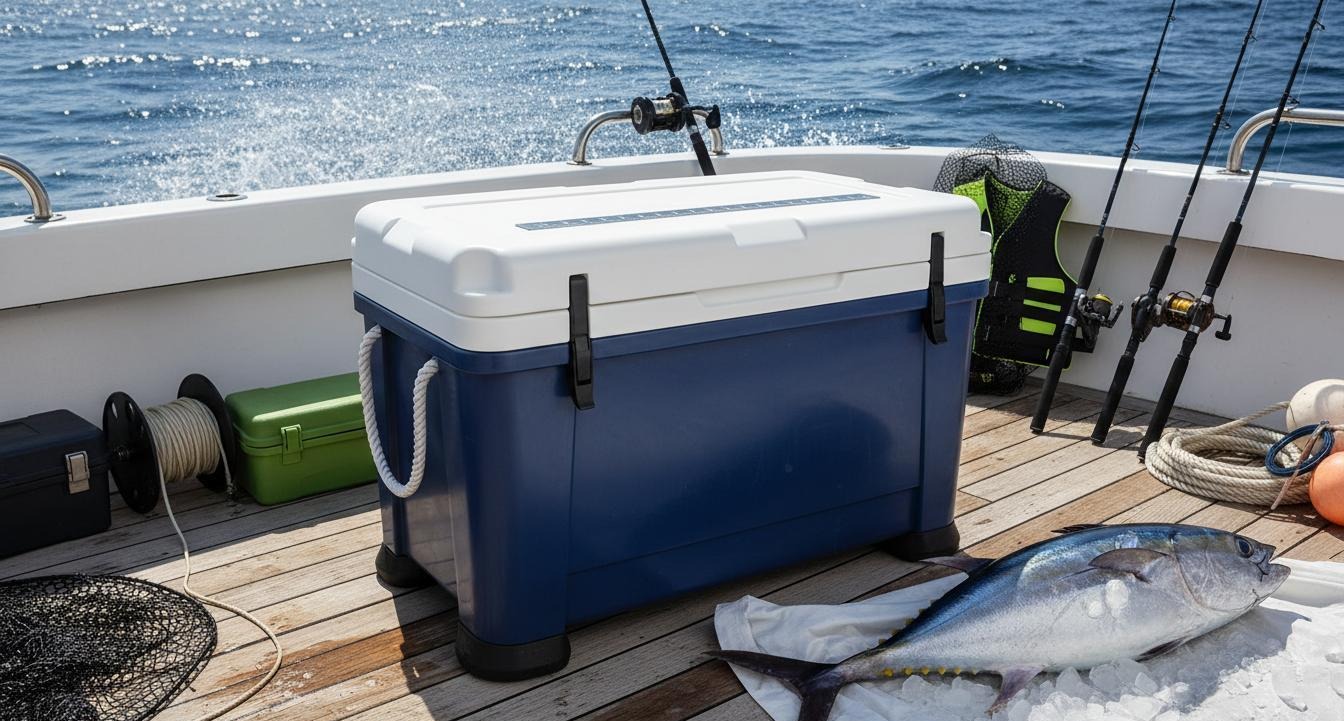
I’ve watched a charter fishing operation in the Gulf spend $4,200 on entry-level coolers in year one, then spend another $3,800 in year two replacing the ones that cracked, warped, and had their latch mechanisms fail after sustained salt air exposure. The operation manager told me he thought he was being frugal—these were “the same as the expensive ones, just without the branding.” He was wrong, and the math caught up with him fast. The cooler box market has a brutal hidden cost structure for buyers who optimize on upfront price, because the actual cost includes not just the unit, but the replacement frequency, the downtime when the cooler fails mid-trip, and the customer trust damage when your customer’s catch spoils because the ice melted too fast. At Ningbo Iceberg Electronic Appliance, we manufacture thermoelectric and compressor-based portable cooling solutions across the full durability spectrum, and in this post I’m going to explain exactly what separates a cooler box that survives a decade of saltwater exposure from one that survives one season. I’ve been in the product development and wholesale channel at this factory for over eight years, and I’ve seen the failure modes up close. Let me give you the technical grounding you need to source smarter.
What Marine Distributors Are Actually Searching For When They Search “Cooler Box Wholesale”
When a charter captain or commercial fishing operation searches cooler box wholesale, they’re not looking for a beach picnic unit. They’re evaluating suppliers on a specific set of performance criteria: rotomolded HDPE shell integrity, multi-day ice retention in humid marine environments, pressure-equalization valves that don’t fail at altitude changes between dock and offshore, and UV-stabilized materials that don’t become brittle after two summers in the cockpit. These buyers know what kills cheap coolers—salt spray, thermal cycling, impact loading from gear stowing—and they’re willing to pay a premium for units that don’t fail mid-trip.
I want to be direct about the market dynamic I’ve observed over the past several years: the marine supply channel has consolidated significantly, and the distributors who survived are the ones who learned to source based on total cost of ownership rather than upfront unit price. A cheap cooler that needs replacement every 12 months costs more over five years than a properly specified unit that lasts five years. The buyers in this channel have figured that out, which means the suppliers who are still competing on price alone are increasingly not getting the reorders.
The marine supply channel is one of the highest-margin wholesale segments in the portable cooling category, but it demands a specific product DNA that generic thermoelectric cooler box suppliers typically can’t deliver. Let me walk through the specifications that actually matter for this channel—specs that will determine whether your customers come back for a second order or file a return.
Marine Environment Corrosion: Why Saltwater Changes Everything About What You Should Stock
Before I get into the product specifications, I need to address the fundamental reason marine environments destroy cheap cooler boxes, because if you don’t understand the corrosion mechanism, you’ll keep sourcing the wrong products and wondering why your return rates stay high. Saltwater is an electrolyte—it conducts ions between dissimilar metals, accelerates oxidation reactions, and creates conditions where even UV-stabilized polymers degrade faster than they would in freshwater or arid environments. Every component in a cooler box that touches saltwater or salt air is subject to this accelerated degradation, and the components that fail first are the ones that most directly affect the cooler’s functional performance: hinge pins, latch mechanisms, drain valve threads, and any steel fasteners that aren’t marine-grade stainless.
The failure sequence I observe most frequently in PP coolers used in marine environments goes like this: the UV radiation in direct sunlight begins breaking polymer chains in the PP shell within the first season of exposure—the material becomes more brittle and micro-cracks form at stress concentration points like the hinge area and latch pocket. Simultaneously, salt spray settles on the metal hardware (hinge pins, latch springs, carry handle attachments) and initiates galvanic corrosion that weakens the metal over 18-24 months. By the end of the second season, the hinge pin has lost enough cross-section that the lid no longer sits flush, the latch no longer engages properly, and the thermal seal is compromised—meaning ice retention drops even though the foam inside the cooler is still intact. The cooler is now thermally compromised but structurally failed, and the customer buys a replacement.
For marine supply distributors sourcing cooler boxes for commercial use, this means you need to evaluate the entire component stack, not just the shell material. The specific things I recommend checking on every model you’re considering for your inventory:
- Hinge pin material and coating — stainless steel 304 or 316 hinge pins should be specified, not zinc-plated steel. If you see a cooler with zinc-plated hinge pins, assume they’re going to corrode within 18 months in a marine environment. The cost delta between zinc-plated and stainless is about $0.30 per unit at the component level—it’s a signal about what else the manufacturer cut.
- Latch spring material — the latch spring is the component that gives the user the satisfying “click” when the lid seals. Zinc-plated spring steel latch springs corrode and lose their spring force—the latch still clicks but doesn’t hold compression, which means the gasket isn’t being compressed, which means ice melts faster. Look for stainless or UV-stabilized polymer latch components.
- Carry handle attachments — the attachment points where the carry handle connects to the shell body are high-stress areas under load. If these are fastened with steel screws into a PP shell, and the attachment point sees saltwater ingress, you’ll get galvanic corrosion between the steel screw and the PP body that creates a failure mode called “creep corrosion” where the screw hole enlarges and the handle attachment loosens. Marine-grade units use stainless threaded inserts molded into the shell during production.
- Drain valve sealing mechanism — the drain valve is the most frequently opened threaded fitting on a marine cooler, and it’s the most likely point for saltwater ingress to cause a sealing failure. Flanged drain valves with silicone washers seal better and are more resistant to cross-threading than simple threaded plugs.
We design our marine-grade cooler boxes with this failure sequence in mind, and we document the specific material choices for each component in our specification sheets. When you’re evaluating competitors, ask for the component material spec sheet—not the marketing brochure—and look for the details on hinge pin material, latch spring material, and carry handle attachment. If a supplier can’t provide this information, it’s because they’re not managing the component level quality, which means the product was designed to hit a price point rather than to survive a marine environment.
Supply Chain Risk in the Marine Cooler Market: Why Factory Relationship Matters More Than Price
The marine cooler market has seen significant supply chain disruption over the past three years, with container freight rate volatility, raw material price fluctuations for PP and HDPE, and periodic shortages of refrigeration components (compressors, fans, control boards) creating unpredictability in delivery lead times. For marine supply distributors who’ve built their inventory around just-in-time ordering from the lowest-price supplier, this volatility has been brutal—they’ve seen their lead times double or triple without warning, their container costs spike mid-order, or their supplier simply stop being able to deliver the spec they need.
The distributors who’ve navigated this volatility best are the ones who established factory relationships rather than supplier relationships. The distinction matters: a supplier sells you what they have; a factory partner works with you on what you need. When I talk to our long-term marine supply accounts, the ones who’ve been with us for five years or more tell me the same thing—the stability of knowing what our production capacity looks like, being able to schedule their container orders six months ahead, and having a direct line to the people making the product decisions is worth more to them than the 3-5% price advantage they might get by playing suppliers against each other every year.
Here’s what a factory relationship looks like in practice versus a trading company relationship: when a marine supply distributor comes to us with a forecast for 2,400 coolers across four models for the upcoming fishing season, we can lock in pricing, reserve production capacity, and commit to a delivery schedule that matches their container shipping timeline. When there’s a compressor shortage (which happened in 2022 and 2023), those accounts get priority allocation because they have a forecast and a relationship. The distributors who were buying from trading companies on a spot basis were competing for available supply with no priority and no committed pricing—and they paid the market price when supply got tight.
For your own supply chain resilience, I recommend identifying two factories you’re willing to build a relationship with, rather than maintaining ten supplier relationships at arm’s length. The relationship depth you get from working with two factories seriously is worth more than the negotiating leverage you get from spreading your volume across ten trading companies. You’ll get better pricing through volume commitment, better lead time stability through forecast sharing, and better technical support when something goes wrong with a production run.
Rotomolded HDPE vs. Injection-Molded PP: Why the Material Choice Determines Customer Retention
Most entry-level cooler boxes in the wholesale market are made from injection-molded polypropylene (PP). PP is fine for a daytime beach cooler—it weighs less and costs less to produce. But PP has a fundamental fatigue problem in marine environments: the material becomes increasingly brittle with UV exposure and thermal cycling, and the hinge points and latch shoulders crack after 18–24 months of use. Your customer buys three cheap coolers a year instead of one quality unit, and you spend your margin on return logistics, replacement inventory, and customer service time that adds no value to your business.
Rotomolded high-density polyethylene (HDPE) is a different material category entirely. The rotational molding process produces a one-piece seamless shell with consistent wall thickness and no weld lines—the primary failure point in multi-piece construction. HDPE resists UV-initiated chain scission better than PP, tolerates saltwater contact without stress cracking, and maintains impact resistance at -20°C in ways that PP simply cannot match. When you’re specifying for a commercial fishing operation where the cooler gets dropped on a boat deck, loaded with 40 pounds of catch, and pressure-washed between trips, you need the material that survives that treatment for multiple seasons, not one.
For marine supply distributors specifying cooler boxes for commercial use, I recommend sourcing units with rotomolded HDPE shells and insisting on UV stabilization rating documentation from the manufacturer. Any supplier who can’t provide the UV stabilization data should be flagged as a potential risk in your approved vendor list. UV degradation is slow until it isn’t—the material properties can look fine in the first season and then crack dramatically in the second summer of UV exposure. Don’t source on the visual appearance of a sample; source on the material data sheet and the documented UV stabilization package.
Ice Retention Performance: What “5-Day Retention” Actually Means and Why Most Claims Are Meaningless
The 5-day ice retention claim is the most abused specification in the cooler box industry. Every supplier will tell you their cooler holds ice for five days. Very few can back it up with data from a test that reflects real-world conditions. Here’s what the credible ice retention spec actually requires:
- Insulation thickness and density — polyurethane foam (PU foam) at 40+ kg/m³ density with uniform wall thickness delivers the thermal resistance needed to slow melt rates to the point where five-day retention is achievable in moderate ambient conditions. Thin-wall construction under 25mm with low-density foam might claim 5-day retention but delivers 2-day in 85°F ambient conditions with repeated lid opening. Ask for the foam density specification, not the marketing claim.
- Gasket quality and lid compression — silicone gasket compression and latch engagement force determine how much warm ambient air enters the cooler every time someone opens the lid. A poorly compressed lid gasket can triple the melt rate compared to the same cooler with a properly seated gasket. In a marine environment where the cooler is opened frequently—15–20 times per day on a working fishing boat—the gasket specification is critical and often the first thing a manufacturer cuts to reduce cost.
- Drain valve design and corrosion resistance — marine environments mean saltwater, melted ice, and fish care debris. A drain valve that corrodes or clogs affects the usability and perceived quality of the cooler across its service life. Saltwater compatibility in the drain valve material is not optional for marine supply channel products.
For marine supply distributors, I’d specifically ask suppliers for ice retention test data conducted at realistic conditions—not the ASTM F2387 controlled chamber test that uses sealed lids and doesn’t account for the 15–20 lid openings per day that a working fishing boat actually produces. Ask for field test data or get the unit on your test bench for 72 hours with simulated opening cycles before you commit to a container order. If a supplier can’t provide this data, that’s information about their product development rigor that matters more than the price quote.
The Case for Thermoelectric + Compressor Dual-Technology Inventory Strategy
For marine distributors covering a broad customer base, the practical inventory strategy isn’t “pick one technology”—it’s “stock both and let customer use case drive the SKU selection.” Here’s how I’d structure it based on what I’ve seen work in the field:
Thermoelectric Cooler Boxes: The Day-Trip and Coastal Running Segment
Our CBP series thermoelectric cooler boxes cover the inshore fishing, coastal cruising, and family boating segment where the primary use case is keeping drinks cold and bait viable during day trips. These units operate on semiconductor (Peltier) cooling, which means no compressor, no refrigerant, no moving gas, and operation below deck on a boat’s DC supply without starting an engine. For the marina operator outfitting a fleet of charter boats, this is a meaningful operational advantage: the cooler runs silently, draws minimal current from the boat’s house battery, and doesn’t require the engine to be running to maintain temperature.
The specs your marine customers care about:
| Series | Capacity | Net Weight (kg) | Dimensions (mm) | Voltage | Cooling Delta | MOQ |
|---|---|---|---|---|---|---|
| CBP-25L-B | 25L | 4.9–5.8 | 446 × 306 × 447 | DC12V / AC220V | 16–20°C below ambient | 500 units |
| CBP-30L-B | 30L | 5.9–6.6 | 446 × 306 × 507 | DC12V / AC220V | 16–20°C below ambient | 500 units |
| CBP-40L-A | 40L | 7.7–8.3 | 529 × 337 × 518 | DC12V / AC220V | 16–20°C below ambient | 500 units |
All three models are PP construction, feature built-in bottle openers, portable side handles, and optional top door cover swaps for appearance customization. The low-noise operation (below 38dB) matters in fishing tournament contexts where a quiet boat is a competitive advantage, and the dual-voltage DC12V/AC220V compatibility means a single SKU covers the marina’s rental fleet, the charter boat’s house battery system, and the customer’s home garage between trips.
For your commercial fishing customers, the 25L and 30L models are your core inventory units—they store enough bait and drinks for a full day on the water without the weight penalty of larger models. The 40L is your family and charter boat SKU: enough capacity for a 6-hour offshore trip with a full crew and a cooler full of catch, with enough thermal mass to keep the catch cold through the ride back to the dock.
These units don’t freeze, and you should never represent them as doing so. But they do maintain the temperatures needed for fresh bait, cold drinks, and food safety for day-trip use cases. For customers who need to preserve fresh-caught fish or frozen bait over multiple days, you need the compressor line, which I’ll cover next.
Compressor Fridges: The Multi-Day Offshore and Medical Transport Segment
For your customers running offshore charters, multi-day fishing competitions, or temperature-sensitive medical transport—insulin, breast milk, biologics—thermoelectric cooling simply doesn’t have the thermal performance to deliver the -18°C temperatures these customers need. That’s where the compressor refrigeration line enters the inventory mix. I consider the compressor line the highest-margin and most loyal customer segment in the marine supply channel: once a charter captain finds a compressor fridge that works reliably on their boat, they reorder for every new boat in their fleet and refer their fishing buddies.
The CFP series delivers genuine freezer performance in a mobile form factor:
| Model | Volume | Dimensions (mm) | Power | Voltage | Temp Range | Refrigerant | MOQ |
|---|---|---|---|---|---|---|---|
| CFP-35L | 35L | 350 × 620 × 390 | 48W | 12V / 24V DC | -18°C to +20°C | R134a | 200 units |
| CFP-45L | 45L | 350 × 620 × 490 | 48W | 12V / 24V DC | -18°C to +20°C | R134a | 200 units |
The 35L fits the cargo bay of most center-consoles and smaller sport fishing boats. The 45L works for larger cabin cruisers and the cabin storage compartments of trawler-style yachts. Both models support 12V/24V DC operation from the boat’s electrical system and can run on 100–240V AC with an adapter for home and dock use—critical for the customer who wants one unit that works on the boat and at the dock before departure and after return. The anti-shake and anti-vibration design means these units operate reliably under the vibration and motion loading present on a boat operating in choppy conditions, which is a failure mode that commodity coolers don’t account for.
For medical transport operators in the marine channel—and this is a growing segment as personal medical device use expands—the compressor line delivers the temperature stability required for cold chain compliance. A diabetic fisherman who needs to keep insulin at 2–8°C can’t use a thermoelectric cooler that struggles to maintain 10°C below ambient on a 30°C day. The compressor line at -18°C to +20°C range gives them the margin they need for reliable cold chain compliance even in challenging ambient conditions.
Certification Coverage: Why Your Shelf Compliance and Liability Position Depend on It
Marine supply distributors selling into EU, North American, and Asia-Pacific retail channels need to verify that their cooler box suppliers carry the correct market certifications. This isn’t bureaucratic paperwork—it’s your legal liability shield and your retail channel access key. Ningbo Iceberg holds BSCI, ISO9001, ISO14001, IATF16949, CE, CB, ETL, ROHS, PSE, KC, SAA, and LFGB certifications across the full product line. Let me be specific about what each certification does for your business:
- BSCI (Business Social Compliance Initiative) — increasingly required by European retail buyers as a condition of supply. If you’re selling to EU-based retail chains or distributors, they will ask for BSCI as evidence of supply chain social compliance. It’s a purchasing condition, not a marketing badge.
- ISO9001 and ISO14001 — these aren’t just quality management system documentation; they’re the baseline certifications that institutional buyers use to filter suppliers. A marine supply distributor without ISO-certified supply chain partners has a harder time qualifying for government and institutional procurement contracts.
- CE marking — required for legal sale in EU member states. If your dealers are selling into European markets, CE is non-negotiable. A CE mark means the product has been type-tested against applicable EU Directives (Low Voltage Directive, EMC Directive, RoHS Directive) by an accredited notified body. It’s not optional decoration on the spec sheet; it’s the regulatory requirement that keeps products off customs hold and retailers out of regulatory trouble.
- CB Scheme — the CB Scheme covers mutual recognition of electrical equipment safety test reports across 50+ participating countries. A CB report means your product has been evaluated against IEC standards, and member countries accept it as the basis for their own national certification. For a portable refrigerator manufacturer selling into global marine markets, CB is the foundational certification that unlocks national marks in individual countries without requiring redundant testing.
- ETL Listed — the ETL mark is recognized in the United States and Canada as evidence of product compliance with relevant safety standards. For North American retail channel compliance, ETL is often preferred because it’s recognized by OSHA as a Nationally Recognized Testing Laboratory (NRTL), which means the mark carries regulatory weight in the US market in a way that some other marks don’t.
- LFGB — the German Food and Feed Law compliance mark. If you’re selling into the European marine retail market and your customers are using these coolers for food storage on charter vessels, LFGB compliance matters because it demonstrates food-contact material safety. For marine supply distributors whose customers run food service operations on boats, this certification is a sales enabler.
When you’re quoting container quantities for the marine supply channel, don’t let a supplier quote you a lower price by omitting the certification package. In the marine supply channel, certification gaps create liability exposure that far exceeds the per-unit savings. If a cooler fails and causes a food safety incident on a charter boat, the certification documentation is your primary legal defense. A unit without CE or ETL marking that causes an incident also creates regulatory liability for the retailer who sold it and the distributor who imported it.
OEM Customization: Turning a Commodity Box into a Branded Inventory Asset
For marine supply distributors, the customization angle is one of the most underused margin levers in the channel. Our thermoelectric cooler boxes support OEM color customization, logo printing, and packaging customization at 500-unit MOQ. For distributors serving regional marine markets, branded cooler boxes serve two purposes: they create retail floor differentiation that commands margin, and they build brand recall that drives repeat purchasing.
I’ve watched distributors take the portable car cooler box and rebrand it for their local marine retail chain—the same unit, same spec, but with the distributor’s logo on the lid and custom color that matches the marine store’s brand identity. The unit moves at full retail price instead of competing on price against the generic import catalog, and the store builds customer loyalty with a product that performs for multiple seasons. The per-unit margin improvement on a 500-unit container of custom-branded coolers versus generic stock typically runs 15–25% higher, which on a container value of $12,500–$19,000 is a meaningful difference in gross profit.
For the marine channel specifically, I recommend considering custom colors that match boat gelcoat colors and marine brand aesthetics. A cooler that looks like it belongs on a Grady-White or a Sea Ray is a cooler that sells at full margin instead of going on promotion. The customization conversation should happen at the category planning stage, not after the container has shipped.
What to Ask Before You Place Your Container Order: The Procurement Checklist I Give Every New Account
Here’s the procurement checklist I recommend marine supply distributors run through before confirming a wholesale order for cooler boxes. I’ve seen every one of these items create a problem when they weren’t confirmed upfront in the procurement conversation:
- Insulation material and density — confirm PU foam density (40+ kg/m³ preferred for marine use), not just “high-quality foam” without a spec. Ask for the thermal conductivity rating (W/m·K) if the supplier can provide it. The number should be below 0.025 W/m·K for quality PU foam. If they can’t provide a thermal conductivity spec, they’re not managing this parameter in production, which means the foam quality is inconsistent lot-to-lot.
- UV stabilization documentation — HDPE rotomolded units should have UV stabilizer additive documented in the material data sheet. PP injection-molded units degrade faster in marine UV environments; know what you’re stocking. The UV stabilizer additive loading should be in the 0.5–2% range by weight for adequate UV protection in marine environments.
- Drain valve material and corrosion resistance — saltwater service demands stainless steel or high-grade polymer drain valves, not zinc-plated steel components that corrode in saltwater within 6 months. Confirm the drain valve material in the product spec sheet before you order. A corroded drain valve is one of the top customer complaints for marine cooler users.
- Warranty parts and outbound freight terms — confirm whether free parts replacement includes outbound freight to the end customer or just parts-only. For a fleet of 30+ coolers on a charter operation, the difference in warranty terms can be worth more than the per-unit price delta. Parts-only warranty with customer-pay freight is a warranty in name only for price-sensitive commercial operators.
- Sample lead time and test protocol — use the 3–5 day sample lead time to run your own ice retention test before committing to container quantities. Don’t rely on the supplier’s marketing data; verify on your test bench with lid opening cycles that reflect real-world use. If the supplier won’t send samples before container commitment, that’s a signal about their confidence in their own product performance.
- Factory production capacity and lead time stability — ask about the production line capacity and current lead time. During Q4 peak ordering season, lead times extend and the suppliers who gave you 35 days in June may quote 55 days in September. A supplier with 16 production lines and 500+ employees is going to have more capacity stability than a small factory that can only handle one or two container runs at a time.
The Factory Behind the Product: What to Verify Before You Commit
Ningbo Iceberg Electronic Appliance Co., Ltd. is a 40,000-square-meter manufacturing facility founded in 2015, with 500+ employees including 17 R&D engineers, 8 production management personnel, and 25 sales staff. The factory operates 16 production lines with an annual output of 2.6 million units. We hold 20+ patents across the product line and maintain BSCI, ISO9001, and ISO14001 certifications. Our products are sold in the EU, US, Japan, South Korea, Australia, and other markets where certification and quality compliance are taken seriously by the regulatory authorities and the retail buyers who operate in those channels.
For marine supply distributors evaluating whether they’re buying from a factory or a trading company: ask for a video call through the production floor. Watch for the injection molding and rotomolding equipment, the assembly lines, and the in-house testing facilities. Trading companies can show you a warehouse; a factory can show you the production process that determines the quality of the product you’re buying. When you’re placing a container order for marine-grade products, you need to know that the supplier has production control over the critical manufacturing parameters—foam density, shell wall thickness, gasket compression—that determine whether the product performs in the marine environment or fails prematurely.
When you’re ready to build your marine channel inventory, browse the full product catalog or contact the factory directly for a wholesale specification package and sample evaluation. The marine supply channel rewards those who source with technical rigor and penalizes those who buy on price alone. Build your inventory around the specs that matter, verify the certifications for your target markets, and the reorders will follow.
Post time: May-29-2026