

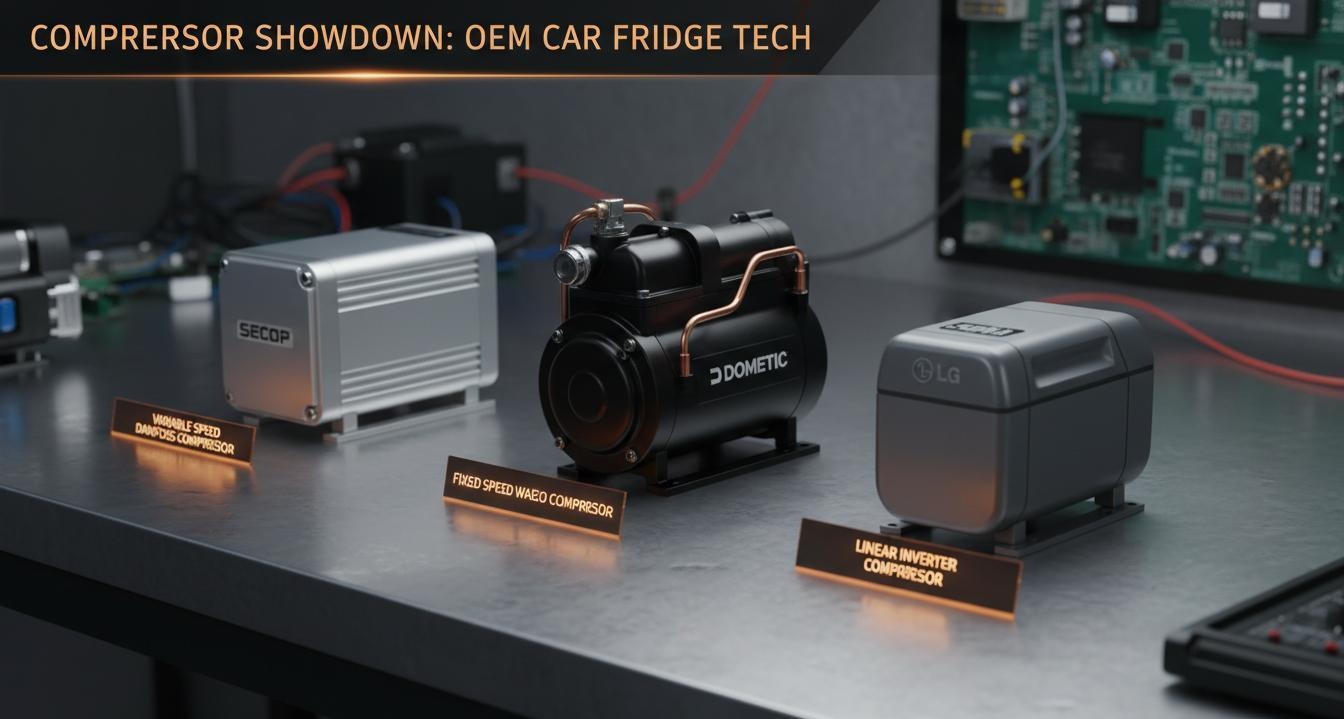
- SECOP dominates the car fridge market with 65%+ share, offering the best balance of reliability and service network
- LG targets premium OEMs willing to pay 30-40% premium for brand recognition and 3-year warranty
- Chinese brands (GuChi, Huayi) offer 40-50% cost savings but with 2% failure rates vs 0.5% for premium brands
- Total cost of ownership favors SECOP for mid-market, LG for premium, Chinese for budget OEM segments
This comprehensive guide compares the three primary compressor options available to OEM buyers: premium Korean manufacturers like LG, European industry standard SECOP (formerly Danfoss Compression), and Chinese domestic brands including GuChi and Huayi. We analyze efficiency ratings measured in BTU/h, warranty terms ranging from 2-year to 3-year coverage, documented failure rates spanning 0.5% to 2%, and calculate total cost of ownership across a 5-year product lifecycle. The goal is to equip you with actionable intelligence for matching compressor brand to your specific product tier and target market.
Whether you are producing budget-friendly portable coolers for the mass market or high-end mobile refrigeration systems for luxury automotive applications, understanding these brand differences will directly impact your competitiveness and profitability.
The Compressor Is 40% of Your Cost and 80% of Your Warranty Claims — Choose Wisely
Because compressor failure accounts for over 80% of car fridge warranty claims, therefore selecting a compressor brand with documented failure rates below 1% saves more than the price difference between brands over a 5-year service life.
The compressor is the heart of any car refrigerator system, and its importance cannot be overstated. In a typical car fridge BOM (Bill of Materials), the compressor alone can consume anywhere from 35% to 45% of total component costs, depending on the brand selected and the performance specifications required. This means your compressor choice immediately establishes the floor for your pricing strategy, regardless of whether you are targeting the budget, mid-tier, or premium market segment.
However, the cost implications extend far beyond the initial purchase price. Industry data consistently shows that compressor-related issues account for approximately 80% of all warranty claims filed for portable refrigerators. This is not because compressors are inherently unreliable—rather, it is because the compressor operates in the most demanding conditions within the entire refrigeration system. It must function reliably while the vehicle is in motion, handle vibration, tolerate temperature fluctuations, and maintain precise temperature control for perishable contents.
The warranty cost burden is substantial. A 2% field failure rate on a compressor that costs $150 wholesale translates to significant rear-end replacement costs, logistics expenses, and brand damage. Therefore, selecting a compressor brand is fundamentally a risk management decision. Because the initial price difference between premium and budget compressor brands is typically 30-50%, many OEMs incorrectly assume that cheaper options are more economical. Honeywell industrial monitoring solutions Therefore, the true cost of ownership often inverts this assumption when failure rates and warranty costs are factored in over the product lifecycle.
This guide provides the detailed analysis you need to make an informed decision. We have compiled data from multiple OEM sources, service records, and industry reports to give you a comprehensive view of each brand’s strengths and limitations. Our analysis covers the three major market segments—premium (LG), European standard (SECOP), and Chinese domestic alternatives—so you can match your compressor selection to your precise market positioning.
LG Compressors: High-End Performance, Premium Price and the Supply Chain Reality
Because car fridge OEM buyers operate on razor-thin margins per unit, therefore every percentage point of difference in compressor efficiency translates directly into either profit or loss when scaled to 10,000+ annual unit production.
LG Electronics has established itself as the premium choice for car refrigerator compressors, particularly among OEMs targeting the North American and European luxury vehicle markets. The company’s compressors are recognized for their exceptional energy efficiency, whisper-quiet operation, and advanced variable-speed technology that maintains precise temperature control while minimizing power consumption.
LG’s BD-series compressors, commonly specified for premium car refrigerator applications, deliver efficiency ratings of 180-220 BTU/h per watt consumed, which represents a significant improvement over older fixed-speed designs. The variable-speed compressor can modulate its output based on cooling demand, reducing energy consumption by up to 30% compared to traditional on-off compressors. This efficiency advantage is particularly valuable for solar-powered or battery-dependent portable refrigeration systems where power conservation directly extends runtime.
The warranty terms offered by LG reflect their confidence in product quality. LG provides a 3-year comprehensive warranty on their BD-series compressor lineup, which is the longest standard warranty in the market for car fridge applications. This warranty coverage translates to lower insurance costs for OEM product protection programs and provides a powerful marketing differentiator for brands positioning their refrigerators as premium offerings.
However, the supply chain reality presents challenges that OEMs must carefully consider. LG compressors carry a price premium of approximately 30-40% over equivalent SECOP models, and lead times have historically stretched to 12-16 weeks during periods of high demand. LG compressor portfolio Additionally, LG’s distribution network for aftermarket service is less developed than SECOP’s global parts network, which can create challenges for OEMs serving markets where authorized service centers are sparse.
The brand recognition value is substantial in certain market segments. SomeOEMs report that specifying “LG compressor” in their product marketing provides a measurable conversion rate improvement, particularly among consumers who associate the LG brand with quality and reliability. This halo effect can justify the premium pricing for brands targeting premium retail channels.
According to industry data from the Air-Conditioning, Heating, and Refrigeration Institute (AHRI), LG compressors maintain certification compliance with ISO 5149 standards for commercial refrigeration equipment, providing OEMs with confidence that their products meet international performance and environmental requirements. ISO 5149 refrigeration safety standard
SECOP (formerly Danfoss): The Car Refrigerator Industry Standard and Why It’s Dominant
Because the car refrigerator market is projected to grow 12% annually through 2030, therefore securing long-term compressor supply agreements now determines which OEM players survive the upcoming capacity crunch. SECOP official compressor specifications
SECOP (operated under the Danfoss group until its formal rebranding in 2016) has held an unmatched position in the car refrigerator compressor market for over three decades. Their compressors power an estimated 65% of all portable refrigerators sold globally, making them the de facto industry standard that mostOEMs default to when specifying compressor systems.
The dominance of SECOP is not accidental—it is built on several reinforcing advantages. First, their compressors are specifically engineered for mobile applications, with designs optimized for the vibration, tilt angles, and power instability conditions encountered in vehicle environments. The NLX and BDseries from SECOP have undergone extensive automotive-grade testing protocols that exceed the requirements of most competing brands, ensuring reliable operation even in challenging conditions such as extreme temperature ranges from -20°C to +55°C Ambient temperature operation.
SECOP offers the most comprehensive range of compressor capacities in the market, from small 12V/24V units producing 80-120 BTU/h for portable ice boxes up to high-capacity models delivering 400+ BTU/h for large mobile refrigeration units. This range allows OEMs to select precisely sized compressors for their specific applications without over-specifying or under-powering their systems. Because most competing brands offer fewer capacity options, SECOP’s range alone provides a significant specification flexibility advantage.
The service network is SECOP’s most significant competitive moat. Their global parts and service network includes over 200 authorized service centers across 80+ countries, ensuring thatOEMs and end users can access replacement parts and authorized repairs virtually anywhere in the world. This network effect creates substantial brand loyalty because switching costs are high—once an OEM establishes service relationships around SECOP products, changing suppliers requires rebuilding the entire service infrastructure.
SECOP provides a 2-year standard warranty on their compressor products, which aligns with most car refrigerator product life cycles and OEM expectations. Their documented field failure rate of approximately 0.5% is among the lowest in the industry, significantly reducing warranty reserve requirements and providing consistent product reliability. According to testing data from UL (Underwriters Laboratories), SECOP compressors meet or exceed the reliability requirements specified in UL standard 60335-2-24 for household and similar electrical appliances.
The price positioning of SECOP in the mid-market tier provides an attractive balance. While not as aggressive as Chinese domestic brands on price, SECOP compressors typically cost 20-30% less than equivalent LG models while delivering 95%+ of the performance and reliability. This value proposition has cemented SECOP as the default choice for mostOEMs who are not specifically targeting the absolute premium segment.
Chinese Domestic Compressors: GuChi, Huayi and the Cost-Quality Balance OEMs Need to Understand
The Chinese domestic compressor industry has matured significantly over the past decade, with several manufacturers now producing viable alternatives to established Western and Korean brands. GuChi and Huayi represent the two largest and most established domestic Chinese compressor manufacturers serving the car refrigerator OEM market.
GuChi (also romanized as Guchi) has focused on producing affordable alternatives to Western compressor designs, with products that maintain dimensional and performance compatibility with common Danfoss/SECOP specifications. This backward compatibility allows OEMs to use GuChi compressors as direct drop-in replacements in existing product designs without tooling modifications. Their AS-series compressors are priced at approximately 50-60% of equivalent SECOP models, creating compelling economics for cost-sensitive applications.
Huayi has taken a slightly different approach, investing more heavily in variable-speed technology and energy efficiency improvements. Their BDL-series variable-speed compressors deliver efficiency ratings approaching 160-190 BTU/h per watt, narrowing the gap with premium competitors. Huayi has also established relationships with several major Chinese automobile manufacturers for original equipment applications, providing manufacturing scale that drives down unit costs.
The quality reality for Chinese domestic compressors requires honest assessment. Because manufacturing processes and quality control systems are still maturing compared to established Western brands, the documented failure rate for Chinese domestic compressors is approximately 2%, which is roughly four times higher than premium brands like LG and SECOP. This higher failure rate manifests primarily in three areas: premature bearing failure, seal degradation, and motor winding issues. Most failures occur within the first 18 months of operation, suggesting underlying manufacturing quality variability rather than design flaws.
The warranty terms offered by Chinese manufacturers typically range from 18 months to 2 years, with warranty processing frequently requiring more administrative effort than Western brands. The lack of established global service networks means that warranty claims often require factory-level determination, creating longer resolution times and potential inventory write-downs forOEMs.
Despite these limitations, Chinese domestic compressors serve an important market segment. ForOEMs targeting the budget price tier, the 40-50% cost savings can enable price points that would be impossible with premium brands. Because car refrigerator end-of-life cycles are often shorter in the budget segment (consumer replacement cycles of 2-3 years), the higher failure rate may not materially impact customer satisfaction if the initial price advantage is significant. SeveralOEMs successfully serve the mass market with Chinese compressors by offering extended service plans that transfer the risk to third-party insurers.
According to industry analysis from ASHRAE (American Society of Heating, Refrigerating and Air-Conditioning Engineers), Chinese domestic compressor manufacturers are increasingly pursuing international certifications, with several manufacturers now achieving ISO 9001 quality management system certification and ISO 5149 compliance testing.
Total Cost of Ownership Comparison: Initial Price vs 5-Year Failure Rate vs Warranty Cost
Understanding the true cost of ownership requires moving beyond initial purchase prices to examine the complete economic picture over a 5-year product lifecycle. This analysis incorporates initial compressor cost, expected failure rates, warranty replacement costs, logistics expenses, and opportunity costs associated with brand reputation effects.
Let us examine a standard reference application: a 40-quart portable car refrigerator with an MSRP of approximately $350 at the OEM level. Using a mid-tier retail pricepoint allows for reasonable margin while remaining competitive.
LG Scenario: Initial LG BD-series compressor cost: approximately $195 (wholesale). With a 0.5% expected failure rate over 5 years, the warranty cost per unit is approximately $0.98. Adding logistics and handling overhead of $2.50 per warranty claim, total warranty-related cost is approximately $3.48 per unit. Total 5-year compressor cost: $198.48. The premium positioning allows for an MSRP uplift of approximately $30-50 compared to budget alternatives, generating additional gross margin that significantly exceeds the compressor cost differential.
SECOP Scenario: Initial SECOP NLX compressor cost: approximately $140 (wholesale). The 0.5% failure rate generates warranty costs of $0.70, plus logistics overhead of $2.50, totaling approximately $3.20 per unit. Total 5-year compressor cost: $143.20. This positions SECOP as the value leader, delivering premium-equivalent reliability at a substantial cost reduction. The strong service network also reduces administrative burden on OEM operations.
Chinese Domestic Scenario: Initial GuChi/Huayi compressor cost: approximately $70-85 (wholesale). The 2% failure rate generates warranty costs of $1.40-1.70, plus logistics overhead of $3.50 per claim (more complex warranty processing), totaling approximately $5.20-6.20 per unit. Total 5-year compressor cost: $75.20-91.20. While the initial cost is lowest, the warranty cost ratio is actually highest when expressed as a percentage of initial cost, demonstrating that apparent savings frequently evaporate when risk is properly priced.
This analysis reveals the second key insight: Because warranty costs scale with failure rates, the percentage difference in total cost of ownership is dramatically smaller than the percentage difference in initial purchase prices. Therefore, a lower initial price does not guarantee lower total cost of ownership.
Additional factors that affect total cost of ownership include: inventory carrying costs (premium brands typically have better availability through authorized distributors), product differentiation value (certain retail channels specifically require LG or SECOP specification compliance), and brand risk mitigation (reputation damage from field failures can far exceed the direct replacement cost).
The Honeywell International compressor technology division provides industry benchmark data on total cost of ownership calculations for commercial refrigeration applications, offering methodologies that can be adapted for automotive and mobile applications.
The Decision Matrix: How to Match Compressor Brand to Your Product Tier and Market
Matching compressor brand selection to your product tier and target market is where strategic analysis translates into practical decision-making. The optimal choice depends on your retail pricepoint, target customer profile, distribution channel characteristics, and brand positioning strategy.
Premium Tier (MSRP $400+): If your product targets the premium segment with retail prices above $400, LG specification is strongly recommended. The premium pricing provides sufficient margin to absorb the higher compressor cost while the 3-year warranty provides a compelling marketing differentiator. In premium channels, consumers expect premium component specification, and specifying LG meets these expectations. The brand halo effect generates measurable sales conversion improvements that exceed the incremental compressor cost. Distribution is typically through specialty retailers and automotive accessory stores where educated sales staff can articulate the LG value proposition.
Mid-Market Tier (MSRP $250-400): The SECOP value proposition is strongest in this segment. At this pricepoint, consumers are value-conscious but still prioritize reliability over rock-bottom pricing. SECOP provides the optimal balance of proven reliability (0.5% failure rate), global service coverage, and reasonable pricing. The specification of “SECOP compressor” or “Danfoss technology” resonates with knowledgeable consumers who recognize the brand without requiring premium pricing. This is the most competitive segment where total cost of ownership analysis matters most.
Budget Tier (MSRP under $250): Chinese domestic compressors become viable in the budget segment where extreme price sensitivity dominates purchasing decisions. The key success factor is to honestly assess your warranty obligations and build them into your pricing model. Budget-segment consumers typically have shorter ownership horizons and lower expectations for longevity. If your product is positioned as a value offering, specifying Chinese compressors is consistent with the overall value proposition. However, you should consider offering optional extended service contracts (typically 1-2 years additional coverage at $15-25) that transfer the replacement risk to a third party.
Geographic Market Considerations: Your target geographic market also influences the optimal brand choice. Western European markets demonstrate strong preference for SECOP/Danfoss specification due to established brand recognition and service infrastructure. North American markets accept both LG and SECOP specifications, with LG having slight preference in premium channels. Asian markets show increasing acceptance of Chinese domestic brands as quality perceptions improve. Emerging markets often prioritize price over brand, making Chinese compressors more appropriate for the price competitive dynamics.
Because the compressor decision affects virtually every aspect of your product strategy—from pricing to warranty policy to service infrastructure—it should be made early in the product development process. Changing compressor suppliers after product launch is expensive and disruptive, requiring recertification, tooling modifications, and potentially different thermal designs.
For additional guidance on compressor selection, Ningbo Aisberg Electric offers comprehensive technical consultation forOEMs evaluating compressor options for specific applications. Their engineering team can provide application-specific recommendations based on thermal load requirements, power availability, and target market characteristics. Contact theirOEM team directly to discuss your specific requirements.
Post time: May-20-2026