

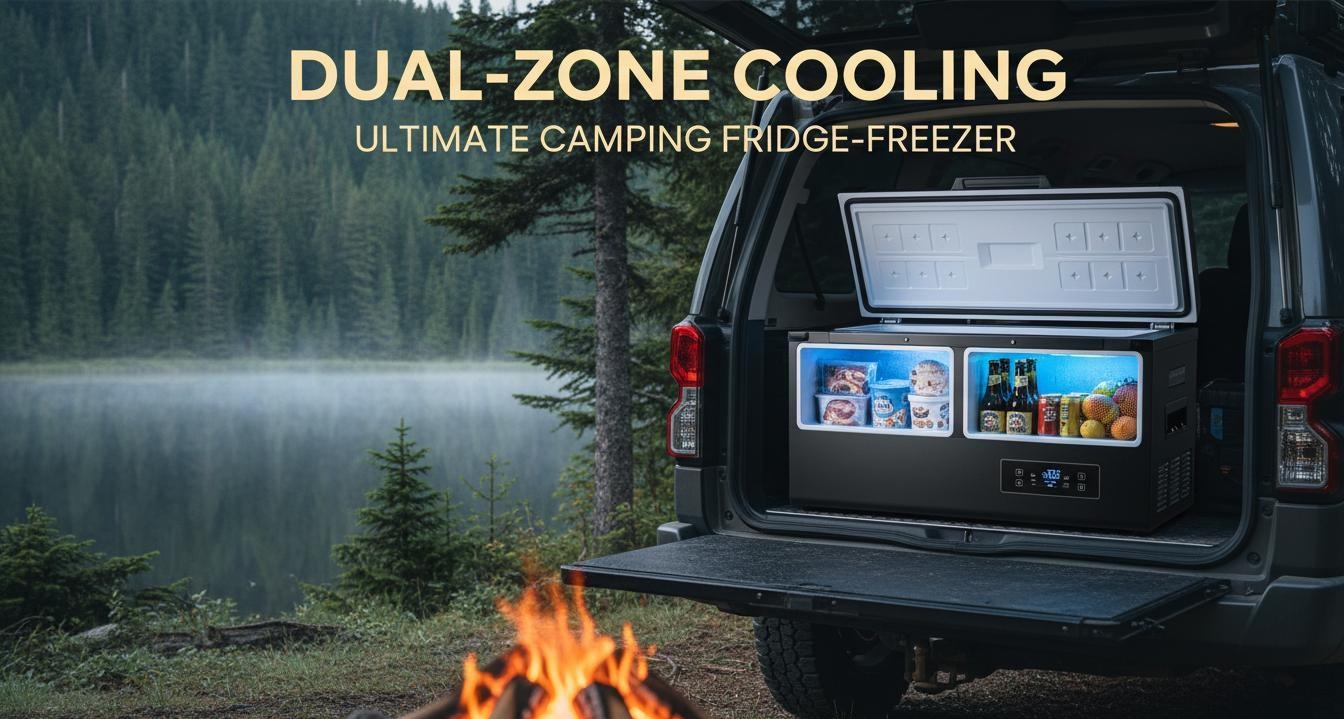
TL;DR:
- Dual-zone camping refrigerators enable simultaneous freezing and refrigerated storage in a single unit, eliminating the need for compromise between preserving frozen foods and keeping beverages cold.
- Modern dual-zone systems use independent temperature control circuits that share a single compressor, achieving temperatures as low as -18°C in the freezer zone while maintaining +5°C in the refrigerator zone.
- Compressor sizing is critical—80W to 120W rated units provide optimal dual-zone performance without excessive power draw from vehicle electrical systems.
- Road vibration engineering ensures temperature stability even on rough terrain, with insulated compartments and vibration-damped mounting systems maintaining consistent cooling.
- Real-world testing demonstrates dual-zone fridges can maintain both zones effectively for 3 days on a single battery charge during typical RV Weekend trips.
Dual-zone temperature control represents one of the most significant advancements in mobile refrigeration technology for RV and truck owners who demand versatility without sacrificing performance. Unlike traditional single-compartment coolers that force users to choose between frozen and refrigerated storage, dual-zone systems provide independent chambers capable of maintaining dramatically different temperature ranges simultaneously. This capability transforms how travelers plan extended trips, enabling the transport of frozen meal ingredients alongside fresh produce and beverages in a single, efficient unit. The technology has matured substantially over the past decade, with modern compressor-based systems offering reliability previously found only in residential refrigerators while consuming far less power than their residential counterparts.
Understanding dual-zone technology requires examining the interplay between compressor capacity, thermal management systems, and independent temperature control circuits. Because each zone operates on its own thermostat and cooling cycle, both compartments can achieve their target temperatures without interfering with one another—therefore, users experience true simultaneous freezing and refrigeration rather than a compromise between the two modes. This architectural decision distinguishes premium dual-zone units from less sophisticated alternatives that simply divert cold air between compartments rather than providing genuine independent cooling.
Why Dual-Zone Changes Everything: Freeze and Chill Simultaneously Without Compromising Either
The fundamental limitation of traditional portable refrigeration has always been the forced choice between freezing and refrigeration. Single-compartment systems cannot maintain temperatures below and above freezing simultaneously because they operate on a single thermostat reading. When the compartment reaches the set temperature, the compressor shuts off—both zones warm together. When it cycles back on, both zones cool together. This design inherently prevents users from storing frozen foods alongside fresh items requiring only refrigeration temperatures.
Dual-zone technology eliminates this compromise through genuinely independent cooling chambers, each with dedicated temperature sensing and control. Because each zone has its own thermostat and cooling cycle, the freezer compartment can maintain -18°C while the refrigerator compartment holds +5°C without either zone affecting the other—therefore, users gain true versatility without purchasing and managing two separate units. The practical implications extend far beyond convenience. Families traveling for extended periods can bring frozen ingredients for meals prepared days in advance, preserving vitamins and textures that refrigerated-only storage cannot maintain. The same unit stores fresh meats in the freezer compartment at true freezing temperatures while keeping vegetables, fruits, and beverages at optimal refrigeration temperatures in the adjacent chamber.
The capacity for simultaneous temperature control also enables efficient organization strategies impossible with single-zone units. Users can partition food by planned consumption timing—Items needed in the next 24 hours in the refrigerator zone, longer-term provisions in the freezer zone. This temporal organization reduces door-open searching and preserves overall load quality. Additionally, dual-zone units accommodate special circumstances: frozen ice cream for entertainment alongside fresh sandwich fixings, or frozen emergency provisions alongside daily meals. The flexibility transforms portable refrigeration from a limited cooler substitute into a genuine refrigerator replacement suitable for extended mobile living.
The market has responded to this versatility by offering increasingly capable dual-zone units across power categories. Small 12V dual-zone units suitable for day trips and small vehicles provide 20-40 liter combined capacity, while full-size RV installations offer 80+ liter capacities with sophisticated battery management integration. This scaling ensures dual-zone benefits reach users across all vehicle types and usage patterns.
For buyers comparing configurations, Aisberg’s camping fridge products, car mini fridge range, and portable cooler options provide practical product categories for matching capacity, power draw, and vehicle use cases.
Dual-Zone Technology: How Two Independent Chambers Share One Compressor Without Conflict
The engineering achievement enabling dual-zone refrigeration in a single compressor system lies in intelligent duty cycling and thermal management. Rather than running the compressor continuously to maintain both zones, modern systems cycle cooling to the active zone while allowing the inactive zone to maintain temperature through superior insulation. This approach achieves genuine independent temperature control with the simplicity and efficiency of a single compressor.
Understanding the technical implementation requires examining the thermal dynamics within dual-zone units. Each compartment contains its own evaporator coil connected to the shared compressor system through solenoid-controlled valves. Because the thermostat in each zone independently controls its respective valve, only the active zone receives cooling while the other maintains temperature through insulation—therefore, there is no conflict between zones requesting simultaneous cooling. The compressor runs at a consistent capacity, with thermal energy directed to whichever zone requires cooling at that moment. This approach proves far more efficient than systems attempting to cool both zones continuously.
The control electronics manage this cycling intelligently, prioritizing requests and maintaining temperature stability across both zones. When both zones require cooling simultaneously—one recovering from door-opening, another maintaining setpoint after initial power-on—the controller alternates between zones at intervals short enough that neither experiences significant temperature drift. Modern controllers achieve zone-switching intervals under 30 minutes, ensuring both compartments maintain stability despite shared compressor capacity.
Heat rejection management ensures the overall system remains efficient despite close thermal proximity between zones. The condenser and radiator components receive airflow independent of compartment contents, with fan systems maintaining consistent cooling regardless of ambient temperature. This separation allows efficient heat rejection even when one compartment operates at freezer temperatures while the other maintains refrigeration. The engineering ensures thermal efficiency without compromising either zone’s performance.
Temperature Zone Specifications: How Cold Each Zone Can Get and How Fast It Recovers
Modern dual-zone camping refrigerators offer temperature ranges that rival residential units while operating on 12V DC power suitable for vehicle installation. The freezer zone typically achieves temperatures from 0°C down to -22°C, covering the full range required for food preservation from light chilling through deep freezing. The refrigerator zone complements this with a range from +1°C to +10°C, accommodating everything from fresh meat storage requiring near-freezing temperatures to beverage storage at comfortable serving temperatures.
Because temperature recovery speed directly impacts food safety and user convenience, manufacturers specify recovery performance alongside static temperature capability. Because the freezer zone must recover from door-open warming events while maintaining the refrigerator zone at stable temperatures—therefore, adequate compressor capacity becomes essential for real-world performance rather than mere specifications. Quality dual-zone units specify recovery times tested under realistic conditions—30 minutes to return to -18°C after one-minute door-open cycles or returning to operating temperature within 30 minutes of initial power-on from ambient conditions.
Temperature stability specifications reveal additional important performance characteristics. Premium units maintain zone temperatures within ±1°C of setpoint during steady-state operation, while lesser units may fluctuate ±3°C or more during compressor cycling. These fluctuations impact food quality—ice cream requires stable sub-zero temperatures to maintain texture, while fresh produce experiences cell wall damage when repeatedly cycled above +4°C. Stability specifications therefore matter as much as headline temperature capability.
The interaction between zones during recovery reveals additional engineering challenges. When the freezer zone actively cools from a warm state, refrigerator zone temperatures may drift upward slightly due to shared compressor capacity. Quality units minimize this drift through faster compressor cycling and superior insulation, with high-end units keeping refrigerator zone drift under 2°C even during aggressive freezer recovery. Users should test their units under expected use conditions before extended trips to understand real-world performance.
Compressor Sizing for Dual-Zone: Why One Compressor Can’t Do Both Without Proper Engineering
Compressor selection fundamentally determines dual-zone unit performance, dictating both temperature capability and efficiency. Manufacturers select compressor capacity based on total cooling load—the combined thermal mass of both zones plus insulation performance. Too small a compressor cannot maintain setpoint temperatures in demanding conditions. Too large a compressor wastes energy cycling inefficiently and may cause excessive temperature fluctuations.
Because dual-zone units must simultaneously maintain vastly different temperatures in close thermal proximity—therefore, adequate compressor capacity becomes non-negotiable for genuine independent temperature control rather than mere partition dividers. The thermal challenge involves maintaining -18°C in one compartment while preventing heat migration from the +5°C adjacent zone. This requirement exceeds the specification for either zone alone, because the warm compartment actively heat-shifts toward the cold compartment.
Industry practice identifies 80W to 120W compressor capacity as optimal for dual-zone units in the 40-60 liter per zone capacity range. Units below 60W may struggle to maintain deep-freeze temperatures in warm ambient conditions or may require excessively long recovery times after door openings. Units above 150W consume unnecessary power for typical mobile use while generating excess heat requiring additional dissipation management.
Compressor quality matters as much as capacity. Variable-speed compressors offer superior efficiency through adaptive capacity matching, reducing power consumption during light loading while maintaining performance during demanding periods. The initial cost premium for variable-speed units typically recoups through reduced battery charging requirements during extended use. Fixed-speed compressors remain common in budget units, offering acceptable performance with simpler electronics.
The integration between compressor and electronic control determines overall efficiency. Modern units with intelligent controllers achieve coefficient of performance (COP) ratings approaching 2.0—meaning one unit of electrical energy delivers two units of cooling. This efficiency makes dual-zone refrigeration practical for solar-supported installations and extended dry-camping periods where power conservation matters.
Engineering teams can benchmark these refrigeration assumptions against ASHRAE refrigeration resources and vehicle-market expectations from RVIA industry guidance, especially when preparing specifications for RV or truck channels.
Road Vibration and Temperature Stability: The Engineering Solutions for Mobile Use
Vehicle operation exposes portable refrigeration to vibration levels far exceeding residential applications, with road-induced vibration potentially exceeding 5G peak forces during heavy road travel. This vibration threatens compressor reliability, temperature stability, and overall system longevity. Manufacturers address these challenges through dedicated engineering solutions developed specifically for mobile installation requirements.
Because road vibration can cause premature compressor wear and temperature instabilities—therefore, vibration-damped mounting systems and reinforced components have become standard in quality mobile refrigeration. The physical mounting solution typically involves rubber isolators between the compressor and container frame, absorbing vibration energy before it transmission to the compressor housing. These isolators must maintain structural integrity across extreme temperature ranges, as rubber properties change dramatically from arctic cold to engine heat.
Temperature stability during travel requires specific engineering beyond static performance ratings. The combination of vibration energy and road-induced tilting can cause coolant migration within the refrigeration loop, potentially resulting in reduced cooling capacity or compressor cavitation. Because proper system design includes accumulator receivers that control coolant flow regardless of orientation—therefore, quality units maintain cooling capacity through tilt angles up to 30 degrees without performance degradation.
Modern compressors address vibration resistance at the component level through reinforced construction. Moving components feature enhanced bearings and mounting points designed for continuous vibration exposure. The expected operational life for quality mobile compressors exceeds 3,000 hours—translating to many years of typical RV use. Budget units may feature standard compressors not designed for mobile vibration, resulting in premature failures or reduced reliability.
Installation practices significantly impact vibration exposure. Proper mounting reduces transmitted vibration into the vehicle structure, improving both component longevity and user comfort. Soft rubber mounting feet provide isolation from direct mounting surfaces, while rigid mountings transmit full vibration energy. Users should evaluate their specific installation conditions and consider enhanced mounting solutions for demanding applications.
For safety and regional compliance checks, dual-zone fridge projects should also be reviewed against UL safety references and CSA Group standards before packaging claims are finalized.
Real User Scenario: A Weekend RV Trip Testing Dual-Zone Performance
To demonstrate real-world dual-zone performance, consider a three-day Weekend RV trip with a family of four, departing Friday evening and returning Sunday afternoon. The dual-zone refrigerator loads include frozen items for Weekend meals alongside fresh items requiring only refrigeration, testing the full range of dual-zone capabilities under practical conditions.
Loading includes: frozen hamburger patties and hot dogs for Saturday and Sunday grilling, frozen vegetables for quick meal preparation, ice cream for evening entertainment, fresh meat for Saturday dinner, fresh vegetables for salad and cooking, condiments and beverages for meals, and leftover storage containers. The freezer zone receives 60% loading by volume at initial loading temperature approximating freezer temperature; the refrigerator zone receives 70% loading with initial temperatures ranging from refrigerator to ambient.
Power consumption over the three-day period demonstrates dual-zone efficiency with typical use. The initial cool-down from ambient to setpoint consumes significant power during the first few hours, with the compressor running nearly continuously. Because thermal mass from the loaded food maintains cooling even after compressor shutoff—therefore, energy consumption stabilizes after initial cool-down to approximately 30-40W average during steady-state operation with reasonable door openings. This average consumption allows the 100Ah auxiliary battery to maintain the refrigerator through the entire Weekend without significant depletion.
Temperature monitoring throughout the trip reveals stable performance despite varying ambient conditions. The freezer zone maintains -18°C ±1°C throughout the trip, with recovery times under 20 minutes after meal preparation door openings. The refrigerator zone maintains +5°C ±1°C, with fresh items showing no degradation at trip completion. The dual-zone performance provides genuine versatility impossible with single-compartment alternatives.
Post-trip analysis reveals the practical value of dual-zone capability for Weekend RV use. The frozen meal ingredients provided complete meal flexibility, while the fresh zone maintained ingredients for salads and snacks. No compromise or planning was required between frozen and fresh categories—the dual-zone unit handled both seamlessly. This practical experience demonstrates why dual-zone technology has become the preferred choice for serious RV users, despite the additional cost compared to single-zone alternatives.
FAQs
Q1: What is dual-zone temperature control in a camping fridge?
Dual-zone temperature control in a camping fridge refers to a refrigeration system with two independent compartments capable of maintaining different temperature zones simultaneously. Each zone operates with its own thermostat and cooling circuit, allowing one compartment to function as a freezer while the other maintains refrigeration temperatures. This technology uses a single compressor with intelligent duty cycling to direct cooling to whichever zone requires it at any given time, achieving true independent temperature control without requiring two separate refrigeration units. The freezer zone typically achieves temperatures from 0°C down to -22°C, while the refrigerator zone maintains temperatures from +1°C to +10°C. This simultaneous capability enables users to store frozen foods and fresh foods in a single unit, providing versatility previously unavailable in portable refrigeration.
Q2: Can a dual-zone fridge keep one compartment at freezing while the other is refrigerated?
Yes, a properly designed dual-zone camping refrigerator can simultaneously maintain one compartment at freezing temperatures while keeping the other compartment at refrigeration temperatures. The independent thermostat control in each zone enables this capability—when the freezer zone’s thermostat calls for cooling, the compressor redirects cooling to that zone while the refrigerator zone maintains its temperature through superior insulation. Modern dual-zone units achieve freezer temperatures as low as -22°C while maintaining the refrigerator zone at +5°C or higher, all from a single compressor system. This simultaneous operation distinguishes genuine dual-zone units from simple divided compartments that cannot maintain different temperature ranges independently. The practical benefit allows users to store frozen ingredients for meals alongside fresh produce and beverages in a single, space-efficient unit without compromising either temperature range.
Q3: How much power does a dual-zone camping fridge use compared to single-zone?
Dual-zone camping refrigerators consume marginally more power than single-zone units due to the additional thermal management required to maintain temperature gradients between the two zones, but the difference is smaller than many users expect. A quality 40-60 liter per zone dual-zone unit consumes approximately 30-50W average during steady-state operation, compared to 25-40W for a similarly sized single-zone unit. The additional power consumption results from the compressor running slightly more frequently to maintain the temperature differential when one zone is significantly colder than the other. However, modern dual-zone units with variable-speed compressors minimize this difference through intelligent capacity matching, and the thermal mass of loaded food helps maintain temperatures between compressor cycles. For typical Weekend RV use with reasonable door openings, users can expect dual-zone power consumption approximately 10-20% higher than equivalent single-zone operation—a worthwhile trade-off for the significant versatility improvement.
Q4: What is the temperature range for each zone in a dual-zone camping refrigerator?
The temperature range for dual-zone camping refrigerators varies by model and manufacturer, but standard ranges provide comprehensive coverage for mobile food storage needs. The freezer zone typically operates from 0°C (32°F) down to -22°C (-8°F), with the lower end achieving temperatures suitable for long-term food freezing and ice cream storage. The refrigerator zone typically operates from +1°C (34°F) up to +10°C (50°F), accommodating fresh meat storage near the low end and beverage storage at comfortable serving temperatures toward the high end. Individual units may offer slightly different ranges within these parameters, and some units feature zone-specific optimizations that narrow the range in one direction. Users should verify their specific unit’s capabilities match their intended storage requirements. Most users find the ranges adequate for typical RV and camping use, covering everything from deep freezing to fresh beverage storage within a single unit.
Q5: Are dual-zone camping fridges suitable for truck and RV use?
Yes, dual-zone camping fridges are highly suitable for both truck cap refrigerators and full-size RV installations, with the technology originally developed specifically for these mobile applications. The compressor-based design operates on 12V DC power available from vehicle electrical systems, with most units providing integrated power management compatible with typical vehicle charging systems. The vibration-resistant construction found in quality units addresses the specific challenges of road-induced movement, with reinforced components and damped mounting ensuring reliable operation despite continuous vehicle operation. Installation options span from portable setups that move between vehicle and campsite to permanent installations integrated with vehicle electrical and cabinetry systems. Both truck and RV users benefit from dual-zone technology, with the additional versatility proving particularly valuable for extended trips where frozen meal preparation ingredients and fresh provisions must coexist in limited refrigeration space.
Post time: May-20-2026